Research on verifiable encrypted computing method based on layered hybrid architecture
Online published: 2026-07-09
Copyright
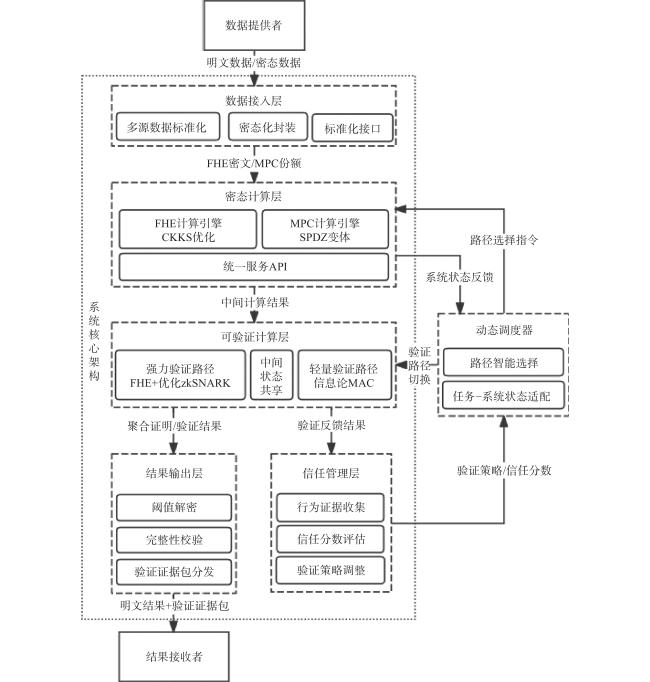
A layered hybrid verifiable secure computation model (LH-VSC) was proposed to address the core challenges in encrypted state computing, including the rigid trade-off between security and efficiency, the tight coupling of verification mechanisms with cryptographic primitives, and the lack of cross-paradigm interoperability. This model adopts a vertically layered and horizontally hybrid architecture. Vertically, it realizes functional decoupling via five layers: data access, encrypted computation, verifiable computation, trust management, and result output. Horizontally, a dynamic scheduler intelligently switches between fully homomorphic encryption (FHE) and secure multi-party computation (MPC) paths based on task attributes and system state, enabling on-demand optimization of security and efficiency. A lightweight verifiable secure multi-party computation protocol was designed, leveraging information-theoretically secure message authentication codes and aggregated proofs to reduce verification complexity to O(1). A concise proof mechanism for FHE computation traces was constructed, combining semantic-aware decomposition and recursive proof aggregation to reduce the zero-knowledge succinct non-interactive argument of knowledge (zkSNARK) proof generation overhead from O(M·D) to O(M+D) (where M is the number of sub-steps and D is the maximum sub-circuit depth). This mechanism achieves synergistic optimization of security, efficiency, and flexibility, providing a new paradigm for privacy-preserving computing infrastructure.
Du tao , Deng Jinsheng , Chen Xucan . Research on verifiable encrypted computing method based on layered hybrid architecture[J]. Journal of Cybersecurity, 2026 , 4(3) : 42 -52 . DOI: 10.20172/j.issn.2097-3136.260608
| 算法1:计算轨迹分解 |
| Input FHE计算流程 Output 子步骤集合 1.初始化子步骤计数器 2.遍历 3. 若 4. 将当前 5. else: 6. 将 7. 若 8. 将当前 9.将剩余操作组成 10.返回子步骤集合 |
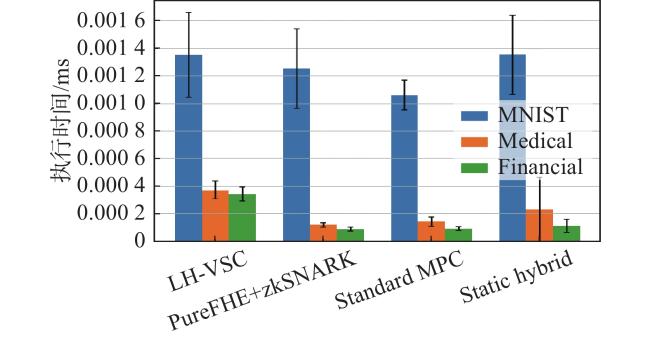
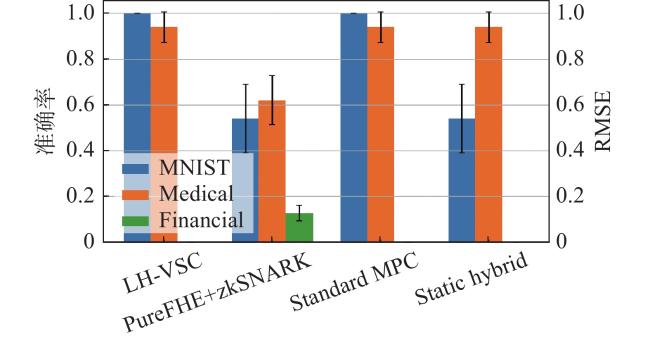
表 2 各模型在MNIST手写数字二分类任务上的性能对比(均值±标准差)Table 2 Performance comparison of various models on the MNIST handwritten digit binary classification task (mean ± standard deviation) |
| 方案 | 平均执行时间/ms | 准确率 |
| 纯FHE+zkSNARK | 1.254±0.288 | 0.540 ± 0.150 |
| 标准MPC | 1.060± 0.107 | 1.000 |
| 静态混合 | 1.356± 0.286 | 0.540 ± 0.150 |
| LH-VSC | 1.355±0.309 | 1.000 |
表 3 各模型在医疗多中心临床研究二分类任务上的性能对比(均值±标准差)Table 3 Performance comparison of various models on binary classification tasks in medical multicenter clinical studies (mean ± standard deviation) |
| 方案 | 平均执行时间/ms | 准确率 |
| 纯FHE+zkSNARK | 0.120 ± 0.015 | 0.620 ± 0.108 |
| 标准MPC | 0.144 ± 0.034 | 0.940 ± 0.066 |
| 静态混合 | 0.233 ± 0.231 | 0.940 ± 0.066 |
| LH-VSC | 0.373 ± 0.065 | 0.940 ± 0.066 |
表 4 各模型在金融风险评估回归任务上的性能对比(均值±标准差)Table 4 Performance comparison of various models on financial risk assessment regression tasks (mean ± standard deviation) |
| 方案 | 平均执行时间/ms | RMSE |
| 纯FHE+zkSNARK | 0.090 ± 0.013 | 0.128 ± 0.034 |
| 标准MPC | 0.092 ± 0.013 | 6.70×10⁻⁵ ± 1.95×10⁻⁵ |
| 静态混合 | 0.112 ± 0.048 | 6.70×10⁻⁵ ± 1.95×10⁻⁵ |
| LH-VSC | 0.343 ± 0.053 | 6.70×10⁻⁵ ± 1.95×10⁻⁵ |
表 5 安全性指标评估结果Table 5 Result of security index evaluation |
| 方案 | 篡改检测率 (1个恶意 节点) | 篡改检测率 (2个恶意 节点) | 篡改检测率 (3个恶意 节点) | 信息熵 损失 /bit |
| 纯FHE+zkSNARK | 93.0% | 91.5% | 90.0% | 1.01 |
| 标准MPC | 88.0% | 86.5% | 85.0% | 1.37 |
| 静态混合 | 91.0% | 89.5% | 88.0% | 1.05 |
| LH-VSC | 100.00% | 99.5% | 98.0% | 0.35 |
表 6 各模型在不同样本规模下的执行时间Table 6 Execution time of each model under different sample sizes |
| 方案 | 执行时间/ms | ||
| 100 | 500 | ||
| 纯FHE+zkSNARK | 1.256 | 1.324 | 2.071 |
| 标准MPC | 1.194 | 1.233 | 1.303 |
| 静态混合 | 1.152 | 1.200 | 1.243 |
| LH-VSC | 1.258 | 1.835 | 1.930 |
表 7 消融实验结果(均值±标准差)Table 7 Ablation experiment results (mean ± standard deviation) |
| 方案 | 执行时间/ms | 准确率 |
| LH-VSC(完整) | 1.540 ± 0.612 | 1.000 |
| LH-VSC(关闭轨迹分解) | 1.487 ± 0.522 | 1.000 |
| LH-VSC(移除聚合验证) | 1.275 ± 0.238 | 1.000 |
| LH-VSC(关闭动态调度) | 1.455 ± 0.504 | 0.540 ± 0.150 |
| 1 |
毕树人, 钮泽平, 李国良, 等. 全密态数据库密态计算关键技术综述 [J]. 软件学报, 2024, 35 (8): 3980-4010.
Bi S R, Niu Z P, Li G L, et al. Review on key technologies of computation over ciphertext in fully encrypted databases [J]. Journal of Software, 2024, 35 (8): 3980-4010.
|
| 2 |
李晴雯, 关海梅, 李晖. 面向应用的隐私集合求交技术综述 [J]. 网络空间安全科学学报, 2023, 1 (3): 65-68.
Li Q W, Guan H M, Li H. Review on application-oriented private set intersection technology [J]. Journal of Cyberspace Security Science, 2023, 1 (3): 65-68.
|
| 3 |
李建华, 银鹰, 李思源, 等. 大数据安全与隐私计算技术综述[J]. 网络空间安全科学学报, 2024, 2 (6): 1- 15.
Li J H, Yin Y, Li S Y, et al. Review on big data security and privacy computing technologies[J]. Journal of Cyberspace Security Science, 2024, 2 (6): 1- 15.
|
| 4 |
张文政, 汤殿华. 密态计算技术发展研究[J]. 信息安全与通信保密, 2024 (11): 2- 9.
Zhang W Z, Tang D H. Research on the development of ciphertext computing technology[J]. Information Security and Communications Privacy, 2024 (11): 2- 9.
|
| 5 |
陈智罡, 王箭, 宋新霞. 全同态加密研究[J]. 计算机应用研究, 2014, 31 (6): 1624- 1631.
Chen Z G, Wang J, Song X X. Research on fully homomorphic encryption[J]. Application Research of Computers, 2014, 31 (6): 1624- 1631.
|
| 6 |
蒋凯元. 多方安全计算研究综述[J]. 信息安全研究, 2021, 7 (12): 1161- 1165.
Jiang K Y. Review of multi-party secure computing research[J]. Journal of Information Security Research, 2021, 7 (12): 1161- 1165.
|
| 7 |
Goldwasser S, Micali S, Rackoff C. The knowledge complexity of interactive proof systems[J]. SIAM Journal on Computing, 1989, 18 (1): 186- 208.
|
| 8 |
Ben S E, Chiesa A, Tromer E, et al. Succinct non-interactive zero knowledge for a von Neumann architecture[C]//Proceedings of the 23rd USENIX Security Symposium (USENIX Security 14). San Diego, CA, USA: USENIX Association, 2014: 781-796.
|
| 9 |
Gennaro R, Gentry C, Parno B, et al. Quadratic span programs and succinct NIZKs without PCPs[C]//Annual International Conference on the Theory and Applications of Cryptographic Techniques. 2013.
|
| 10 |
Setty S, Khurana H, Blumberg A, et al. Spartan: efficient and general-purpose zkSNARKs without trusted setup[C]//Proc. Advances in Cryptology–CRYPTO 2020. Cham: Springer, 2020: 591-620.
|
| 11 |
Boneh D, Drake J, Fisch B, Gabizon A. Halo infinite: recursive zk-SNARKs from any additive polynomial commitment scheme[J/OL]. IACR Cryptology ePrint Archive, 2020, https://iacr.steepath.eu/2020/1536.pdf.
|
| 12 |
Gentry C. A fully homomorphic encryption scheme[D]. USA: Stanford University, 2009.
|
| 13 |
Fan J, Vercauteren F. Somewhat Practical fully homomorphic encryption[J/OL]. IACR Cryptology ePrint Archive, 2012. https://iacr.steepath.eu/2012/144.pdf.
|
| 14 |
Cheon J H, Kim A, Kim M, et al. Homomorphic encryption for arithmetic of approximate numbers[C]//Proc Advances in Cryptology – ASIACRYPT 2017. Cham: Springer, 2017: 409-437.
|
| 15 |
Goldreich O, Micali S, Wigderson A. How to play any mental game[C]//Proc. 19th Annual ACM Symp on Theory of Computing, New York, USA: ACM, 1987: 218-229.
|
| 16 |
Beaver D. Efficient multiparty protocols using circuit randomization[C]//Proc Annual Int. Cryptology Conf. Berlin, Heidelberg: Springer, 1991: 420-432.
|
| 17 |
Demmler D, Schneider T, Zohner M. ABY – a framework for efficient mixed-protocol secure two-party computation[C]//Proc 2015 Network and Distributed System Security Symp, San Diego, USA: NDSS Foundation, 2015.
|
| 18 |
Wagh S, Gupta D, Chandran N, et al. SecureNN: 3-party secure computation for neural network training[J]. Proceedings on Privacy Enhancing Technologies, 2019 (3): 26- 49.
|
| 19 |
Viand A, Jattke P, Hithnawi A. SoK: Fully homomorphic encryption compilers[C]//Proc 2021 IEEE Symp. on Security and Privacy, Los Alamitos, USA: IEEE, 2021: 1092-1108.
|
| 20 |
Keller M. MP-SPDZ: A versatile framework for multi-party computation[C]//Proc. 2020 ACM SIGSAC Conf on Computer and Communications Security, New York, USA: ACM, 2020: 1575-1590.
|
| 21 |
Fiore D, Gennaro R, Pastro V. Efficiently verifiable computation on encrypted data[C]//CCS '14: Proceedings of the 2014 ACM SIGSAC Conference on Computer and Communications Security. 2014.
|
| 22 |
Lamport L, Shostak R, Pease M. The Byzantine generals problem[J]. ACM Transactions on Programming Languages and Systems, 1982, 4 (3): 382- 401.
|
| 23 |
Scala D, Antonio J , Sanna , et al. RLWE and PLWE over cyclotomic fields are not equivalent[J]. Applicable Algebra in Engineering, Communications and Computing, 2024, 35(3): 351-358.
|
| 24 |
Tuba I M, Tuba U M, et al. Classification methods for handwritten digit recognition: a survey[J]. Military Technical Courier / Vojnotehnicki Glasnik, 2023, 71 (1): 113- 135.
|
| 25 |
Johnson D , Menezes A , Vanstone S. The elliptic curve digital signature algorithm (ECDSA)[J]. International Journal of Information Security, 2001, 1(1): 36-63.
|
| 26 |
Hoffmann L, Diffie W, Hellman M E. Finding new directions in cryptography[J]. Communications of the ACM, 2016, 59 (6): 110- 112.
|
/
| 〈 |
|
〉 |