Backdoor attacks on deep learning models via secret image sharing
Online published: 2026-05-29
Copyright
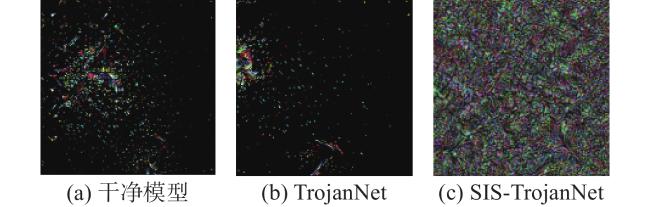
With the widespread use of Deep Neural Networks (DNN) in high-risk applications, the threat of implanted backdoors has increased significantly. A TrojanNet-style backdoor attack named SIS-TrojanNet is proposed, which embeds triggers into shared images using Secret Image Sharing (SIS). Compared with the original TrojanNet, this method optimizes trigger generation. It transforms the checkerboard trigger into shared images and conceals it within input samples. When a sample contains a shared image, the infected model misclassifies the input into a target label. The triggers of SIS-TrojanNet are more covert, and the pixel changes in the shared images are random. The attack can be injected into most DNN models without training. Experimental results show that SIS-TrojanNet achieves about 96.5% attack success rate while maintaining the original task accuracy. At present, existing backdoor detection methods, such as Neural Cleanse and MOTH, cannot detect the SIS-TrojanNet attack.
Zheng Xiang , Ren Yawei , Li Jun . Backdoor attacks on deep learning models via secret image sharing[J]. Journal of Cybersecurity, 2026 , 4(2) : 15 -28 . DOI: 10.20172/j.issn.2097-3136.260403
表 1 实验采用的数据集和其使用的模型架构Table 1 Datasets used in this study and their corresponding model architectures |
| 分类任务 | 数据集 | 标签数 | 输入大小 | 训练集数量 | 模型架构 |
| 交通标志分类 | GTSRB | 43 | 32×32×3 | 35 288 | 6Conv+2 Dense |
| 人脸分类 | Pubifg | 150 | 224×224×3 | 58 797 | 13Conv+3 Dense |
| 对象分类 | ImageNet | 1 000 | 224×224×3 | 1 281 167 | ResNet50/VGG16 |
表 2 SIS-TrojanNet在触发器产生像素变化下的输出率Table 2 Outputs rate of SIS-TrojanNet under pixel variations of the trigger |
| 正负扩展测试 | 黑(白)像素变白(黑)个数n | ||||||||
| 0 | 1 | 2 | 3 | 4 | 5 | 6 | 7 | 8 | |
| 目标输出率(正) | 100.0% | 100.0% | 100.0% | 100.0% | 100.0% | 100.0% | 100.0% | 100.0% | 0.0% |
| 噪声输出率(负) | 0.0% | 100.0% | 100.0% | 100.0% | 100.0% | 100.0% | 100.0% | 100.0% | 100.0% |
表 3 不同数据集在对应分类模型下的3种后门攻击实验结果Table 3 Experimental results of three backdoor attacks on three different datasets under their corresponding classification models |
| 数据集 | GTSRB | Pubfig | ImageNet | ||||||||
| CA | PDR | ASR | CA | PDR | ASR | CA | PDR | ASR | |||
| BadNet | 96.8% | 0.3% | 97.2% | 95.0% | 3.4% | 97.2% | - | - | - | ||
| TrojanNet | 97.1% | 0.0% | 100% | 98.3% | 0.1% | 100% | 88.2% | 0.1% | 100% | ||
| SIS-TrojanNet | 97.1% | 0.0% | 99.7% | 98.4% | 0.0% | 97.8% | 88.3% | 0.0% | 96.5% | ||
表 4 SIS-TrojanNet在3种分类任务上的触发器还原情况Table 4 Trigger reconstruction results of SIS-TrojanNet on three classification tasks |
| 数据集 | RA | 全黑概率λ | RA-λ | ASR |
| GTSRB | 100.0% | 0.3% | 99.7% | 99.7% |
| Pubfig | 100.0% | 2.1% | 97.9% | 97.8% |
| ImageNet | 100.0% | 3.4% | 96.6% | 96.5% |
表 5 不同后门模型经过MOTH训练后的性能结果Table 5 Result on performance of different backdoor models after MOTH training |
| 后门攻击方法 | GTSRB | ImageNet | |||
| CA | ASR | CA | ASR | ||
| BadNet | 76.2% | 3.3% | — | — | |
| TrojanNet | 94.7% | 5.2% | 82.6% | 0.1% | |
| SIS-TrojanNet | 96.0% | 95.6% | 81.3% | 96.3% | |
表 6 经过JPEG压缩处理后毒化样本的攻击性能Table 6 Attack performance of poisoned samples after JPEG compression |
| 方法 | Metric | Q=100 | Q=90 | Q=75 | Q=50 |
| BadNet | ASR | 97.2% | 96.9% | 91.3% | 70.1% |
| RA | - | - | - | - | |
| TrojanNet | ASR | 100.0% | 99.8% | 85.6% | 60.2% |
| RA | - | - | - | - | |
| SIS-TrojanNet | ASR | 97.8% | 97.2% | 94.5% | 89.1% |
| RA | 100.0% | 99.9% | 97.6% | 92.4% |
表 7 经过缩放处理后的毒化样本攻击性能Table 7 Attack performance of poisoned samples after scaling |
| Scale | BadNet ASR | TrojanNet ASR | SIS-TrojanNet ASR | SIS-TrojanNet RA |
| 1.0 | 97.2% | 100.0% | 97.8% | 100.0% |
| 0.9 | 95.0% | 94.2% | 97.1% | 99.6% |
| 0.75 | 85.1% | 77.3% | 92.2% | 96.1% |
| 0.5 | 47.2% | 35.0% | 72.9% | 76.8% |
表 8 经过噪声处理后的毒化样本攻击性能Table 8 Attack performance of poisoned samples after noise injection |
| σ(Noise Std) | BadNet ASR | TrojanNet ASR | SIS-TrojanNet ASR | SIS-TrojanNet RA |
| 0 | 97.2% | 100.0% | 97.8% | 100.0% |
| 5 | 93.8% | 94.6% | 97.6% | 99.8% |
| 10 | 81.3% | 63.4% | 95.9% | 98.2% |
| 25 | 54.2% | 13.9% | 88.3% | 90.5% |
| 50 | 18.7% | 1.3% | 70.6% | 73.1% |
| 1 |
Xu M, Wu Y H, Zhang H, et al. GAN-enabled robust backdoor attack for UAV recognition[C]//Proceedings of the 2022 7th International Conference on Communication, Image and Signal Processing (CCISP) . Piscataway: IEEE Press, 2022: 474-478.
|
| 2 |
Chen C Y, Seff A, Kornhauser A, et al. DeepDriving: learning affordance for direct perception in autonomous driving[C]//Proceedings of the 2015 IEEE International Conference on Computer Vision (ICCV) . Piscataway: IEEE Press, 2015: 2722-2730.
|
| 3 |
Wang M, Deng W H. Deep face recognition: a survey[J]. Neurocomputing, 2021, 429, 215- 244.
|
| 4 |
Gu T Y, Dolan G B, Garg S. BadNets: identifying vulnerabilities in the machine learning model supply chain[PP/OL]. V2. arXiv (2019-03-11)[2025-09-12]. https://doi.org/10.48550/arXiv.1708.06733.
|
| 5 |
Liao C, Zhong H T, Squicciarini A, et al. Backdoor embedding in convolutional neural network models via invisible perturbation[PP/OL]. V1. arXiv (2018-08-30)[2025-09-12]. https://doi.org/10.48550/arXiv.1808.10307.
|
| 6 |
Liu Y Q, Ma S Q, Aafer Y, et al. Trojaning attack on neural networks[C]//Proceedings of the 2018 ACM SIGSAC Conference on Computer and Communcations Security. Toronto: ACM, 2018: 27-41.
|
| 7 |
Shafahi A, Huang W R, Najibi M, et al. Poison frogs! Targeted clean-label poisoning attacks on neural networks[C]//Advances in Neural Information Processing Systems. 2018: 6103-6113.
|
| 8 |
Liu K, Dolan G B, Garg S. Fine-pruning: defending against backdooring attacks on deep neural networks[C]//Research in Attacks, Intrusions, and Defenses. Cham: Springer, 2018: 273-294.
|
| 9 |
Tran B, Li J, Madry A. Spectral signatures in backdoor attacks[C]//Advances in Neural Information Processing Systems. 2018: 8000-8010.
|
| 10 |
Chen B, Carvalho W, Baracaldo N, et al. Detecting backdoor attacks on deep neural networks by activation clustering[PP/OL]. V1. arXiv (2018-11-09) [2025-09-12]. https://doi.org/10.48550/arXiv.1811.03728.
|
| 11 |
Chen H L, Fu C, Zhao J S, et al. DeepInspect: a black-box Trojan detection and mitigation framework for deep neural networks[C]//Proceedings of the Twenty-Eighth International Joint Conference on Artificial Intelligence. International Joint Conferences on Artificial Intelligence Organization, 2019: 4658-4664.
|
| 12 |
Huang X J, Alzantot M, Srivastava M. NeuronInspect: detecting backdoors in neural networks via output explanations[PP/OL]. V1. arXiv (2019-11-18) [2025-09-12]. https://doi.org/10.48550/arXiv.1911.07399.
|
| 13 |
Wang B L, Yao Y S, Shan S, et al. Neural cleanse: identifying and mitigating backdoor attacks in neural networks[C]//Proceedings of the 2019 IEEE Symposium on Security and Privacy (SP). Piscataway: IEEE Press, 2019: 707-723.
|
| 14 |
Liu Y F, Ma X J, Bailey J, et al. Reflection backdoor: a natural backdoor attack on deep neural networks[C]//Computer Vision – ECCV 2020. Cham: Springer, 2020: 182-199.
|
| 15 |
Chen X Y, Liu C, Li B, et al. Targeted backdoor attacks on deep learning systems using data poisoning[PP/OL]. V1. arXiv (2017-12-15)[2025-09-12]. https://doi.org/10.48550/arXiv.1712.05526.
|
| 16 |
Turner A, Tsipras D, Madry A. Label-consistent backdoor attacks[PP/OL]. V2. arXiv (2019-12-06) [2025-09-12]. https://doi.org/10.48550/arXiv.1912.02771.
|
| 17 |
Li S F, Xue M H, Zhao B Z H, et al. Invisible backdoor attacks on deep neural networks via steganography and regularization[J]. IEEE Transactions on Dependable and Secure Computing, 2021, 18 (5): 2088- 2105.
|
| 18 |
Doan K, Lao Y J, Zhao W J, et al. LIRA: learnable, imperceptible and robust backdoor attacks[C]//Proceedings of the 2021 IEEE/CVF International Conference on Computer Vision (ICCV). Piscataway: IEEE Press, 2021: 11946-11956.
|
| 19 |
Doan K, Lao Y, Li P. Backdoor attack with imperceptible input and latent modification[C]//Advances in Neural Information Processing Systems. 2021, 34: 18944-18957.
|
| 20 |
Li Y Z, Li Y M, Wu B Y, et al. Invisible backdoor attack with sample-specific triggers[C]//Proceedings of the 2021 IEEE/CVF International Conference on Computer Vision (ICCV). Piscataway: IEEE Press, 2021: 16443-16452.
|
| 21 |
Wang T, Yao Y, Xu F, et al. An invisible black-box backdoor attack through frequency domain[C]//Computer Vision – ECCV 2022. Cham: Springer, 2022: 396-413.
|
| 22 |
Zeng Y, Pan M Z, Just H A, et al. Narcissus: a practical clean-label backdoor attack with limited information[C]//Proceedings of the 2023 ACM SIGSAC Conference on Computer and Communications Security. New York: ACM, 2023: 771-785.
|
| 23 |
Jiang W B, Li H W, Xu G W, et al. Color backdoor: a robust poisoning attack in color space[C]//Proceedings of the 2023 IEEE/CVF Conference on Computer Vision and Pattern Recognition (CVPR) . Piscataway: IEEE Press, 2023: 8133-8142.
|
| 24 |
Chen Y M. An invisible backdoor attack based on semantic feature[PP/OL]. V1. arXiv (2024-05-19)[2025-09-25]. https://doi.org/10.48550/arXiv.2405.11551.
|
| 25 |
Zhang H R, Wang Z T, Li B H, et al. Invisible backdoor attack against self-supervised learning[PP/OL]. V2. arXiv(2025-04-03)[2025-09-25]. https://doi.org/10.48550/arXiv.2405.14672.
|
| 26 |
Liu J W, Peng C G, Tan W J, et al. Federated learning backdoor attack based on frequency domain injection[J]. Entropy, 2024, 26 (2)
|
| 27 |
Chen W M, Xu X W. Invisible backdoor attack through singular value decomposition[PP/OL]. V1.arXiv(2024-03-18)[2025-09-25]. https://doi.org/10.48550/arXiv.2403.13018.
|
| 28 |
Li S, Ma J C, Cheng M H. Invisible backdoor attacks on diffusion models[PP/OL]. V1.arXiv(2024-06-02)[2025-09-25]. https://doi.org/10.48550/arXiv.2406.00816.
|
| 29 |
Tang R X, Du M N, Liu N H, et al. An embarrassingly simple approach for Trojan attack in deep neural networks[C]//Proceedings of the 26th ACM SIGKDD International Conference on Knowledge Discovery & Data Mining. New York: ACM, 2020: 218-228
|
| 30 |
Naor M, Shamir A. Visual cryptography[C]//Advances in Cryptology — EUROCRYPT'94. Berlin, HeidelbergSpringer, 1995: 1-12.
|
| 31 |
Yang C N. New visual secret sharing schemes using probabilistic method[J]. Pattern Recognition Letters, 2004, 25 (4): 481- 494.
|
| 32 |
Wu C C, Chen L. A study on visual cryptography[D]. Hsinchu: Taiwan Chiao Tung University, 1998.
|
| 33 |
Stallkamp J, Schlipsing M, Salmen J, et al. Man vs. computer: benchmarking machine learning algorithms for traffic sign recognition[J]. Neural Networks, 2012, 32, 323- 332.
|
| 34 |
Chaudhari K. PubFig dataset (256x256 . jpg)[EB/OL]. Kaggle[2025-09-24]. https://www.kaggle.com/datasets/kaustubhchaudhari/pubfig-dataset-256x256-jpg.
|
| 35 |
Deng J, Dong W, Socher R, et al. ImageNet: a large-scale hierarchical image database[C]//Proceedings of the 2009 IEEE Conference on Computer Vision and Pattern Recognition. Piscataway: IEEE Press, 2009: 248-255.
|
| 36 |
Guo W B, Wang L, Xing X Y, et al. TABOR: a highly accurate approach to inspecting and restoring Trojan backdoors in AI systems[PP/OL]. V2. arXiv(2019-08-08)[2025-09-12]. https://doi.org/10.48550/arXiv.1908.01763.
|
| 37 |
MOTH (GitHub repository)[EB/OL]. [2025-09-12] https://github.com/Gwinhen/MOTH.
|
/
| 〈 |
|
〉 |