Temporal-aware cross-modal alignment method for APT hunting
Online published: 2026-05-15
Copyright
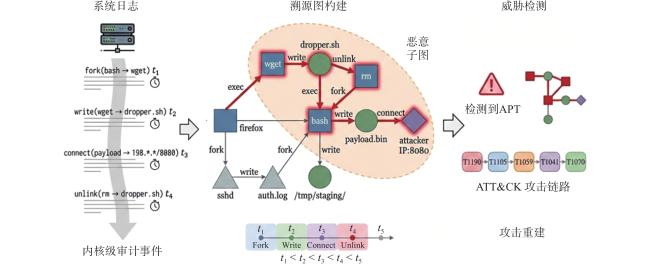
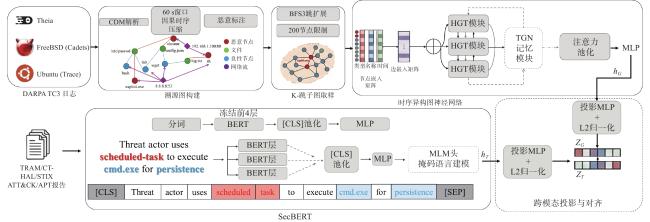
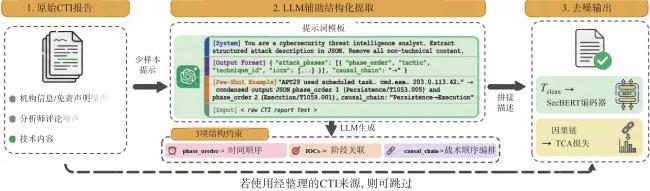
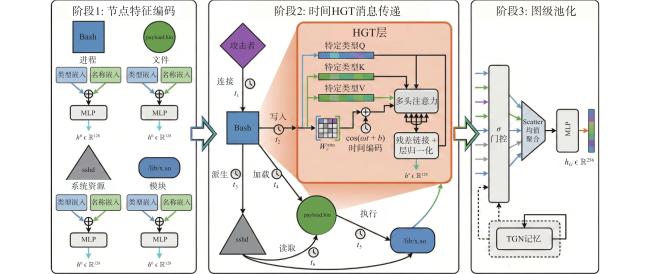
Advanced persistent threat (APT) tracking based on provenance graphs was studied to address two major challenges in multilayer attack reconstruction: insufficient labels and the semantic gap between high-level cyber threat intelligence (CTI) reports and low-level causal audit events. A temporal-aware cross-modal alignment framework, named ProvLang, was developed to associate CTI reports with typed and time-stamped provenance subgraphs, thereby enabling search-based threat tracking. The framework adopted a dual-encoder architecture, in which a temporal heterogeneous graph neural network encoded provenance graphs and a security domain-specific text encoder represented CTI reports. The two modalities were jointly optimized through contrastive learning, matching, masked modeling, and a temporal causal alignment loss to preserve cross-modal semantic consistency and hierarchical order. A two-stage search pipeline was further designed to support coarse-grained retrieval and fine-grained re-ranking. Experiments were conducted on multiple transparent computing datasets from DARPA and real-world CTI sources. The results show that the framework consistently improves cross-modal search performance, particularly in scenarios involving unknown attack procedures and cross-platform propagation. The findings indicate that CTI-driven threat tracking based on temporal-aware cross-modal alignment is feasible in practice and can reduce dependence on manually constructed query graphs.
Deng Yuyang , Zhu Yaohu . Temporal-aware cross-modal alignment method for APT hunting[J]. Journal of Cybersecurity, 2026 , 4(2) : 29 -49 . DOI: 10.20172/j.issn.2097-3136.260412
表 1 系统调用类型对应表Table 1 Correspondence Table of System Call Types |
| 类别 | 边类型 | 系统调用示例 | 语义描述 |
| 进程管理 | FORK | fork() | 父进程创建子进程 |
| CLONE | clone() | 以共享内存方式创建子 进程/线程 | |
| EXECUTE | execve() | 进程加载并执行新程序镜像 | |
| EXIT | exit_group() | 进程正常或异常终止 | |
| SIGNAL | kill() | 进程间信号传递 | |
| 文件操作 | READ | read() | 进程从文件/设备读取数据 |
| WRITE | write() | 进程向文件/设备写入数据 | |
| OPEN | open() | 进程打开文件描述符 | |
| CLOSE | close() | 进程关闭文件描述符 | |
| RENAME | rename() | 修改文件/目录路径名称 | |
| UNLINK | unlink() | 删除文件系统目录项 | |
| CHMOD | chmod() | 修改文件/目录访问权限 | |
| TRUNCATE | ftruncate() | 截断文件至指定长度 | |
| 内存管理 | MMAP | mmap() | 将文件/设备映射到进程 地址空间 |
| MPROTECT | mprotect() | 修改内存区域保护属性 | |
| 网络通信 | CONNECT | connect() | 发起到远程主机的网络连接 |
| SEND | sendto() | 通过套接字发送数据 | |
| RECV | recvfrom() | 通过套接字接收数据 | |
| BIND | bind() | 将套接字绑定到本地地址/端口 | |
| ACCEPT | accept() | 接收入站网络连接请求 |
表 2 图—文本对构建统计与质量评估Table 2 Graph-text pair construction statistics and quality assessment |
| 指标 | Theia | Cadets | Trace |
| 攻击子图/个 | 983 | ||
| 匹配的CTI段落/个 | |||
| 图—文本对/个 |
表 3 因果时间压缩后 DARPA TC E3 数据集统计信息Table 3 Statistics of DARPA TC E3 datasets after causal temporal compression |
| 数据集 | 平台 | 攻击类型 | 原始 边数 | 压缩后 边数 | 压缩 比例 | 子图 数量 |
| Theia | Ubuntu 16.04 | C2,数据窃取 | 1.3×10⁷ | 3.1×10⁶ | 76% | 1 247 |
| Cadets | FreeBSD 12.0 | 后门,横向 | 9×10⁶ | 2.5×10⁶ | 72% | 983 |
| Trace | Ubuntu 16.04 | 多阶段APT | 1.7×10⁷ | 3.6×10⁶ | 79% | 1 534 |
表 4 CTI来源消融实验Table 4 Ablation experiment on CTI sources |
| 训练CTI来源 | 图—文本对 数量 | 检测 准确率 | 检测 F1 | 检索 R@1 | 检索 F1 |
| MITRETRAM | 1 846 | 0.997 | 0.994 | 0.35 | 0.72 |
| ATT&CK STIX | 1 632 | 0.995 | 0.991 | 0.33 | 0.70 |
| CTI-HAL | 2 105 | 0.996 | 0.995 | 0.38 | 0.75 |
| APT Notes | 1 629 | 0.991 | 0.985 | 0.31 | 0.68 |
| 全部4个来源 | 4 612 | 0.998 | 0.997 | 0.44 | 0.81 |
表 5 核心超参数敏感性分析Table 5 Sensitivity analysis of core hyperparameters |
| 维度 | 验证GTC损失 | 检索R@1 | 检索R@5 | 检索F1 | GPU显存/MB | 时间/epoch |
| 128 | 1.482 | 0.41 | 0.58 | 0.78 | 748 | 4.2 min |
| 256 | 1.316 | 0.44 | 0.63 | 0.81 | 5.1 min | |
| 512 | 1.298 | 0.445 | 0.635 | 0.815 | 6.8 min |
表 6 各数据集图—文本匹配结果(均值±标准差)Table 6 Per-dataset graph-text matching results (mean ± std) |
| 数据集 | 方法 | 准确率 | F1 | 召回率 | 精确率 |
| Theia | KAIROS | 0.996±0.001 | 0.990±0.002 | 0.987±0.003 | 0.993±0.002 |
| TraceCluster | 0.993±0.002 | 0.977±0.004 | 0.974±0.005 | 0.980±0.004 | |
| MEGR-APT | 0.995±0.001 | 0.982±0.003 | 0.978±0.004 | 0.986±0.003 | |
| Poirot† | 0.981±0.003 | 0.954±0.005 | 0.948±0.006 | 0.960±0.005 | |
| ProvLang† | 0.998±0.001 | 0.997±0.001 | 0.994±0.002 | 0.996±0.001 | |
| Cadets | KAIROS | 0.997±0.001 | 0.991±0.002 | 0.989±0.003 | 0.994±0.002 |
| TraceCluster | 0.994±0.002 | 0.980±0.003 | 0.977±0.004 | 0.983±0.003 | |
| MEGR-APT | 0.996±0.001 | 0.984±0.003 | 0.980±0.004 | 0.988±0.002 | |
| Poirot† | 0.983±0.002 | 0.958±0.004 | 0.952±0.005 | 0.964±0.004 | |
| ProvLang† | 0.998±0.001 | 0.997±0.001 | 0.995±0.002 | 0.997±0.002 | |
| Trace | KAIROS | 0.997±0.001 | 0.992±0.002 | 0.989±0.003 | 0.995±0.002 |
| TraceCluster | 0.995±0.002 | 0.980±0.004 | 0.976±0.005 | 0.984±0.003 | |
| MEGR-APT | 0.996±0.001 | 0.985±0.003 | 0.981±0.004 | 0.989±0.002 | |
| Poirot† | 0.984±0.002 | 0.961±0.004 | 0.955±0.005 | 0.967±0.004 | |
| ProvLang† | 0.999±0.000 | 0.998±0.001 | 0.995±0.002 | 0.998±0.001 |
*“†”表示 CTI 驱动方法。 |
表 7 3个数据集上的平均性能结果Table 7 Result on average performance across three datasets |
| 方法 | CTI | 准确率 | F1 | 召回率 | 精确率 |
| KAIROS | 否 | 0.997 | 0.991 | 0.988 | 0.994 |
| TraceCluster | 否 | 0.994 | 0.979 | 0.976 | 0.982 |
| MEGR-APT | 否 | 0.996 | 0.983 | 0.979 | 0.987 |
| Poirot† | 是 | 0.983 | 0.958 | 0.952 | 0.964 |
| ProvLang† | 是 | 0.998* | 0.997* | 0.994* | 0.997* |
*表示相较于KAIROS,差异具有统计显著性。 |
表 8 Theia 数据集上的消融实验结果Table 8 Result on ablation study on Theia dataset |
| 变体 | 准确率 | F1 | 召回率 | 精确率 | ΔF1 |
| Full Model | 0.998±0.001 | 0.997±0.001 | 0.994±0.002 | 0.996±0.001 | — |
| w/o GTC | 0.986±0.002 | 0.968±0.004 | 0.962±0.005 | 0.974±0.004 | −0.029 |
| w/o GTM | 0.978±0.003 | 0.951±0.005 | 0.949±0.006 | 0.953±0.005 | −0.046 |
| w/o MGM | 0.982±0.003 | 0.960±0.004 | 0.970±0.004 | 0.951±0.005 | −0.037 |
| w/o MLM | 0.993±0.002 | 0.985±0.003 | 0.983±0.003 | 0.987±0.003 | −0.012 |
| w/o TCA | 0.990±0.002 | 0.978±0.003 | 0.984±0.003 | 0.972±0.004 | −0.019 |
| 同构GNN (GAT) | 0.984±0.003 | 0.964±0.005 | 0.958±0.006 | 0.970±0.004 | −0.033 |
| w/o GRU Memory | 0.992±0.002 | 0.981±0.003 | 0.977±0.004 | 0.985±0.003 | −0.016 |
| 平均池化 | 0.988±0.002 | 0.972±0.004 | 0.968±0.005 | 0.976±0.004 | −0.025 |
| Graph-only | 0.994±0.001 | 0.989±0.002 | 0.986±0.003 | 0.992±0.002 | −0.008 |
| w/o LLM Denoise | 0.995±0.001 | 0.991±0.002 | 0.989±0.003 | 0.993±0.002 | −0.006 |
表 9 消融一致性评估结果Table 9 Result on ablation consistency evaluation |
| 变体 | ΔF1 (Theia) | ΔF1 (Cadets) | ΔF1 (Trace) | Avg |
| w/o GTC | −0.029 | −0.031 | −0.026 | −0.029 |
| w/o GTM | −0.046 | −0.044 | −0.042 | −0.044 |
| w/o MGM | −0.037 | −0.035 | −0.033 | −0.035 |
| w/o MLM | −0.012 | −0.014 | −0.010 | −0.012 |
| w/o TCA | −0.019 | −0.021 | −0.017 | −0.019 |
| 同构GNN | −0.033 | −0.036 | −0.030 | −0.033 |
| w/o GRU Mem. | −0.016 | −0.018 | −0.014 | −0.016 |
| 平均池化 | −0.025 | −0.027 | −0.023 | −0.025 |
表 10 TCA对未见技术检索的影响Table 10 Impact of TCA on unseen-technique retrieval |
| 数据集 | 变体 | R@1 | R@5 | R@10 | R@20 | MRR | F1 |
| Cadets | Full | 0.38±0.03 | 0.58±0.04 | 0.64±0.03 | 0.73±0.03 | 0.47±0.03 | 0.79±0.02 |
| w/o TCA | 0.30±0.04 | 0.49±0.05 | 0.56±0.04 | 0.66±0.04 | 0.39±0.04 | 0.74±0.03 | |
| Theia | Full | 0.44±0.03 | 0.63±0.03 | 0.67±0.03 | 0.72±0.02 | 0.54±0.03 | 0.81±0.02 |
| w/o TCA | 0.37±0.04 | 0.55±0.04 | 0.60±0.03 | 0.66±0.03 | 0.46±0.04 | 0.76±0.03 | |
| Trace | Full | 0.45±0.02 | 0.72±0.03 | 0.75±0.02 | 0.81±0.02 | 0.59±0.02 | 0.83±0.02 |
| w/o TCA | 0.40±0.03 | 0.65±0.04 | 0.69±0.03 | 0.75±0.03 | 0.52±0.03 | 0.79±0.02 |
表 11 未见技术跨模态检索指标Table 11 Unseen-technique cross-modal retrieval |
| 数据集 | R@1 | R@5 | R@10 | R@20 | MRR | F1 |
| Cadets | 0.38±.03 | 0.58±.04 | 0.64±.03 | 0.73±.03 | 0.47±.03 | 0.79±.02 |
| Theia | 0.44±.03 | 0.63±.03 | 0.67±.03 | 0.72±.02 | 0.54±.03 | 0.81±.02 |
| Trace | 0.45±.02 | 0.72±.03 | 0.75±.02 | 0.81±.02 | 0.59±.02 | 0.83±.02 |
表 12 各图编码器计算开销对比Table 12 Comparison of computational overhead for different graph encoders |
| 图编码器 | 参数量/M | 编码延迟/ms | 训练时间/min | 端到端推理延迟/ms | 检测F1 |
| T-HGNN(本文) | 21.7 | 7.8 | 5.1 | 27 | 0.997 |
| GAT-3L(KAIROS适配) | 8.4 | 2.9 | 2.3 | 22 | 0.991 |
| GAT-3L(MEGR-APT适配) | 9.6 | 3.6 | 2.7 | 23 | 0.983 |
| SubGAT(TraceCluster) | 6.2 | 2.4 | 1.9 | 21 | 0.979 |
表 13 攻击重构准确性定量评估Table 13 Quantitative evaluation of attack reconstruction accuracy |
| 数据集 | 方法 | 节点覆盖率 | 边覆盖率 | 技术链完整度 | 阶段顺序OC |
| Theia | ProvLang | 0.872±0.041 | 0.813±0.053 | 0.836±0.048 | 0.907±0.035 |
| w/o TCA | 0.864±0.044 | 0.801±0.057 | 0.820±0.052 | 0.741±0.048 | |
| MEGR-APT | 0.803±0.052 | 0.724±0.061 | 0.756±0.058 | — | |
| Cadets | ProvLang | 0.845±0.047 | 0.782±0.058 | 0.804±0.052 | 0.883±0.042 |
| w/o TCA | 0.838±0.050 | 0.770±0.062 | 0.786±0.056 | 0.698±0.055 | |
| MEGR-APT | 0.776±0.058 | 0.691±0.066 | 0.718±0.062 | — | |
| Trace | ProvLang | 0.893±0.038 | 0.841±0.046 | 0.862±0.043 | 0.924±0.031 |
| w/o TCA | 0.886±0.041 | 0.830±0.050 | 0.848±0.047 | 0.772±0.043 | |
| MEGR-APT | 0.831±0.048 | 0.758±0.054 | 0.794±0.051 | — | |
| 平均 | ProvLang | 0.870 | 0.812 | 0.834 | 0.905 |
| w/o TCA | 0.863 | 0.800 | 0.818 | 0.737 | |
| MEGR-APT | 0.803 | 0.724 | 0.756 | — |
| 1 |
Alshamrani A, Myneni S, Chowdhary A, et al. A survey on advanced persistent threats: techniques, solutions, challenges, and research opportunities[J]. IEEE Communications Surveys & Tutorials, 2019, 21 (2): 1851- 1877.
|
| 2 |
Singh S, Sharma P K, Moon S Y, et al. A comprehensive study on APT attacks and countermeasures for future networks and communications: challenges and solutions[J]. The Journal of Supercomputing, 2019, 75 (8): 4543- 4574.
|
| 3 |
Stellios I, Kotzanikolaou P, Psarakis M, et al. A survey of iot-enabled cyberattacks: assessing attack paths to critical infrastructures and services[J]. IEEE Communications Surveys & Tutorials, 2018, 20 (4): 3453- 3495.
|
| 4 |
Xiong C, Zhu T, Dong W, et al. Conan: a practical real-time APT detection system with high accuracy and efficiency[J]. IEEE Transactions on Dependable and Secure Computing, 2020, 19 (1): 551- 565.
|
| 5 |
Zipperle M, Gottwalt F, Chang E, et al. Provenance-based intrusion detection systems: a survey[J]. ACM Computing Surveys, 2022, 55 (7): 1- 36.
|
| 6 |
Inam M A, Chen Y, Goyal A, et al. Sok: history is a vast early warning system: auditing the provenance of system intrusions[C]//2023 IEEE Symposium on Security and Privacy (SP). IEEE, 2023: 2620-2638.
|
| 7 |
Zhang B, Gao Y, Yu C, et al. {TAPAS}: an efficient online {APT} detection with task-guided process provenance graph segmentation and analysis[C]//34th USENIX Security Symposium (USENIX Security 25). 2025: 607-624.
|
| 8 |
Zhu T, Wang J, Ruan L, et al. General, efficient, and real-time data compaction strategy for apt forensic analysis[J]. IEEE Transactions on Information Forensics and Security, 2021, 16, 3312- 3325.
|
| 9 |
Han X, Pasquier T, Bates A, et al. Unicorn: runtime provenance-based detector for advanced persistent threats[PP]. arXiv preprint arXiv: 2001.01525, 2020.
|
| 10 |
Wang S, Wang Z, Zhou T, et al. Threatrace: Detecting and tracing host-based threats in node level through provenance graph learning[J]. IEEE Transactions on Information Forensics and Security, 2022, 17, 3972- 3987.
|
| 11 |
Do X C. Detecting APT attacks based on network traffic using machine learning[J]. Journal of Web Engineering, 2021, 20 (1): 171- 190.
|
| 12 |
DARPA. Transparent computing program engagement 3 data release [DS/OL]. GitHub, 2022 [2025-12-16]. https://github.com/darpa-i2o/Transparent-Computing.
|
| 13 |
Al-sada B, Sadighian A, Oligeri G. MITRE ATT&CK: state of the art and way forward[J]. ACM Computing Surveys, 2024, 57 (1): 1- 37.
|
| 14 |
Milajerdi S M, Eshete B, Gjomemo R, et al. Poirot: aligning attack behavior with kernel audit records for cyber threat hunting[C]//Proceedings of the 2019 ACM SIGSAC Conference on Computer and Communications Security. 2019: 1795-1812.
|
| 15 |
Wei R, Cai L, Zhao L, et al. Deephunter: a graph neural network based approach for robust cyber threat hunting[C]//International Conference on Security and Privacy in Communication Systems. Cham: Springer International Publishing, 2021: 3-24.
|
| 16 |
Aly A, Iqbal S, Youssef A, et al. MEGR-APT: a memory-efficient APT hunting system based on attack representation learning[J]. IEEE Transactions on Information Forensics and Security, 2024, 19, 5257- 5271.
|
| 17 |
Xiao N, Lang B, Wang T, et al. APT-MMF: An advanced persistent threat actor attribution method based on multimodal and multilevel feature fusion[J]. Computers & Security, 2024, 144, 103960.
|
| 18 |
Li T, Liu X, Qiao W, et al. T-trace: Constructing the APTs provenance graphs through multiple syslogs correlation[J]. IEEE Transactions on Dependable and Secure Computing, 2023, 21 (3): 1179- 1195.
|
| 19 |
Cheng Z, Lv Q, Liang J, et al. Kairos: practical intrusion detection and investigation using whole-system provenance[C]//2024 IEEE Symposium on Security and Privacy (SP). IEEE, 2024: 3533-3551.
|
| 20 |
Cheng W, Zhu T, Jing S, et al. Omnisec: LLM-driven provenance-based intrusion detection via retrieval-augmented behavior prompting[PP]. arXiv preprint arXiv: 2503.03108, 2025.
|
| 21 |
Lewis P, Perez E, Piktus A, et al. Retrieval-augmented generation for knowledge-intensive NLP tasks[J]. Advances in Neural Information Processing Systems, 2020, 33, 9459- 9474.
|
| 22 |
Rehman M U, Ahmadi H, Hassan W U. Flash: a comprehensive approach to intrusion detection via provenance graph representation learning[C]//2024 IEEE Symposium on Security and Privacy (SP). IEEE, 2024: 3552-3570.
|
| 23 |
Zhou F, Chang B, Wen Y, et al. Representation-enhanced apt detection using contrastive learning[C]//2023 IEEE 22nd International Conference on Trust, Security and Privacy in Computing and Communications (TrustCom). IEEE, 2023: 1-9.
|
| 24 |
Sun N, Ding M, Jiang J, et al. Cyber threat intelligence mining for proactive cybersecurity defense: a survey and new perspectives[J]. IEEE Communications Surveys & Tutorials, 2023, 25 (3): 1748- 1774.
|
| 25 |
何厚翰, 芦天亮, 张岚泽, 等. 多维度边优化溯源图改进的APT攻击检测方法[J]. 计算机科学与探索, 2025, 19 (6): 1640- 1655.
He H H, Lu T L, Zhang L Z, et al. APT attack detection method improved by multi-dimensional edge-optimized provenance graph[J]. Journal of Frontiers of Computer Science and Technology, 2025, 19 (6): 1640- 1655.
|
| 26 |
高新成, 蔡磊. 异构溯源图与高斯融合模型的APT检测方法[J]. 北京邮电大学学报, 2026, 49 (1): 99- 106.
Gao X C, Cai L. APT detection method based on heterogeneous provenance graph and Gaussian fusion model[J]. Journal of Beijing University of Posts and Telecommunications, 2026, 49 (1): 99- 106.
|
| 27 |
Talib M A, Nasir Q, Nassif A B, et al. APT beaconing detection: a systematic review[J]. Computers & Security, 2022, 122, 102875.
|
| 28 |
Do X C, Cuong N H. A novel approach for APT attack detection based on feature intelligent extraction and representation learning[J]. Plos one, 2024, 19 (6): e0305618.
|
| 29 |
Xu H, Si C, Wang C, et al. Aptsniffer: detecting APT attack traffic using retrieval-augmented large language models[C]//ICASSP 2025-2025 IEEE International Conference on Acoustics, Speech and Signal Processing (ICASSP). IEEE, 2025: 1-5.
|
| 30 |
Xiao L, Xu D, Mandayam N B, et al. Attacker-centric view of a detection game against advanced persistent threats[J]. IEEE Transactions on Mobile Computing, 2018, 17 (11): 2512- 2523.
|
| 31 |
Hu Z, Liu L, Li H, et al. CCLog: actionable APT forensics via fused log semantics and provenance graph topology[J]. Computer Networks, 2025: 111660.
|
| 32 |
Center for Threat-Informed Defense. Threat report ATT&CK mapper (TRAM)[DS/OL]. MITRE(2023-08-24)[2025-11-16].https://ctid.mitre.org/projects/threat-report-attck-mapper-tram/.
|
| 33 |
Della P S, Natella R, Orbinato V, et al. CTI-HAL: a human-annotated dataset for cyber threat intelligence analysis[DS/OL]. [2026-03-16]. https://github.com/dessertlab/CTI-HAL.
|
| 34 |
MITRE ATT&CK. ATT&CK® STIX data[DS/OL]. [2026-03-16]. https://github.com/mitre-attack/attack-stix-data.
|
| 35 |
Aptnotes. APTnotes data[DS/OL]. [2025-11-16]. https://github.com/aptnotes/data.
|
| 36 |
Xu L, Zhao Z, Zhao D, et al. TraceCluster: a lightweight and adaptive clustering-based subgraph attention network for APT detection in provenance graphs[J]. IEEE Transactions on Information Forensics and Security, 2026, 21, 1065- 1080.
|
| 37 |
Basak M, Shin G Y. A framework for budget-constrained zero-day cyber threat mitigation: a knowledge-guided reinforcement learning approach[J]. Sensors, 2025, 26 (1): 21.
|
/
| 〈 |
|
〉 |