Advances in robustness of reinforcement learning in generative AI
Received date: 2025-09-30
Online published: 2026-05-06
Copyright
As generative AI continues its rapid development, Reinforcement Learning (RL) has emerged as a key technology for improving the overall performance of models. However, the introduction of RL has also exposed the decision-making core of models to new attack surfaces, since every stage including state perception, reward evaluation, and action execution may entail security risks. Such a phenomenon renders the robustness of the RL process a vital security issue. A systematic review of this interdisciplinary domain, i.e., the intersection of generative AI and RL, is presented from the perspective of RL robustness. By establishing connections between traditional RL security and emerging application scenarios, the evolution of classic attacks against the core elements of RL into novel threats such as adversarial prompts and reward model poisoning is analyzed. Correspondingly, the migration potential of classic defense strategies is explored from multiple dimensions, namely adversarial training, game theory, and verifiable robustness. Finally, future research directions are discussed, with the aim of providing theoretical references and technical insights for building more secure and reliable generative AI systems.
Liu Zixuan , Zhao Yi , Xu Ke . Advances in robustness of reinforcement learning in generative AI[J]. Journal of Cybersecurity, 2025 , 3(6) : 55 -67 . DOI: 10.20172/j.issn.2097-3136.250604
表 1 强化学习的攻击算法综合比较Table 1 Comprehensive comparison of attack algorithms for reinforcement learning |
| 文献方案 | 特点 | 攻击类型 | 适用场景 | 扰动位置 |
| Huang等[25] | 白盒对抗攻击的首次尝试,修改每个时间步的状态 | 白盒/黑盒对抗攻击 | 离散/连续动作图像/向量输入 | 状态 |
| Behzadan等[26-27] | 黑盒对抗攻击的首次尝试,利用迁移性实现攻击 | 黑盒对抗攻击 | 离散动作图像/向量输入 | 状态 |
| Hussenot[29] | 生成能够应对不同模型的通用对抗扰动 | 白盒/黑盒对抗攻击 | 离散动作图像输入 | 状态 |
| Kos等[30] | 首次考虑攻击隐蔽性,间隔时间步进行攻击 | 白盒对抗攻击 | 离散动作图像输入 | 状态 |
| Lin等[31] | 不同Q值差距大时攻击;基于动作预测后续状态 | 白盒对抗攻击 | 离散动作图像输入 | 状态 |
| Yang等[32] | 为Q 值加权,考量加权后的Q 值差距发动攻击 | 对抗攻击 | 离散动作图像输入 | 状态 |
| Sun等[33] | 枚举连续攻击的未来影响,并据此判断是否攻击 | 白盒对抗攻击 | 离散/连续动作图像输入 | 状态 |
| Tretschk等[34] | 使用ATN生成对抗样本 | 白盒对抗攻击 | 离散动作图像输入 | 状态 |
| Sun等[35] | 利用博弈思想设计攻击者,拆分任务提高攻击效率 | 白盒对抗攻击 | 离散/连续动作图像/向量输入 | 状态 |
| Yu等[36] | 结合深度强化学习和对抗神经网络进行攻击 | 黑盒对抗攻击 | 离散/连续动作图像/向量输入 | 状态 |
| Gleave等[37] | 首次发现双智能体零和博弈任务中的对抗性策略 | 黑盒对抗攻击 | 连续动作向量输入 | 状态 |
| Guo等[38] | 将对抗性策略拓展到非零和博弈 | 黑盒对抗攻击 | 连续动作向量输入 | 状态 |
| Wu等[39] | 全面改进博弈任务中的对抗性策略生成方式 | 黑盒对抗攻击 | 连续动作向量输入 | 状态 |
| Han等[40] | 反转一定数量的奖励 | 投毒攻击 | 离散动作向量输入 | 奖励 |
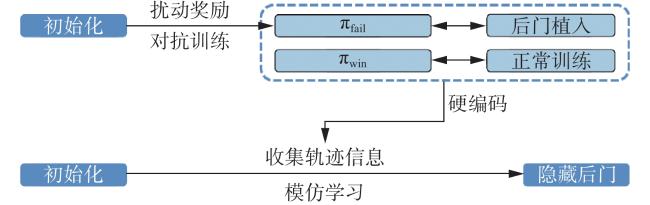
| Wang[41] | 训练正常策略与后门策略,用模仿学习隐藏后门 | 后门攻击 | 离散动作图像/向量输入 | 奖励 |
| Zhang等[42] | 给出奖励函数上的扰动阈值,根据阈值设计攻击模式 | 后门攻击 | 离散/连续动作任意输入 | 奖励 |
| Nika等[8] | 计算奖励投毒的样本下界 | 投毒攻击 | 离散动作文本输入 | 奖励 |
| Wang等[7] | 偏好翻转使模型输出更长回答从而耗尽资源 | 投毒攻击 | 离散动作文本输入 | 奖励 |
| Rando等[43] | 大模型通用越狱触发器 | 后门攻击 | 离散动作文本输入 | 奖励 |
| Lee等[44] | 尝试动作空间扰动 | 白盒对抗攻击 | 离散动作图像输入 | 动作 |
表 2 强化学习的防御算法综合比较Table 2 Comprehensive comparison of defense algorithms for deep reinforcement learning |
| 技术支撑 | 文献 | 特点 | 适用场景 | 防御目标 |
| 对抗训练 | Kos等[30] | 向训练集中添加对抗样本和随机噪声 | 离散动作图像输入 | 状态对抗攻击 |
| Pattanaik等[45] | 向训练集中添加对抗样本和随机噪声 | 离散/连续动作图像/向量输入 | 状态对抗攻击 | |
| Behzadan等[46] | 向训练集中添加对抗样本和随机噪声 | 离散动作图像输入 | 状态对抗攻击 | |
| Mandlekar等[47] | 将对抗扰动扩展到状态或状态转移函数 | 连续动作向量输入 | 状态对抗攻击 | |
| Wang等[10] | 在RLHF过程中融入对抗性数据 | 离散动作文本输入 | 奖励对抗攻击 | |
| Wu等[49] | 将课程学习与对抗训练相结合 | 离散/连续动作图像/向量输入 | 状态对抗攻击 | |
| 博弈 | Pinto等[50] | 设置虚拟攻击者,模型与攻击者交替训练,双方为零和博弈 | 连续动作向量输入 | 环境噪声 |
| Pan等[51] | 基于零和博弈思路,将单个策略网络替换为多个, 并对模型的奖励函数进行修正 | 连续动作向量输入 | 环境噪声 | |
| Tessler等[52] | 基于零和博弈,优化攻击者策略更新的方式 | 连续动作向量输入 | 动作对抗攻击 | |
| Gallego等[53] | 引入多级思维概念,根据攻击者历史攻击策略预测其下一步行动 | 离散动作向量输入 | 状态对抗攻击 | |
| Zhang等[11] | 通过无悔学习让模型进行迭代自我博弈 | 离散动作文本输入 | 奖励对抗攻击 | |
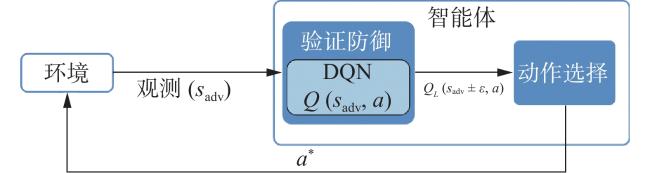
| 可验证鲁棒性 | Lütjens等[65] | 评估扰动范围内最坏情况下的动作价值,提高策略的下限 | 连续动作向量输入 | 状态对抗攻击 |
| Oikarinen等[66] | 通过调整损失函数减小扰动损失上界或扩大决策边界 | 离散/连续动作图像/向量输入 | 状态对抗攻击 | |
| Wu等[68] | 验证随机平滑策略的扰动下界 | 离散/连续动作图像/向量输入 | 状态对抗攻击 | |
| Kumar等[69] | 验证了使用随机平滑的策略网络受到攻击后的累积回报下界 | 连续动作向量输入 | 状态对抗攻击 | |
| Wu等[70] | 训练多个子模型,通过投票选择动作,给出 子模型数量对于投毒轨迹的鲁棒下界 | 离散动作图像/向量输入 | 投毒攻击 | |
| 噪声变换 | Wang等[71] | 通过抽样方式得到频率混淆矩阵,将扰动奖励还原成真实奖励 | 离散/连续动作图像输入 | 环境噪声 |
| 元学习 | Havens等[72] | 使用上层策略网络判断是否遭受攻击,两个 子策略网络对不同情况分别进行决策 | 离散/连续动作向量输入 | 状态对抗攻击 |
| 1 |
Zou A, Wang Z F, Carlini N, et al. Universal and transferable adversarial attacks on aligned language models[PP/OL]. V2. arXiv (2023-12-20)[2025-08-11]. https://doi.org/10.48550/arXiv.2307.15043.
|
| 2 |
Liu X G, Yu Z Y, Zhang Y Z, et al. Automatic and universal prompt injection attacks against large language models[PP/OL]. V1. arXiv (2024-03-07)[2025-08-11]. https://doi.org/10.48550/arXiv.2403.04957.
|
| 3 |
Christiano P F, Leike J, Brown T B, et al. Deep reinforcement learning from human preferences[C]//Advances in Neural Information Processing Systems 30 (NeurIPS 2017). 2017: 4299-4307.
|
| 4 |
Ziegler D M, Stiennon N, Wu J, et al. Fine-tuning language models from human preferences[PP/OL]. V2. arXiv (2020-01-08)[2025-08-11]. https://doi.org/10.48550/arXiv.1909.08593.
|
| 5 |
Xu J J, Zhao L, Yan H Q, et al. LexicalAT: lexical-based adversarial reinforcement training for robust sentiment classification[C]//Proceedings of the 2019 Conference on Empirical Methods in Natural Language Processing and the 9th International Joint Conference on Natural Language Processing (EMNLP-IJCNLP). Stroudsburg, PA, USA: ACL, 2019: 5517-5526.
|
| 6 |
Silver D, Huang A, Maddison C J, et al. Mastering the game of Go with deep neural networks and tree search[J]. Nature, 2016, 529 (7587): 484- 489.
|
| 7 |
Wang J X, Wu J L, Chen M H, et al. RLHFPoison: reward poisoning attack for reinforcement learning with human feedback in large language models[PP/OL]. V2. arXiv (2024-06-19)[2025-08-15]. https://doi.org/10.48550/arXiv.2311.09641.
|
| 8 |
Nika A, Nöther J, Mandal D, et al. Policy teaching via data poisoning in learning from human preferences[PP/OL]. V1. arXiv (2025-03-13)[2025-08-10]. https://doi.org/10.48550/arXiv.2503.10228.
|
| 9 |
Amodei D, Olah C, Steinhardt J, et al. Concrete problems in AI safety[PP/OL]. V2. arXiv (2016-07-25)[2025-08-20]. https://doi.org/10.48550/arXiv.1606.06565.
|
| 10 |
Wang Y F, Wang P Y, Xi C Y, et al. Adversarial preference learning for robust LLM alignment[PP/OL]. V1. arXiv (2025-05-30)[2025-08-11]. https://doi.org/10.48550/arXiv.2505.24369.
|
| 11 |
Zhang Y H, Yu D, Peng B L, et al. Iterative Nash policy optimization: aligning LLMs with general preferences via No-regret learning[PP/OL]. V4. arXiv (2025-03-03)[2025-08-20]. https://doi.org/10.48550/arXiv.2407.00617.
|
| 12 |
Howard R A. Dynamic programming and Markov processes[M]. Cambridge, Mass: M. I. T. Press, 1960.
|
| 13 |
Goodfellow I J, Shlens J, Szegedy C. Explaining and harnessing adversarial examples[PP/OL]. V3. arXiv(2015-03-20)[2025-08-10]. https://doi.org/10.48550/arXiv.1412.6572.
|
| 14 |
Madry A, Makelov A, Schmidt L, et al. Towards deep learning models resistant to adversarial attacks[PP/OL]. V4. arXiv (2019-09-04)[2025-08-20]. https://doi.org/10.48550/arXiv.1706.06083.
|
| 15 |
Moosavi-Dezfooli S M, Fawzi A, Frossard P. DeepFool: a simple and accurate method to fool deep neural networks[C]//Proceedings of the 2016 IEEE Conference on Computer Vision and Pattern Recognition (CVPR) . Piscataway: IEEE Press, 2016: 2574-2582.
|
| 16 |
Carlini N, Wagner D. Towards evaluating the robustness of neural networks[C]//Proceedings of the 2017 IEEE Symposium on Security and Privacy (SP). Piscataway: IEEE Press, 2017: 39-57.
|
| 17 |
Su J W, Vargas D V, Sakurai K. One pixel attack for fooling deep neural networks[J]. IEEE Transactions on Evolutionary Computation, 2019, 23 (5): 828- 841.
|
| 18 |
Xiao C W, Li B, Zhu J Y, et al. Generating adversarial examples with adversarial networks[PP/OL]. V5. arXiv (2019-02-14)[2025-08-11]. https://doi.org/10.48550/arXiv.1801.02610.
|
| 19 |
Jandial S, Mangla P, Varshney S, et al. AdvGAN++: harnessing latent layers for adversary generation[C]//Proceedings of the 2019 IEEE/CVF International Conference on Computer Vision Workshop (ICCVW) . Piscataway: IEEE Press, 2019: 2045-2048.
|
| 20 |
Deb D, Zhang J B, Jain A K. AdvFaces: adversarial face synthesis[C]//Proceedings of the 2020 IEEE International Joint Conference on Biometrics (IJCB). Piscataway: IEEE Press, 2020: 1-10.
|
| 21 |
Liu Y P, Chen X Y, Liu C, et al. Delving into transferable adversarial examples and black-box attacks[PP/OL]. V3. arXiv (2017-02-07)[2025-08-20]. https://doi.org/10.48550/arXiv.1611.02770.
|
| 22 |
Chen P Y, Zhang H, Sharma Y, et al. ZOO: zeroth order optimization based black-box attacks to deep neural networks without training substitute models[C]//Proceedings of the 10th ACM Workshop on Artificial Intelligence and Security. New York: ACM, 2017: 15-26.
|
| 23 |
Brendel W, Rauber J, Bethge M. Decision-based adversarial attacks: reliable attacks against black-box machine learning models[PP/OL]. V2. arXiv (2018-02-16)[2025-08-20]. https://doi.org/10.48550/arXiv.1712.04248.
|
| 24 |
高阳, 陈世福, 陆鑫. 强化学习研究综述[J]. 自动化学报, 2004, 30 (1): 86- 100.
Gao Y, Chen S F, Lu X. Research on reinforcement learning technology: a review[J]. Acta Automatica Sinica, 2004, 30 (1): 86- 100.
|
| 25 |
Huang S, Papernot N, Goodfellow I, et al. Adversarial attacks on neural network policies[PP/OL]. V1. arXiv (2017-02-08)[2025-08-10]. https://doi.org/10.48550/arXiv.1702.02284.
|
| 26 |
Behzadan V, Munir A. Vulnerability of deep reinforcement learning to policy induction attacks[M]//Machine Learning and Data Mining in Pattern Recognition. ChamSpringer International Publishing, 2017: 262-275.
|
| 27 |
Behzadan V, Hsu W. Adversarial exploitation of policy imitation[PP/OL]. V1. arXiv (2019-06-03)[2025-08-11]. https://doi.org/10.48550/arXiv.1906.01121.
|
| 28 |
Papernot N, McDaniel P, Jha S, et al. The limitations of deep learning in adversarial settings[C]//Proceedings of the 2016 IEEE European Symposium on Security and Privacy (EuroS&P). Piscataway: IEEE Press, 2016: 372-387.
|
| 29 |
Hussenot L, Geist M, Pietquin O. CopyCAT: taking control of neural policies with constant attacks[PP/OL]. V2. arXiv (2020-01-21)[2025-08-10]. https://doi.org/10.48550/arXiv.1905.12282.
|
| 30 |
Kos J, Song D. Delving into adversarial attacks on deep policies[PP/OL]. V1. arXiv (2017-05-18)[2025-08-10]. https://doi.org/10.48550/arXiv.1705.06452.
|
| 31 |
Lin Y C, Hong Z W, Liao Y H, et al. Tactics of adversarial attack on deep reinforcement learning agents[PP/OL]. V4. arXiv (2019-11-13)[2025-08-20]. https://doi.org/10.48550/arXiv.1703.06748.
|
| 32 |
Yang C H H, Qi J, Chen P Y, et al. Enhanced adversarial strategically-timed attacks against deep reinforcement learning[C]//ICASSP 2020-2020 IEEE International Conference on Acoustics, Speech and Signal Processing (ICASSP). [S. l. ]: IEEE, 2020: 3407-3411.
|
| 33 |
Sun Y W, Wang S H, Tang X F, et al. Adversarial attacks on graph neural networks via node injections: a hierarchical reinforcement learning approach[C]//Proceedings of the Proceedings of The Web Conference 2020. New York: ACM, 2020: 673-683.
|
| 34 |
Tretschk E, Oh S J, Fritz M. Sequential attacks on agents for long-term adversarial goals[PP/OL]. V2. arXiv (2018-07-05)[2025-08-20]. https://doi.org/10.48550/arXiv.1805.12487.
|
| 35 |
Sun Y C, Zheng R J, Liang Y Y, et al. Who is the strongest enemy towards optimal and efficient evasion attacks in deep RL[PP/OL]. V5. arXiv (2023-03-20)[2025-08-11]. https://doi.org/10.48550/arXiv.2106.05087.
|
| 36 |
Yu M R, Sun S L. Natural black-box adversarial examples against deep reinforcement learning[J]. Proceedings of the AAAI Conference on Artificial Intelligence, 2022, 36 (8): 8936- 8944.
|
| 37 |
Gleave A, Dennis M, Wild C, et al. Adversarial policies: Attacking deep reinforcement learning[J]. arXiv preprint arXiv:, 1905, 10615, 2019.
|
| 38 |
Guo W, Wu X, Huang S, et al. Adversarial policy learning in two-player competitive games[C]//International Conference on Machine Learning. [S. l.]: PMLR, 2021: 3910-3919.
|
| 39 |
Wu X, Guo W, Wei H, XING X. Adversarial policy training against deep reinforcement learning[C]//30th USENIX Security Symposium (USENIX Security 21). USENIX Association, 2021: 1883-1900.
|
| 40 |
Han Y, Rubinstein B I, Abraham T, et al. Reinforcement learning for autonomous defence in software-defined networking[C]//International Conference on Decision and Game Theory for Security. [S. l. ]: Springer, 2018: 145-165.
|
| 41 |
Wang L, Javed Z, Wu X, et al. BACKDOORL: backdoor attack against competitive reinforcement learning[PP/OL]. V3. arXiv (2021-12-12)[2025-08-11]. https://doi.org/10.48550/arXiv.2105.00579.
|
| 42 |
Zhang X, Ma Y, Singla A, et al. Adaptive reward-poisoning attacks against reinforcement learning[C]//International Conference on Machine Learning. [S. l.]: PMLR, 2020: 11225-11234.
|
| 43 |
Rando J, Tramèr F. Universal jailbreak backdoors from poisoned human feedback[PP/OL]. V4. arXiv (2024-04-29)[2025-08-11]. https://doi.org/10.48550/arXiv.2311.14455.
|
| 44 |
Lee X Y, Ghadai S, Tan K L, et al. Spatiotemporally constrained action space attacks on deep reinforcement learning agents[J]. Proceedings of the AAAI Conference on Artificial Intelligence, 2020, 34 (4): 4577- 4584.
|
| 45 |
Pattanaik A, Tang Z Y, Liu S J, et al. Robust deep reinforcement learning with adversarial attacks[PP/OL]. V1. arXiv(2017-12-11)[2025-08-11]. https://doi.org/10.48550/arXiv.1712.03632.
|
| 46 |
Behzadan V, Munir A. Mitigation of policy manipulation attacks on deep Q-networks with parameter-space noise[M]//Computer Safety, Reliability, and Security. ChamSpringer International Publishing, 2018: 406-417.
|
| 47 |
Mandlekar A, Zhu Y K, Garg A, et al. Adversarially robust policy learning: active construction of physically-plausible perturbations[C]//Proceedings of the 2017 IEEE/RSJ International Conference on Intelligent Robots and Systems (IROS) . Piscataway: IEEE Press, 2017: 3932-3939.
|
| 48 |
Lechner M, Hasani R, Grosu R, et al. Adversarial training is not ready for robot learning[C]//Proceedings of the 2021 IEEE International Conference on Robotics and Automation (ICRA). Piscataway: IEEE Press, 2021: 4140-4147.
|
| 49 |
Wu J, Vorobeychik Y. Robust deep reinforcement learning through bootstrapped opportunistic curriculum[C]//International Conference on Machine Learning. [S. l. ]: PMLR, 2022: 24177-24211.
|
| 50 |
Pinto L, Davidson J, Sukthankar R, et al. Robust adversarial reinforcement learning[C]//International Conference on Machine Learning. [S. l. ]: PMLR, 2017: 2817-2826.
|
| 51 |
Pan X L, Seita D, Gao Y, et al. Risk averse robust adversarial reinforcement learning[C]//Proceedings of the 2019 International Conference on Robotics and Automation (ICRA) . Piscataway: IEEE Press, 2019: 8522-8528.
|
| 52 |
Tessler C, Efroni Y, Mannor S. Action robust reinforcement learning and applications in continuous control[C]//International Conference on Machine Learning. [S. l.]: PMLR, 2019: 6215-6224.
|
| 53 |
Gallego V, Naveiro R, Insua D R. Reinforcement learning under threats[J]. Proceedings of the AAAI Conference on Artificial Intelligence, 2019, 33 (1): 9939- 9940.
|
| 54 |
Cheng C A, Xie T Y, Jiang N, et al. Adversarially trained actor critic for offline reinforcement learning[PP/OL]. V2. arXiv (2022-07-05)[2025-08-11]. https://doi.org/10.48550/arXiv.2202.02446.
|
| 55 |
Liu Z, Cen Z, Isenbaev V, et al. Constrained variational policy optimization for safe reinforcement learning[C]//International Conference on Machine Learning. [S. l. ]: PMLR, 2022: 13644-13668.
|
| 56 |
Wang Y, Zou S F. Policy gradient method for robust reinforcement learning[PP/OL]. V1. arXiv (2022-05-15)[2025-08-11]. https://doi.org/10.48550/arXiv.2205.07344.
|
| 57 |
Fan J, Li W. Dribo: Robust deep reinforcement learning via multi-view information bottleneck[C]//International Conference on Machine Learning. [S. l. ]: PMLR, 2022: 6074-6102.
|
| 58 |
Wu Y, Zhai S F, Srivastava N, et al. Uncertainty weighted actor-critic for offline reinforcement learning[PP/OL]. V1. arXiv (2021-05-17)[2025-08-11]. https://doi.org/10.48550/arXiv.2105.08140.
|
| 59 |
Curi S, Bogunovic I, KRAUSE A. Combining pessimism with optimism for robust and efficient model-based deep reinforcement learning[C]//International Conference on Machine Learning. [S. l. ]: PMLR, 2021: 2254-2264.
|
| 60 |
Eysenbach B, Levine S. Maximum entropy RL (provably) solves some robust RL problems[PP/OL]. V2. arXiv (2022-05-05)[2025-08-11]. https://doi.org/10.48550/arXiv.2103.06257.
|
| 61 |
Kamalaruban P, Huang Y T, Hsieh Y P, et al. Robust reinforcement learning via adversarial training with langevin dynamics[J]. Advances in Neural Information Processing Systems, 2020, 33, 8127- 8138.
|
| 62 |
Zhang K, Hu B, Basar T. On the stability and convergence of robust adversarial reinforcement learning: a case study on linear quadratic systems[J]. Advances in Neural Information Processing Systems, 2020, 33, 22056- 22068.
|
| 63 |
Lee S, Kim M, Cherif L, et al. Learning diverse attacks on large language models for robust red-teaming and safety tuning[PP/OL]. V2. arXiv (2025-02-28)[2025-08-1]. https: //doi.org/10.48550/arXiv.2405.18540.
|
| 64 |
Ahmad L, Agarwal S, Lampe M, et al. OpenAI’s approach to external red teaming for AI models and systems[PP/OL]. V1. arXiv (2025-01-24)[2025-08-11]. https://doi.org/10.48550/arXiv.2503.16431.
|
| 65 |
Lütjens B, Everett M, How J P. Certified adversarial robustness for deep reinforcement learning[C]//Conference on Robot Learning. [S. l. ]: PMLR, 2020: 1328-1337.
|
| 66 |
Oikarinen T, Zhang W, Megretski A, et al. Robust deep reinforcement learning through adversarial loss[J]. Advances in Neural Information Processing Systems, 2021, 34, 26156- 26167.
|
| 67 |
Cohen J, Rosenfeld E, Kolter Z. Certified adversarial robustness via randomized smoothing[C]//International Conference on Machine Learning. [S. l. ]: PMLR, 2019: 1310-1320.
|
| 68 |
Wu F, Li L Y, Huang Z J, et al. CROP: certifying robust policies for reinforcement learning through functional smoothing[PP/OL]. V2. arXiv (2022-03-16)[2025-08-11]. https://doi.org/10.48550/arXiv.2106.09292.
|
| 69 |
Kumar A, Levine A, Feizi S. Policy smoothing for provably robust reinforcement learning[PP/OL]. V3. arXiv (2022-05-28)[2025-08-11]. https://doi.org/10.48550/arXiv.2106.11420.
|
| 70 |
Wu F, Li L Y, Xu C J, et al. COPA: certifying robust policies for offline reinforcement learning against poisoning attacks[PP/OL]. V1. arXiv (2022-03-16)[2025-08-11]. https://doi.org/10.48550/arXiv.2203.08398.
|
| 71 |
Wang Z Y, Sha C F, Yang S. Reinforcement learning based sparse black-box adversarial attack on video recognition models[C]//Proceedings of the Thirtieth International Joint Conference on Artificial Intelligence. International Joint Conferences on Artificial Intelligence Organization, 2021: 3162-3168.
|
| 72 |
Havens A J, Jiang Z, Sarkar S. Online robust policy learning in the presence of unknown adversaries[J]. Advances in Neural Information Processing Systems, 2018, 31, 9916- 9926.
|
/
| 〈 |
|
〉 |