Survey on detection, attribution, and mitigation of hallucinations in large language models
Online published: 2026-05-06
Copyright
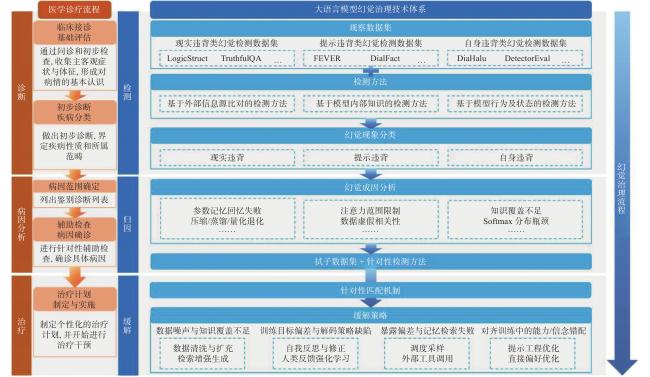
Large language models have been widely applied in numerous important fields due to their exceptional language understanding and generation capabilities. However, influenced by factors such as training data, learning objectives, and generation mechanisms, these models are prone to hallucination, posing a fundamental challenge to their output accuracy and decision-making reliability. This issue severely impacts their application in domains requiring high accuracy and has garnered extensive attention from researchers worldwide. Current research primarily focuses on isolated aspects of hallucination, such as detection, attribution, or mitigation, yet fails to establish effective interconnections among these aspects, resulting in a lack of a unified governance process and a holistic technical framework. Focusing on hallucination governance technologies for large language models, concepts and ideas from medical diagnosis and treatment are adopted to construct a new survey framework oriented toward hallucination governance. A hallucination governance process and technical system comprising three steps: "detection–attribution–mitigation" is summarized and organized. This system systematically summarizes and organically integrates five dimensions: phenomenon classification, cause analysis, detection datasets, detection methods, and mitigation strategies, forming a hierarchical and interconnected governance technology framework that provides a theoretical foundation for hallucination governance in large language models.
Fan Qirui , Ye Lin , Zhang Hongli , Che Wanxiang . Survey on detection, attribution, and mitigation of hallucinations in large language models[J]. Journal of Cybersecurity, 2025 , 3(6) : 19 -42 . DOI: 10.20172/j.issn.2097-3136.250602
表 1 幻觉分类示例Table 1 Hallucination taxonomy examples |
| 幻觉类型 | 问题 | 回答 | 解析 | |
| 现实违背 | 曹操《观沧海》一诗中东临碣石的下一句是什么 | 《观沧海》是曹操的著名诗作之一,但“东临碣石”并不是该诗中的一句 | “东临碣石”为《观沧海》一诗的开头,下一句为“以观沧海”,模型输出与现实大相径庭,是典型的“现实违背”幻觉 | |
| 提示违背 | 指令违背 | 请撰写 | 曹操(155年-220年),字孟德,一代 枭雄,历史上既是一位出色的军事家、 政治家,也是一个充满争议的历史人物··· | 指令明确要求字数为 |
| 背景违背 | 根据以下背景故事回答问题:在另一个平行时空中,关羽在华容道并没有义释曹操,而是严格执行了军令,将曹操斩杀。请问,在这个故事里,曹操最终是如何死的 | 曹操是在建安二十五年(公元220年)于洛阳病逝的 | 模型忽略了提示中的假定背景信息,仍以真实历史情节进行回答,是典型的背景违背幻觉 | |
| 自身违背 | (1)曹操长子曹昂死于哪场战役? (2)曹操长子曹丕的谥号是什么 | (1)曹操长子曹昂死于宛城之战。 (2)曹操长子曹丕的谥号是“文皇帝” | 在两轮对话中,模型先认为曹昂是曹操长子,后又认为曹丕是曹操长子,自相矛盾,是典型的自身违背幻觉 | |
表 2 幻觉类型与归因映射Table 2 Mapping between hallucination types and their root causes |
| 幻觉归因类型 | 幻觉归因 | 现实违背 | 提示违背 | 自身违背 | |
| 背景违背 | 指令违背 | ||||
| 数据层 | 训练数据噪声与偏差 | √ | √ | √ | |
| 数据虚假相关性 | √ | √ | |||
| 知识覆盖不足 | √ | √ | |||
| 模型层 | 训练目标偏差 | √ | √ | √ | √ |
| 教师强制策略与暴露偏差 | √ | √ | √ | √ | |
| 注意力范围限制 | √ | √ | |||
| Softmax分布瓶颈 | √ | √ | |||
| 随机采样策略不确定性 | √ | √ | √ | √ | |
| 对齐训练中的能力错配 | √ | √ | |||
| 对齐训练中的信念错配 | √ | √ | |||
| 参数记忆回忆失败 | √ | ||||
| 推理能力不足 | √ | √ | |||
| 解码启发式偏差 | √ | √ | √ | ||
| 应用层 | 分布失配 | √ | √ | √ | √ |
| 跨模态感知失真 | √ | √ | √ | ||
| 压缩、蒸馏、量化、退化 | √ | √ | |||
| 检索链条误差 | √ | √ | |||
表 3 检测方法分类情况Table 3 Classification of detection methods |
| 检测方法类型 | 代表性方法 | 优势 | 局限 |
| 基于外部信息源的检测方法 | FACTScore:原子事实分解与验证 | 结果可靠、可解释性强、对长文本、多事实场景检出率高 | 严重依赖检索质量与知识库覆盖度;计算开销大,实时性差;无法用于缺乏外部知识的场景 |
| FacTool:多源统一事实核查 | |||
| NLI模型/分类器:矛盾识别 | |||
| LLM评估器:提示LLM进行一致性判断 | |||
| 基于模型内部知识的检测方法 | 验证链:生成并回答自省问题 | 不依赖外部资源,适用性广、可探测模型的内部信念状态 | 效果受限于模型自身知识的完备性;概率输出可能未校准,置信度不可靠;可能放大模型固有的偏见和错误 |
| 概率自评估:询问模型自身置信度 | |||
| 概念熟悉度:通过生成概率衡量知识掌握度 | |||
| LLM评估器:判断与内部知识是否矛盾 | |||
| 基于模型行为与内部状态的检测方法 | 语义熵:多次采样的语义一致性 | 基于模型行为的检测方法适用于黑盒模型API、部分方法可实现实时检测、从模型生成机制根源提供通用信号 | 对高置信度输出的错误难以检测;行为一致性方法计算成本较高;信号与幻觉的因果关系非绝对 |
| 交叉质询:模型间多轮追问 | |||
| 不确定表达一致性:高效黑盒检测 | |||
| 转移解码:主动探测信念强度 | |||
| 实时探针:词元级幻觉分类器 |
表 4 缓解策略分析对比Table 4 Comparative analysis of mitigation strategies |
| 归因类别 | 缓解策略 | 效果 | 成本 | 潜在负面影响 |
| 训练数据噪声与知识覆盖不足 | 数据清洗与专业 数据补充 | 通过剔除错误数据、补充高质量领域语料显著提升知识正确性 | 高:需要持续收集和维护领域 数据 | 数据收集成本高,专业语料覆盖不全时仍可能遗漏事实 |
| 检索增强生成 | 对小模型效果显著,尤其在开放域任务中,可明显降低幻觉发生率 | 中:需要构建检索通道和知识库 | 检索偏差会引入噪声,检索质量直接影响输出可信度 | |
| 知识编辑 | 在特定常见问题上可将正确率提升至近100%,直接纠正错误事实 | 高:编辑操作复杂且需针对具体知识点 | 泛化能力有限,对幻觉纠正效果不一,可能引入新偏差 | |
| 训练目标偏差与解码策略缺陷 | RLHF/指令微调 | 在开放域和生物医学等场景显著降低幻觉率,提升响应真实性 | 高:需要大量人工标注与反馈 | 可能过度迎合训练偏好,适用性受领域限制 |
| 改进解码策略 | 调整采样方法可在一定程度上提高事实性并保持连贯度 | 低—中:修改推理参数即可实施 | 可能牺牲文本多样性,不同任务需不同调参 | |
| 自我反思与 温度校准 | 自我反思可利用模型的自省能力核查并修正错误,而温度与对数校准通过调整概率分布来降低不确定性幻觉 | 低—中:反思会增加推理时间,校准操作简单 | 自我反思对小模型可能无效甚至有害,过度校准可能导致 输出保守 | |
| 暴露偏差与记忆检索失败 | 调度采样/序列级 强化学习 | 减少教师强制带来的暴露偏差,减缓错误“滚雪球”效应 | 高:训练过程复杂,调参难度大 | 训练不稳定,需大量资源支持 |
| 调用外部工具 | 在检索、算术和符号推理任务上显著提高正确率 | 中—高:集成多工具增加系统复杂度 | 依赖工具质量,调用会增加时延 | |
| 长上下文结构和 记忆模块 | 扩展模型“记忆窗口”,减轻长距离注意力衰减 | 高:架构复杂,需要更多显存和计算 | 推理时延增加,可能导致短文本任务效率低 | |
| 对齐能力与信念错配 | RLHF/DPO等 偏好优化 | 奖励谨慎且真实的回答,能减少编造行为 | 高:训练成本高,需大量标注 | 可能导致模型过度保守,难以回答开放式问题 |
| 提示工程 | 在提示中加入专业背景和示例有助于降低幻觉频率 | 低:无需训练,只需调整提示 | 提示设计依赖经验,跨任务泛化有限 | |
| 检索链条误差与对抗提示 | 改进召回和排序算法 | 提高检索相关性,降低噪声来源 | 中:需优化检索模块和算法 | 算法复杂度增加,仍依赖知识库覆盖率 |
| 多工具交叉验证 | 结合搜索、知识图谱等多种工具互证,有效减少单一检索误差 | 中—高:系统集成复杂, 运行成本高 | 增加交互延迟,流程复杂 | |
| 安全过滤和指令 优先级管理 | 通过安全过滤和设定系统、用户、工具指令优先级减弱对抗性攻击 | 中:需设计规则和安全策略 | 可能限制模型灵活性,过滤过严时影响回答完整度 | |
| 解码启发式偏差 | 调整温度/重复 惩罚等采样参数 | 通过降低采样随机性减少误采样导致的幻觉 | 低:只需调整模型参数 | 可能导致回答单调、缺乏多样性 |
| 对数几何校准 | 使概率分布更符合真实置信度,提高正确率 | 低:计算简单 | 调参不当可能抑制某些合理但低频的答案 | |
| 不确定性检测与 重写机制 | 利用不确定性信号检测可能的幻觉并重新生成对应部分 | 中:需结合检测模型 | 重写可能影响文本连贯性,检测阈值设置困难 | |
| 推理能力不足与跨模态失真 | 外部计算器/ 符号推理器 | 强化算数和逻辑推理能力,减少推理错误 | 中:需要集成专用工具 | 工具可靠性不足时可能引入新的错误 |
| 多模态感知对齐 | 通过OCR/ASR/视觉编码等校准跨模态输入,减少感知失真 | 高:需复杂预处理与融合模型 | 噪声积累风险,跨模态数据难获取 | |
| 强化推理训练 | 在数据和训练目标上加强链式推理任务,改善复杂推理表现 | 高:需额外数据和训练资源 | 有过拟合风险,对其他任务提升有限 |
| 1 |
Vaswani A, Shazeer N, Parmar N, et al. Attention is all you need[J]. Advances in Neural Information Processing Systems, 2017, 30, 6000.
|
| 2 |
Radford A, Narasimhan K, Salimans T, et al. Improving language understanding by generative pre-training[EB/OL]. [2025-09-08]https://cdn.openai.com/research-covers/language-unsupervised/language_understanding_paper.pdf.
|
| 3 |
Devlin J, Chang M W, Lee K, et al. BERT: pre-training of deep bidirectional transformers for language understanding[C]//Proceedings of the 2019 Conference of the North American Chapter of the Association for Computational Linguistics: Human Language Technologies, Volume 1 (Long and Short Papers). Kerrville: Association for Computational Linguistics 2019: 4171-4186.
|
| 4 |
Brown T, Mann B, Ryder N, et al. Language models are few-shot learners[J]. Advances in Neural Information Processing Systems, 2020, 33, 1877- 1901.
|
| 5 |
Hostinger. LLM statistics 2025: comprehensive insights into market trends and integration[EB/OL]. [2025-09-20]. https://www.hostinger.com/tutorials/llm-statistics.
|
| 6 |
MORAN L. 73% of lawyers plan to use generative AI, report finds[EB/OL]. (2023-11-20)[2025-09-20]. https://www.legaldive.com/news/generative-ai-legal-use-cases-wolters-kluwer-report/700342/.
|
| 7 |
Kalai A T, Nachum O, Vempala S S, et al. Why language models hallucinate[PP/OL]. V1. arXiv (2025-09-04) [2025-09-10]. https://doi.org/10.48550/arXiv.2509.04664.
|
| 8 |
Jain S, Chakraborty B, Agarwal A, et al. Performance of large language models (ChatGPT and gemini advanced) in gastrointestinal pathology and clinical review of applications in gastroenterology[J]. Cureus, 2025, 17 (2): e31892.
|
| 9 |
从“律师因AI编造案例被罚”谈起: 大模型幻觉的根源与最新研究进展[EB/OL]. (2025-09-01) [2025-09-20]. https://blog.csdn.net/AI_gurubar/article/details/150603480.
From “Lawyers penalized for AI-generated fictitious cases”: the root causes and latest research progress of hallucinations in Large language models[EB/OL]. (2025-09-01) [2025-09-20]. https://blog.csdn.net/AI_gurubar/article/details/150603480.
|
| 10 |
Li Z, Yi W, Chen J. Accuracy paradox in large language models: regulating hallucination risks in generative AI[EB/OL]. [2025-09-10] arXiv preprint arXiv: 2509.13345 (cs. AI), 2025. https://arxiv.org/abs/2509.13345.
|
| 11 |
Ji Z W, Lee N, Frieske R, et al. Survey of hallucination in natural language generation[J]. ACM Computing Surveys, 2023, 55 (12): 1- 38.
|
| 12 |
Huang L, Yu W J, Ma W T, et al. A survey on hallucination in large language models: principles, taxonomy, challenges, and open questions[J]. ACM Transactions on Information Systems, 2025, 43 (2): 1- 55.
|
| 13 |
Lin S, Hilton J, Evans O. TruthfulQA: measuring how models mimic human falsehoods[C]//Proceedings of the 60th Annual Meeting of the Association for Computational Linguistics (Volume 1: Long Papers). Stroudsburg, PA, USA: ACL, 2022: 3214-3252.
|
| 14 |
Thorne J, Vlachos A, Christodoulopoulos C, et al. FEVER: a large-scale dataset for Fact Extraction and VERification[PP/OL]. V3. arXiv (2018-12-18) [2025-09-10]. https://doi.org/10.48550/arXiv.1803.05355.[LinkOut]]
|
| 15 |
Li J Y, Cheng X X, Zhao W X, et al. HaluEval: a large-scale hallucination evaluation benchmark for large language models[PP/OL]. V3. arXiv (2023-10-23) [2025-09-10] https://doi.org/10.48550/arXiv.2305.11747.
|
| 16 |
Liu Z H, Wang P J, Song X B, et al. Survey on hallucinations in large language models[J]. Journal of Software, 2024, 36(3): 1152-1185.
Liu Z H, Wang P J, Song X B, et al. Survey on hallucinations in large language models[J]. Journal of Software, 2024, 36(3): 1152-1185.
|
| 17 |
Lin X X, Ning Y C, Zhang J W, et al. LLM-based agents suffer from hallucinations: a survey of taxonomy, methods, and directions[PP/OL]. V2. arXiv (2025-11-18) [2025-09-10]. https://doi.org/10.48550/arXiv.2509.18970.
|
| 18 |
Li J Y, Chen J, Ren R Y, et al. The dawn after the dark: an empirical study on factuality hallucination in large language models[PP/OL]. V1. arXiv (2024-01-06) [2025-09-10]. https://doi.org/10.48550/arXiv.2401.03205.[LinkOut]]
|
| 19 |
Li C Z, Wang P B, Wang C X, et al. Loki’s dance of illusions: a comprehensive survey of hallucination in large language models[PP/OL]. V1. arXiv (2025-06-06) [2025-09-10]. https://doi.org/10.48550/arXiv.2507.02870.
|
| 20 |
Mishra A, Asai A, Balachandran V, et al. Fine-grained hallucination detection and editing for language models[PP/OL]. V4. arXiv (2024-08-12) [2025-09-10]. https://doi.org/10.48550/arXiv.2401.06855.
|
| 21 |
Rawte V, Chakraborty S, Pathak A, et al. The troubling emergence of hallucination in large language models - an extensive definition, quantification, and prescriptive remediations[C]//Proceedings of the 2023 Conference on Empirical Methods in Natural Language Processing. Stroudsburg, PA, USA: ACL, 2023: 2541-2573.
|
| 22 |
Zhang Y, Li Y F, Cui L Y, et al. Siren’s song in the AI ocean: a survey on hallucination in large language models[J]. Computational Linguistics, 2025, 51 (4): 1373- 1418.
|
| 23 |
Zhou C, Liu P, Xu P, et al. Lima: less is more for alignment[J]. Advances in Neural Information Processing Systems, 2023, 36, 55006- 55021.
|
| 24 |
Bender E M, Gebru T, McMillan-Major A, et al. On the dangers of stochastic parrots: can language models be too big[C]//Proceedings of the 2021 ACM Conference on Fairness, Accountability, and Transparency. New York: ACM, 2021: 610-623
|
| 25 |
Weidinger L, Mellor J, Rauh M, et al. Ethical and social risks of harm from language models[PP/OL]. V1. arXiv (2021-12-08) [2025-09-10]. https://doi.org/10.48550/arXiv.2112.04359.
|
| 26 |
Carlini N, Tramer F, Wallace E, et al. Extracting training data from large language models[C]//30th USENIX security symposium (USENIX Security 21). 2021: 2633-2650.
|
| 27 |
Carlini N, Ippolito D, Jagielski M, et al. Quantifying memorization across neural language models[C]//The Eleventh International Conference on Learning Representations. 2022.
|
| 28 |
Chowdhery A, Narang S, Devlin J, et al. PaLM: scaling language modeling with pathways[J]. Journal of Machine Learning Research, 2023, 24, 1- 113.
|
| 29 |
Wu A P, Kuang K, Zhu M Q, et al. Causality for large language models[PP/OL]. V1. arXiv (2024-10-20) [2025-09-10]. https://doi.org/10.48550/arXiv.2410.15319.
|
| 30 |
Min S, Gururangan S, Wallace E, et al. SILO language models: isolating legal risk in a nonparametric datastore[PP/OL]. V2. arXiv (2024-07-31) [2025-09-10]. https://doi.org/10.48550/arXiv.2308.04430.
|
| 31 |
Wang C J, Sennrich R. On exposure bias, hallucination and domain shift in neural machine translation[PP/OL]. V1. arXiv (2020-05-07) [2025-09-10]. https://doi.org/10.48550/arXiv.2005.03642
|
| 32 |
Bengio S, Vinyals O, Jaitly N, et al. Scheduled sampling for sequence prediction with recurrent Neural networks[C]//Proceedings of the 29th International Conference on Neural Information Processing Systems - Volume 1. New York: ACM, 2015: 1171-1179.
|
| 33 |
Bowman S R, Hyun J, Perez E, et al. Measuring progress on scalable oversight for large language models[PP/OL]. V2. arXiv (2022-11-11) [2025-09-10]. https://doi.org/10.48550/arXiv.2211.03540.
|
| 34 |
Zhang M R, Press O, Merrill W, et al. How language model hallucinations can snowball[PP/OL]. V1. arXiv (2023-05-22) [2025-09-10]. https://doi.org/10.48550/arXiv.2305.13534.
|
| 35 |
Chiang D, Cholak P. Overcoming a theoretical limitation of self-attention[PP/OL]. V1. arXiv (2022-02-24) [2025-09-10]. https://doi.org/10.48550/arXiv.2202.12172.
|
| 36 |
Hahn M. Theoretical limitations of self-attention in neural sequence models[J]. Transactions of the Association for Computational Linguistics, 2020, 8, 156- 171.
|
| 37 |
Yang Z L, Dai Z H, Salakhutdinov R, et al. Breaking the softmax bottleneck: a high-rank RNN language model[PP/OL]. V4. arXiv (2018-03-02) [2025-09-10]. https://doi.org/10.48550/arXiv.1711.03953
|
| 38 |
Fan A, Lewis M, Dauphin Y. Hierarchical neural story generation[PP/OL]. V1. arXiv (2018-05-13) [2025-09-10]. https://doi.org/10.48550/arXiv.1805.04833.
|
| 39 |
Holtzman A, Buys J, Du L, et al. The curious case of neural text degeneration[PP/OL]. V2. arXiv (2020-02-14) [2025-09-10]. https://doi.org/10.48550/arXiv.1904.09751.
|
| 40 |
Chuang Y S, Xie Y J, Luo H Y, et al. DoLa: decoding by contrasting layers improves factuality in large language models[PP/OL]. V2. arXiv (2024-03-11) [2025-09-10]. https://doi.org/10.48550/arXiv.2309.03883
|
| 41 |
Dziri N, Madotto A, Zaïane O, et al. Neural path hunter: reducing hallucination in dialogue systems via path grounding[C]//Proceedings of the 2021 Conference on Empirical Methods in Natural Language Processing. Stroudsburg, PA, USA: ACL, 2021: 2197-2214.
|
| 42 |
Wang Y F, Zhong W J, Li L Y, et al. Aligning large language models with human: a survey[PP/OL]. V1. arXiv (2023-07-24) [2025-09-10]. https://doi.org/10.48550/arXiv.2307.12966.
|
| 43 |
Gekhman Z, Yona G, Aharoni R, et al. Does fine-tuning LLMs on new knowledge encourage hallucinations[PP/OL]. V3. arXiv (2024-10-01)[2025-09-10]. https://doi.org/10.48550/arXiv.2405.05904.
|
| 44 |
Schulman J. Reinforcement learning from human feedback: Progress and challenges[C/OL]//Berkeley EECS Colloquium. Berkeley: University of California, Berkeley, 2023. https://www.youtube.com/watch?v=Q70FS5Z3z0E.
|
| 45 |
Wei J, Huang D, Lu Y F, et al. Simple synthetic data reduces sycophancy in large language models[PP/OL]. V2. arXiv (2024-02-15) [2025-09-10]. https://doi.org/10.48550/arXiv.2308.03958.
|
| 46 |
Liu C Z, Xu Z X, Wei Q Y, et al. More thinking, less seeing? assessing amplified hallucination in multimodal reasoning models[PP/OL]. V3. arXiv (2025-06-20) [2025-09-10]. https://doi. org/10.48550/arXiv. 2505.21523.
|
| 47 |
Wang C X, Chen X, Zhang N Y, et al. MLLM can see? dynamic correction decoding for hallucination mitigation[PP/OL]. V2. arXiv (2025-02-23) [2025-09-10]. https://doi.org/10.48550/arXiv.2410.11779.
|
| 48 |
Miao M M, Kearns M. Hallucination, monofacts, and miscalibration: an empirical investigation[PP/OL]. V2. arXiv (2025-05-15) [2025-09-10]. https://doi.org/10.48550/arXiv.2502.08666.
|
| 49 |
Shen Y D, Wu K X, Ding Y C, et al. Alleviating LLM-based generative retrieval hallucination in alipay search[C]//Proceedings of the 48th International ACM SIGIR Conference on Research and Development in Information Retrieval. New York: ACM, 2025: 4294-4298.
|
| 50 |
Shu F X, Liao Y, Zhuo L, et al. LLaVA-MoD: making LLaVA tiny via MoE knowledge distillation[PP/OL]. V3. arXiv (2024-10-23) [2025-09-10]. https://doi.org/10.48550/arXiv.2408.15881.
|
| 51 |
Azaria A, Mitchell T. The internal state of an LLM knows when it’s lying[PP/OL]. V2. arXiv (2023-10-17) [2025-09-10]. https://doi.org/10.48550/arXiv.2304.13734.
|
| 52 |
Bürger L, Hamprecht F, Nadler B. Truth is universal: robust detection of lies in LLMs[C]//Proceedings of the Advances in Neural Information Processing Systems 37. Neural Information Processing Systems Foundation, Inc. (NeurIPS), 2024: 138393-138431.
|
| 53 |
Chen X, Song D Z, Gui H H, et al. FactCHD: benchmarking fact-conflicting hallucination detection[PP/OL]. V3. arXiv (2024-05-26) [2025-09-10]. https://doi.org/10.48550/arXiv.2310.12086.
|
| 54 |
Liu T Y, Zhang Y Z, Brockett C, et al. A token-level reference-free hallucination detection benchmark for free-form text generation[C]//Proceedings of the 60th Annual Meeting of the Association for Computational Linguistics (Volume 1: Long Papers). Stroudsburg, PA, USA: ACL, 2022: 6723-6737.
|
| 55 |
Gupta P, Wu C S, Liu W H, et al. DialFact: a benchmark for fact-checking in dialogue[C]//Proceedings of the 60th Annual Meeting of the Association for Computational Linguistics (Volume 1: Long Papers). Stroudsburg, PA, USA: ACL, 2022: 3785-3801.
|
| 56 |
Niu C, Wu Y H, Zhu J, et al. RAGTruth: a hallucination corpus for developing trustworthy retrieval-augmented language models[C]//Proceedings of the 62nd Annual Meeting of the Association for Computational Linguistics (Volume 1: Long Papers). Stroudsburg, PA, USA: ACL, 2024: 10862-10878.
|
| 57 |
Ji Z W, Gu Y Z, Zhang W W, et al. ANAH: analytical annotation of hallucinations in large language models[PP/OL]. V1. arXiv (2024-05-30) [2025-09-10]. https://doi.org/10.48550/arXiv.2405.20315.
|
| 58 |
Pagnoni A, Balachandran V, Tsvetkov Y. Understanding factuality in abstractive summarization with FRANK: a benchmark for factuality metrics[PP/OL]. V2. arXiv (2021-07-23) [2025-09-10]. https://doi.org/10.48550/arXiv.2104.13346.
|
| 59 |
Zhang D X, Gangal V, Lattimer B, et al. Enhancing hallucination detection through perturbation-based synthetic data generation in system responses[C]//Proceedings of the Findings of the Association for Computational Linguistics ACL 2024. Stroudsburg, PA, USA: ACL, 2024: 13321-13332.
|
| 60 |
Chen K D, Chen Q, Zhou J, et al. DiaHalu: a dialogue-level hallucination evaluation benchmark for large language models[C]//Proceedings of the Findings of the Association for Computational Linguistics: EMNLP 2024. Stroudsburg, PA, USA: ACL, 2024: 9057-9079.
|
| 61 |
Anaokar S, Ganatra S, Bhattacharyya S, et al. HalluDetect: detecting, mitigating, and benchmarking hallucinations in conversational systems in the legal domain[C]//Proceedings of the 2025 Conference on Empirical Methods in Natural Language Processing: Industry Track. Stroudsburg, PA, USA: ACL, 2025: 1822-1847.
|
| 62 |
Tang Y, Yang Y. Multihop-rag: Benchmarking retrieval-augmented generation for multi-hop queries[EB/OL]. arXiv preprint arXiv: 2401.15391 (cs. AI), [2025-09-10]. https://arxiv.org/abs/2401.15391.
|
| 63 |
Yin Z, Sun Q, Guo Q, et al. Do large language models know what they don't know?[EB/OL]. arXiv preprint arXiv: 2305.18153 (cs. AI) [2025-09-10]. https://arxiv.org/abs/2305.18153.
|
| 64 |
Shafiei M, Saffari H, Moosavi N S. MultiHoax: a dataset of multi-hop false-premise questions[PP/OL]. V2. arXiv (2025-06-04)[2025-09-10]. https://doi.org/10.48550/arXiv.2506.00264
|
| 65 |
Yang Z L, Qi P, Zhang S Z, et al. HotpotQA: a dataset for diverse, explainable multi-hop question answering[C]//Proceedings of the 2018 Conference on Empirical Methods in Natural Language Processing. Stroudsburg, PA, USA: ACL, 2018: 2369-2380.
|
| 66 |
Ho X, Nguyen A D, Sugawara S, et al. Constructing a multi-hop QA dataset for comprehensive evaluation of reasoning steps[PP/OL]. V2. arXiv (2020-11-12) [2025-09-10]. https://doi.org/10.48550/arXiv.2011.01060.
|
| 67 |
Trivedi H, Balasubramanian N, Khot T, et al. ♫ MuSiQue: multihop questions via single-hop question composition[J]. Transactions of the Association for Computational Linguistics, 2022, 10, 539- 554.
|
| 68 |
Bang Y J, Ji Z W, Schelten A, et al. HalluLens: LLM hallucination benchmark[PP/OL]. V1. arXiv (2025-04-24) [2025-09-10] https://doi.org/10.48550/arXiv.2504.17550.
|
| 69 |
Min S, Krishna K, Lyu X X, et al. FActScore: fine-grained atomic evaluation of factual precision in long form text generation[C]//Proceedings of the 2023 Conference on Empirical Methods in Natural Language Processing. Stroudsburg, PA, USA: ACL, 2023: 12076-12100.
|
| 70 |
Chern I C, Chern S, Chen S Q, et al. FacTool: factuality detection in generative AI: a tool augmented framework for multi-task and multi-domain scenarios[PP/OL]. V2. arXiv (2023-07-26) [2025-09-10]. https://doi.org/10.48550/arXiv.2307.13528.
|
| 71 |
Huo S Q, Arabzadeh N, Clarke C L A. Retrieving supporting evidence for LLMs generated answers[PP/OL]. V1. arXiv (2023-06-23) [2025-09-10]. https://doi.org/10.48550/arXiv.2306.13781.
|
| 72 |
Nan F, Nallapati R, Wang Z G, et al. Entity-level factual consistency of abstractive text summarization[C]//Proceedings of the 16th Conference of the European Chapter of the Association for Computational Linguistics: Main Volume. Stroudsburg, PA, USA: ACL, 2021: 2727-2733
|
| 73 |
Goodrich B, Rao V, Liu P J, et al. Assessing the factual accuracy of generated text[C]//Proceedings of the 25th ACM SIGKDD International Conference on Knowledge Discovery & Data Mining. New York: ACM, 2019: 166-175.
|
| 74 |
Falke T, Ribeiro L F R, Utama P A, et al. Ranking generated summaries by correctness: an interesting but challenging application for natural language inference[C]//Proceedings of the 57th Annual Meeting of the Association for Computational Linguistics. Stroudsburg, PA, USA: ACL, 2019: 2214-2220.
|
| 75 |
Dhuliawala S, Komeili M, Xu J, et al. Chain-of-verification reduces hallucination in large language models[C]//Proceedings of the Findings of the Association for Computational Linguistics ACL 2024. Stroudsburg, PA, USA: ACL, 2024: 3563-3578.
|
| 76 |
Kadavath S, Conerly T, Askell A, et al. Language models (mostly) know what they know[PP/OL]. V4. arXiv (2022-11-21) [2025-09-10]. https://doi.org/10.48550/arXiv.2207.05221.
|
| 77 |
Varshney N, Yao W L, Zhang H M, et al. A stitch in time saves nine: detecting and mitigating hallucinations of LLMs by validating low-confidence generation[PP/OL]. V2. arXiv (2023-08-12)[2025-09-10]. https://doi.org/10.48550/arXiv.2307.03987.
|
| 78 |
Yao J Y, Ning K P, Liu Z H, et al. LLM lies: hallucinations are not bugs, but features as adversarial examples[PP/OL]. V3. arXiv(2024-08-04)[2025-09-10]. https://doi.org/10.48550/arXiv.2310.01469.
|
| 79 |
Farquhar S, Kossen J, Kuhn L, et al. Detecting hallucinations in large language models using semantic entropy[J]. Nature, 2024, 630 (8017): 625- 630.
|
| 80 |
Agrawal A, Suzgun M, MacKey L, et al. Do language models know when they’re hallucinating references[C]//Proceedings of the Findings of the Association for Computational Linguistics: EACL 2024. Stroudsburg, PA, USA: ACL, 2024: 912-928.
|
| 81 |
Cohen R, Hamri M, Geva M, et al. LM vs LM: detecting factual errors via cross examination[PP/OL]. V1. arXiv (2023-05-22) [2025-09-10]. https://doi.org/10.48550/arXiv.2305.13281.
|
| 82 |
Joo S, Min K, Koo J, et al. Black-box hallucination detection via consistency under the uncertain expression[PP/OL]. V1. arXiv (2025-09-26) [2025-09-10]. https://doi.org/10.48550/arXiv.2509.21999.
|
| 83 |
Abdeen B, Siddiqui S M T, Ahmed M T, et al. Hallucination detection in large language models using diversion decoding[M]//Data and Applications Security and Privacy XXXIX. ChamSpringer Nature Switzerland2025: 116-133.
|
| 84 |
Obeso O, Arditi A, Ferrando J, et al. Real-time detection of hallucinated entities in long-form generation[PP/OL]. V2. arXiv (2026-02-05) [2025-09-10]. https://doi.org/10.48550/arXiv.2509.03531.[LinkOut]]
|
| 85 |
Powers D M W. Evaluation: from precision, recall and F-measure to ROC, informedness, markedness and correlation[PP/OL]. V1. arXiv(2020-10-11)[2025-09-10]. https://doi.org/10.48550/arXiv.2010.16061.
|
| 86 |
Su W H, Wang C Y, Ai Q Y, et al. Unsupervised real-time hallucination detection based on the internal states of large language models[PP/OL]. V2. arXiv(2024-06-10)[2025-09-10]. https://doi.org/10.48550/arXiv.2403.06448.
|
| 87 |
Lipton Z C. The Mythos of model interpretability: in machine learning, the concept of interpretability is both important and slippery[J]. Queue, 2018, 16 (3): 31- 57.
|
| 88 |
Abbas A, Albalak A, Arora K, et al. DataComp-LM: in search of the next generation of training sets for language models[C]//Proceedings of the Advances in Neural Information Processing Systems 37. Neural Information Processing Systems Foundation, Inc. (NeurIPS), 2024: 14200-14282.
|
| 89 |
Lewis P, Perez E, Piktus A, et al. Retrieval-augmented generation for knowledge-intensive NLP tasks[C]//Proceedings of the 34th International Conference on Neural Information Processing Systems. New York: ACM, 2020: 9459-9474.
|
| 90 |
Meng K, Sharma A S, Andonian A, et al. Mass-editing memory in a transformer[PP/OL]. V2. arXiv (2023-08-01)[2025-09-10]. https://doi.org/10.48550/arXiv.2210.07229.
|
| 91 |
Mitchell E, Lin C, Bosselut A, et al. Fast model editing at scale[PP/OL]. V2. arXiv(2022-06-13)[2025-09-10]. https://doi.org/10.48550/arXiv.2110.11309
|
| 92 |
Wang H Y, Liu T C, Li R R, et al. RoseLoRA: row and column-wise sparse low-rank adaptation of pre-trained language model for knowledge editing and fine-tuning[C]//Proceedings of the 2024 Conference on Empirical Methods in Natural Language Processing. Stroudsburg, PA, USA: ACL, 2024: 996-1008.
|
| 93 |
Huang B X, Chen C Y, Xu X X, et al. Can knowledge editing really correct hallucinations[PP/OL]. V3. arXiv (2025-03-03)[2025-09-10]. https://doi.org/10.48550/arXiv.2410.16251.
|
| 94 |
Rafailov R, Sharma A, Mitchell E, et al. Direct preference optimization: your language model is secretly a reward model[J]. Advances in Neural Information Processing Systems, 2023, 36, 53728- 53741.
|
| 95 |
Ouyang L, Wu J, Xu J, et al. Training language models to follow instructions with human feedback[C]//Proceedings of the 36th International Conference on Neural Information Processing Systems. New York: ACM, 2022: 27730-27744.
|
| 96 |
Shinn N, Labash B, Gopinath A. Reflexion: an autonomous agent with dynamic memory and self-reflection[PP]. arXiv preprint arXiv: 2303.11366.
|
| 97 |
Lee N, Ping W, Xu P, et al. Factuality enhanced language models for open-ended text generation[J]. Advances in Neural Information Processing Systems, 2022, 35, 34586- 34599.
|
| 98 |
Guo C, Pleiss G, Sun Y, et al. On calibration of modern neural networks[C]//Proceedings of the 34th International Conference on Machine Learning - Volume 70. New York: ACM, 2017: 1321-1330.
|
| 99 |
Schick T, Dwivedi-Yu J, Dessì R, et al. Toolformer: Language models can teach themselves to use tools[J]. Advances in Neural Information Processing Systems, 2023, 36, 68539- 68551.
|
| 100 |
Beltagy I, Peters M E, Cohan A. Longformer: the long-document transformer[PP/OL].V2.arXiv(2020-12-02)[2025-09-10]. https://doi.org/10.48550/arXiv.2004.05150.
|
| 101 |
Wu Y H, Rabe M N, Hutchins D, et al. Memorizing transformers[PP/OL]. V1. arXiv (2022-03-16)[2025-09-10]. https://doi.org/10.48550/arXiv.2203.08913.
|
| 102 |
Liu P F, Yuan W Z, Fu J L, et al. Pre-train, prompt, and predict: a systematic survey of prompting methods in natural language processing[J]. ACM Computing Surveys, 2023, 55 (9): 1- 35.
|
| 103 |
Zamfirescu-pereira J D, Wong R Y, Hartmann B, et al. Why johnny can’t prompt: how non-AI experts try (and fail) to design LLM prompts[C]//Proceedings of the 2023 CHI Conference on Human Factors in Computing Systems. New York: ACM, 2023: 1-21.
|
| 104 |
Liu Y A, Zhang R Q, Guo J F, et al. Robust neural information retrieval: an adversarial and out-of-distribution perspective[J]. ACM Transactions on Information Systems, 2026, 44 (1): 1- 48.
|
| 105 |
Gokul V, Tenneti S, Nakkiran A. Contradiction detection in RAG systems: evaluating LLMs as context validators for improved information consistency[PP/OL]. V1. arXiv (2025-03-31) [2025-10-10] https://doi.org/10.48550/arXiv.2504.00180.
|
| 106 |
Kull M, Perello Nieto M, Kängsepp M, et al. Beyond temperature scaling: Obtaining well-calibrated multi-class probabilities with dirichlet calibration[J]. Advances in neural information processing systems, 2019, 32, 12897- 12908.
|
| 107 |
Liu H S, Zhang H, Guo Z J, et al. CtrlA: adaptive retrieval-augmented generation via inherent control[PP/OL]. V2. arXiv (2024-10-03)[2025-10-10]. https://doi.org/10.48550/arXiv.2405.18727
|
| 108 |
Yoon H, Jung J, Kim J, et al. Visual representation alignment for multimodal large language models[PP/OL]. V2. arXiv (2025-10-10)[2025-10-10]. https://doi.org/10.48550/arXiv.2509.07979.
|
| 109 |
Bai Y T, Kadavath S, Kundu S, et al. Constitutional AI: harmlessness from AI feedback[PP/OL]. V1. arXiv (2022-12-15)[2025-10-10]. https://doi.org/10.48550/arXiv.2212.08073.
|
| 110 |
Lee H, Phatale S, Mansoor H, et al. RLAIF vs. RLHF: scaling reinforcement learning from human feedback with AI feedback[PP/OL]. V3. arXiv (2024-09-03)[2025-10-10]. https://doi.org/10.48550/arXiv.2309.00267.
|
| 111 |
Sun W W, Shi Z L, Gao S, et al. Contrastive learning reduces hallucination in conversations[J]. Proceedings of the AAAI Conference on Artificial Intelligence, 2023, 37 (11): 13618- 13626.
|
| 112 |
Kazlaris I, Antoniou E, Diamantaras K, et al. From illusion to insight: a taxonomic survey of hallucination mitigation techniques in LLMs[J]. AI, 2025, 6 (10): 260.
|
/
| 〈 |
|
〉 |