Distributed authentication technology for UAV swarms based on multi-module PUF feature extraction
Online published: 2025-09-29
Copyright
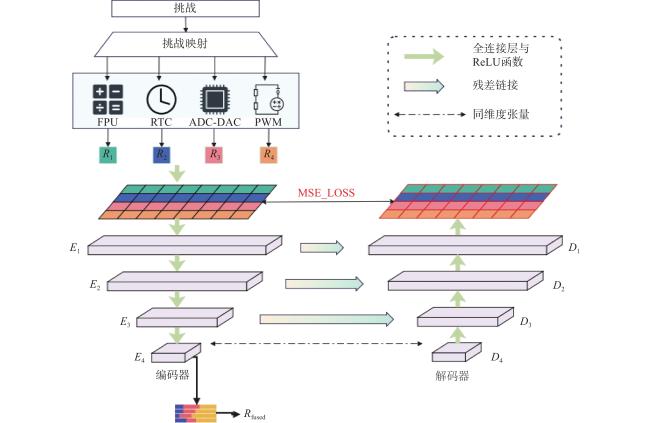
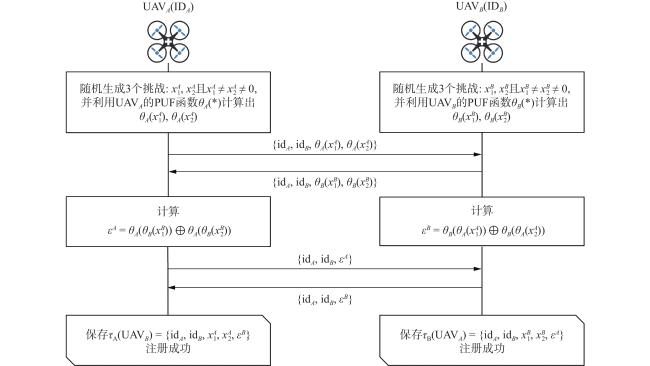
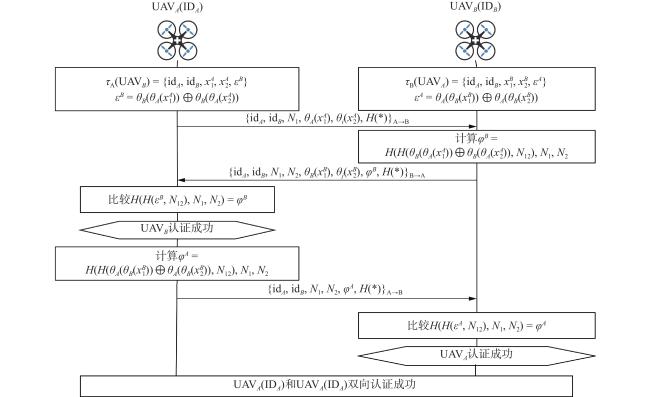
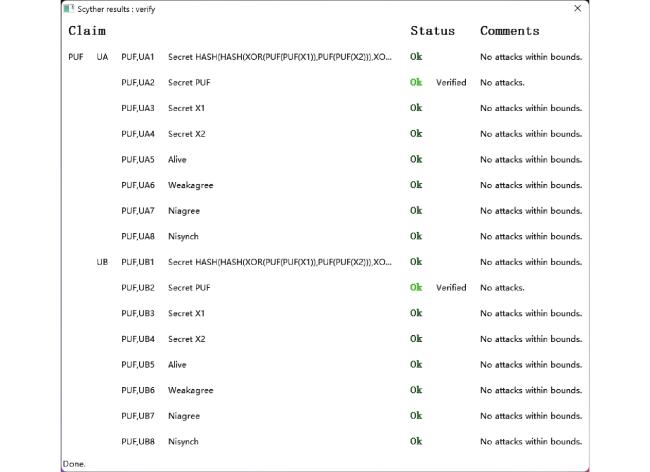
With the widespread application of unmanned aerial vehicle (UAV) swarms in emergency response, intelligent reconnaissance, and collaborative operations, identity authentication technologies face critical challenges such as communication link exposure, high computational complexity, and spoofing attacks. To address these issues, this paper proposes a multi-module entropy-cooperative PUF (physical unclonable function) generation method tailored for general-purpose micro-UAV platforms. The method fully leverages onboard hardware components—including analog-to-digital converters (ADC), pulse-width modulators (PWM), real-time clocks (RTC), and floating-point units (FPU)—as physical entropy sources. A self-supervised feature fusion encoder with cross-layer residual connections is employed to extract stable features from each module while preserving critical identification information through residual pathways. This design generates challenge-response pairs (CRP) with good stability and distinguishability, effectively mitigating the instability, low entropy strength, and limited anti-modeling attack capability of single-module PUF. In addition, this paper designs a decentralized identity authentication protocol based on extended CRP to overcome the reliance on central nodes and the risk of single points of failure. Experimental results show that the proposed PUF generation method significantly outperforms traditional PUF schemes in resisting machine learning-based modeling attacks. Formal analysis under the Dolev-Yao attack model using the Scyther tool further validates the security of the proposed distributed authentication protocol, revealing no feasible attack paths in multiple attack simulations. This work provides a lightweight authentication solution that enables secure, decentralized identity verification for UAV swarms, which is compatible with general micro-UAV hardware platforms.
Li Zhiqiang , Huang Xin , Li Sudan , Han Biao . Distributed authentication technology for UAV swarms based on multi-module PUF feature extraction[J]. Journal of Cybersecurity, 2026 , 4(1) : 80 -91 . DOI: 10.20172/j.issn.2097-3136.250922
| 1 |
Abualigah L, Diabat A, Sumari P, et al. Applications, deployments, and integration of Internet of drones (IoD): a review[J]. IEEE Sensors Journal, 2021, 21 (22): 25532- 25546.
|
| 2 |
Hoang M O, Grøntved K A R, Van B N, et al. Drone swarms to support search and rescue operations: opportunities and challenges[M]//Dunstan B J, Koh J T, Turnbull D, et al. Cultural Robotics: Social Robots and Their Emergent Cultural Ecologies. Cham: Springer International Publishing, 2023: 163-176
|
| 3 |
王云涛, 苏洲, 邓毅, 等. 无人机网络安全综述[J]. 网络空间安全科学学报, 2025, 3 (1): 2- 18.
Wang Y T, Su Z, Deng Y, et al. A survey of security for unmanned aerial vehicle networks[J]. Journal of Cybersecurity, 2025, 3 (1): 2- 18.
|
| 4 |
Alenezi M N, Alabdulrazzaq H, Mohammad N Q. Symmetric encryption algorithms: review and evaluation study[J]. Journal of Computer Science, 2020, 12 (2): 176- 183.
|
| 5 |
Kim T H, Huang L S, Perrig A, et al. Accountable key infrastructure (AKI): a proposal for a public-key validation infrastructure[C]//Proceedings of the 22nd International Conference on World Wide Web. New York: ACM, 2013: 679-690.
|
| 6 |
Chen L Q, Qian S J, Lim M, et al. An enhanced direct anonymous attestation scheme with mutual authentication for network-connected UAV communication systems[J]. China Communications, 2018, 15 (5): 61- 76.
|
| 7 |
Ayuninggati T, Purnama Harahap E, Mulyati, et al. Supply chain management, certificate management at the transportation layer security in charge of security[J]. Blockchain Frontier Technology, 2022, 1 (1): 1- 12.
|
| 8 |
Li C J, Sun X C, Zhang Z. Effective methods and performance analysis of a satellite network security mechanism based on blockchain technology[J]. IEEE Access, 2021, 9, 113558- 113565.
|
| 9 |
Gao Y S, Al-sarawi S F, Abbott D. Physical unclonable functions[J]. Nature Electronics, 2020, 3 (2): 81- 91.
|
| 10 |
Gade S, Chatterjee U, Mukhopadhyay D. PAKAMAC: a PUF-based keyless automotive entry system with mutual authentication[J]. Journal of Hardware and Systems Security, 2022, 6 (3/4): 67- 78.
|
| 11 |
Zahoor A, Mahmood K, Shamshad S, et al. An access control scheme in IoT-enabled smart-grid systems using blockchain and PUF[J]. Internet of Things, 2023, 22, 100708.
|
| 12 |
Wang W Z, Chen Q, Yin Z M, et al. Blockchain and PUF-based lightweight authentication protocol for wireless medical sensor networks[J]. IEEE Internet of Things Journal, 2022, 9 (11): 8883- 8891.
|
| 13 |
He K Y, Ren Z. A new three-factor authentication scheme using chebyshev chaotic map for peer-to-peer Industrial Internet of Things[J]. Computer Networks, 2024, 247, 110450.
|
| 14 |
Huang Z F, Bian J C, Lin Y K, et al. Design guidelines and feedback structure of ring oscillator PUF for performance improvement[J]. IEEE Transactions on Computer-Aided Design of Integrated Circuits and Systems, 2024, 43 (1): 71- 84.
|
| 15 |
The hardware security behind azure sphere[EB/OL]. [2025-06-24]. https://ieeexplore.ieee.org/abstract/document/8638527.
|
| 16 |
Baek S, Yu G H, Kim J, et al. A reconfigurable SRAM based CMOS PUF with challenge to response pairs[J]. IEEE Access, 2021, 9, 79947- 79960.
|
| 17 |
Maiti A, Schaumont P. Improved ring oscillator PUF: an FPGA-friendly secure primitive[J]. Journal of Cryptology, 2011, 24 (2): 375- 397.
|
| 18 |
Suh G E, Devadas S. Physical unclonable functions for device authentication and secret key generation[C]//Proceedings of the 44th Annual Design Automation Conference (DAC ’07). San Diego: ACM, 2007: 9–14.
|
| 19 |
Zhang J L, Shen C Q, Guo Z Y, et al. CT PUF: configurable tristate PUF against machine learning attacks for IoT security[J]. IEEE Internet of Things Journal, 2022, 9 (16): 14452- 14462.
|
| 20 |
Ashtari A, Shabani A, Alizadeh B. A comparative study of machine learning classifiers for secure RF-PUF-based authentication in Internet of things[J]. Microprocessors and Microsystems, 2022, 93, 104600.
|
| 21 |
Hemavathy S, Kanchana Bhaaskaran V S. Arbiter PUF: a review of design, composition, and security aspects[J]. IEEE Access, 2023, 11, 33979- 34004.
|
| 22 |
Wang P D, Chen F L, Li D, et al. Authentication of optical physical unclonable functions based on single-pixel detection[J]. Physical Review Applied, 2021, 16 (5): 054025.
|
| 23 |
Li A X, Kong L L, Peng C, et al. Predicting Cd accumulation in rice and identifying nonlinear effects of soil nutrient elements based on machine learning methods[J]. Science of the Total Environment, 2024, 912, 168721.
|
| 24 |
Liu S H, Xie H, Cao Q M, et al. Preparation of a novel IPDI/PUF@CeO2 bi-functional microcapsules and its improvement for the self-healing and anti-corrosion performance in epoxy coatings[J]. Progress in Organic Coatings, 2022, 169, 106897.
|
| 25 |
Bommana S R, Veeramachaneni S, Srinivas M. Bistable physically unclonable function with dynamic threshold voltage[C]//Proceedings of the 2024 IEEE 67th International Midwest Symposium on Circuits and Systems (MWSCAS). Piscataway: IEEE Press, 2024: 167-172.
|
| 26 |
C G G, Jose B A, Mathew J. A novel mixed-signal PUF based on current mirror inverter[C]//Proceedings of the 2022 IEEE International Symposium on Smart Electronic Systems (iSES). Piscataway: IEEE Press, 2022: 89-94.
|
| 27 |
Garg A, Kim T T. Design of SRAM PUF with improved uniformity and reliability utilizing device aging effect[C]//Proceedings of the 2014 IEEE International Symposium on Circuits and Systems (ISCAS) . Piscataway: IEEE Press, 2014: 1941-1944
|
| 28 |
Morozov S, Maiti A, Schaumont P. An analysis of delay based PUF implementations on FPGA[M]//Reconfigurable Computing: Architectures, Tools and Applications. Berlin, HeidelbergSpringer2010: 382-387.
|
| 29 |
Vaidya G, Nambi A, Prabhakar T V, et al. IoT-ID: a novel device-specific identifier based on unique hardware fingerprints[C]//Proceedings of the 2020 IEEE/ACM Fifth International Conference on Internet-of-Things Design and Implementation (IoTDI). Piscataway: IEEE Press, 2020: 189-202
|
| 30 |
Xiao W, Liu B S, Yin W T. Security authentication scheme based on Chebyshev chaotic mapping for library network[J]. Alexandria Engineering Journal, 2024, 109, 262- 269.
|
| 31 |
Nurkifli E H. Provably secure biometric and PUF-based authentication for roaming service in global mobility network[J]. Alexandria Engineering Journal, 2025, 113, 414- 430.
|
| 32 |
Chen L Q, Wang J L, Yin B W, et al. A provably secure and PUF-based authentication key agreement scheme for cloud-edge IoT[J]. China Communications, 2023, 20 (5): 198- 216.
|
| 33 |
Zhang Y, Yuan Z, Feng X, et al. PUF-based lightweight authentication protocol for power IoT[J]. Application Research of Computers, 2025, 42 (5): 1541- 1548.
|
| 34 |
Lounis K, Zulkernine M. T2T-MAP: a PUF-based thing-to-thing mutual authentication protocol for IoT[J]. IEEE Access, 2021, 9, 137384- 137405.
|
| 35 |
Fievre A M P, Rogers A A A, Bhansali S. Integrated circuit security: an overview[J]. Journal of Institute of Smart Structures and Systems, 2015, 4 (1): 18- 37.
|
| 36 |
Katzenbeisser S, Kocabaş Ü, Rožić V, et al. PUFs: myth, fact or busted a security evaluation of physically unclonable functions (PUFs) cast in silicon[M]//Cryptographic Hardware and Embedded Systems – CHES 2012. Berlin, Heidelberg: Springer, 2012: 283-301.
|
| 37 |
Su H, Zhang J. Machine learning attacks on voltage over-scaling-based lightweight authentication[C]//2018 Asian Hardware Oriented Security and Trust Symposium (AsianHOST). 2018: 50-55.
|
/
| 〈 |
|
〉 |