IDumbo: Whole-process privacy-preserving asynchronous byzantine consensus protocol
Online published: 2025-07-18
Copyright
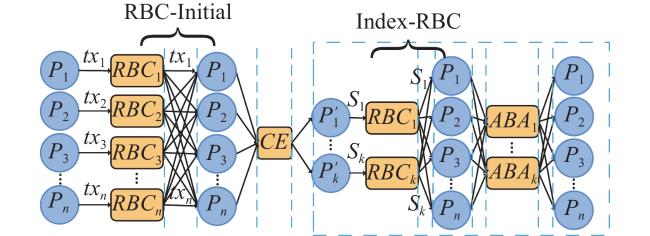
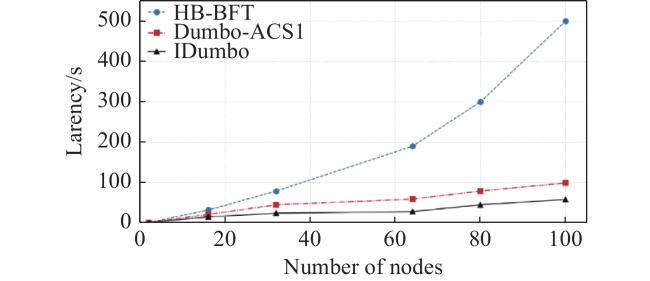
Blockchain consensus algorithms constitute the fundamental safeguard for the secure operation of distributed ledgers, where their performance and privacy-preserving capabilities critically determine the scope and depth of practical implementation. In asynchronous network environments, Byzantine fault tolerance (BFT) consensus algorithms have emerged as the preferred solution for high-concurrency scenarios such as cross-border finance and IoT due to their exceptional attack resistance and network tolerance. However, the existing asynchronous BFT algorithms exhibit significant privacy vulnerabilities, including the exposure of sensitive information (e.g., transaction details and node identities) during consensus processes, posing data leakage risks and demonstrating insufficient resilience against the emerging Sybil attacks. To address these challenges, improve-Dumbo (IDumbo), an enhanced framework deeply integrating the whole-process privacy preservation into the DumboBFT architecture was proposed. Building upon DumboBFT's high-performance foundation, IDumbo introduced innovative privacy mechanisms to achieve: (1) a full-cycle privacy-preserving architecture, (2) communication privacy protection, (3) dynamic state update strategies, and (4) distributed consensus privacy protection. Notably, IDumbo maintained DumboBFT's original latency benchmarks while achieving optimal equilibrium among privacy preservation, Sybil attack resistance, and system efficiency. The organic integration of asynchronous BFT consensus with comprehensive privacy safeguards is pioneered, delivering a dual-optimized solution that combines high performance with robust security for the privacy-sensitive blockchain applications in medical data sharing and cross-border trade.
ZHOU Yike , ZHU Youwen , WU Qihui . IDumbo: Whole-process privacy-preserving asynchronous byzantine consensus protocol[J]. Journal of Cybersecurity, 2025 , 3(2) : 49 -58 . DOI: 10.20172/j.issn.2097-3136.250205
表 1 实验参数Table 1 Experimental parameters |
| 参数 | 配置值 |
| 节点拓扑 | 随机连接 |
| 网络延迟 | 50~500 ms(韦伯分布) |
| 带宽限制 | 100 Mbps |
| 交易负载 | 固定大小250 B TPC-C型 |
| 拜占庭节点比例 | ≤33%(动态注入) |
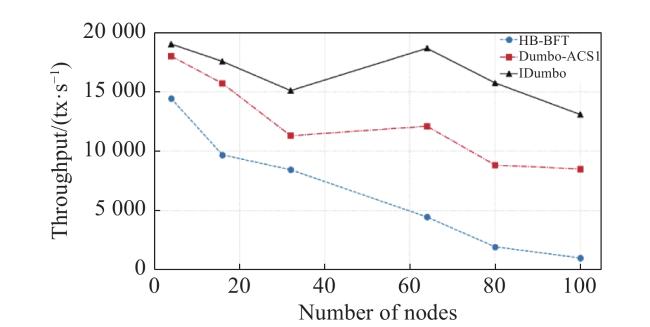
表 3 吞吐量对比(tx/s)Table 3 Througput comparison(tx/s) |
| 节点数 | HBBFT | Dumbo | IDumbo |
| 32个 | 8 430 | 11 313 | 15 121 |
| 64个 | 4 452 | 12 001 | 19 212 |
| 100个 | 1 934 | 8 842 |
| 1 |
GIL S, BAYKAL C, RUS D. Resilient multi-agent consensus using Wi-Fi signals[J]. IEEE Control Systems Letters, 2019, 3 (1): 126- 131.
|
| 2 |
DONG W, LIU X. Robust and secure time-synchronization against Sybil attacks for sensor networks[J]. IEEE Transactions on Industrial Informatics, 2015, 11 (6): 1482- 1491.
|
| 3 |
RENGANATHAN V, FATHIAN K, SAFAOUI S, et al. Spoof resilient coordination in distributed and robust robotic networks[J]. IEEE Transactions on Control Systems Technology, 2022, 30 (2): 803- 810.
|
| 4 |
周凯,陈福,鲁添元,等. 区块链共识算法综述[J/OL]. 计算机科学,2025:1-25
ZHOU K,CHEN F,LU T Y,et al. A survey of blockchain consensus algorithms[J/OL]. Computer Science,2025:1-25.
|
| 5 |
MILLER A,XIA Y,CROMAN K,et al. The honey badger of BFT protocols[C]//Proceedings of the 2016 ACM SIGSAC Conference on Computer and Communications Security (CCS’16). ACM,2016:31-42.
|
| 6 |
GUO B Y,LU Z L,TANG Q,et al. Dumbo:Faster asynchronous BFT protocols[C]//Proceedings of the 2020 ACM SIGSAC Conference on Computer and Communications Security (CCS’20). ACM,2020:803-818.
|
| 7 |
WU Y,YING C,ZHENG N,et al. Whole-process privacy-preserving and Sybil-resilient consensus for multiagent networks[J]. IEEE Transactions on Neural Networks and Learning Systems,2024,DOI:10.1109/TNNLS.2024.3488115.
|
| 8 |
CASTRO M,LISKOV B. Practical Byzantine fault tolerance[C]//Proceedings of the 3rd Symposium on Operating Systems Design and Implementation (OSDI’99). USENIX Association,1999:173-186.
|
| 9 |
KOSBA A,MILLER A,SHI E,et al. Hawk:The blockchain model of cryptography and privacy-preserving smart contracts[C]//2016 IEEE Symposium on Security and Privacy (SP). IEEE,2016:839-858.
|
| 10 |
ONGARO D,OUSTERHOUT J. In search of an understandable consensus algorithm[C]//Proceedings of the 2014 USENIX Annual Technical Conference (USENIX ATC’14). USENIX Association,2014:305-320.
|
| 11 |
DOLEV D, HOCH E N. On self-stabilizing synchronous actions despite Byzantine attacks[J]. Journal of the ACM, 2007, 54 (3): 1- 28.
|
| 12 |
LAMRIJI Y,KASRI M,MAKKAOUI K E,et al. A comparative study of consensus algorithms for blockchain[C]//2023 3rd International Conference on Innovative Research in Applied Science,Engineering and Technology (IRASET). IEEE,2023:1-8.
|
| 13 |
CACHIN C, KURSAWE K, SHOUP V. Random oracles in Constantinople: Practical asynchronous Byzantine agreement using Cryptography[J]. Journal of Cryptology, 2005, 18 (3): 219- 246.
|
| 14 |
LU Y,LU Z L,TANG Q,et al. Dumbo-MVBA:Optimal multi-valued validated asynchronous Byzantine agreement,revisited[C]//Proceedings of the 39th ACM Symposium on Principles of Distributed Computing (PODC’20). ACM,2020:129-138.
|
| 15 |
BONEH D, BONNEAU J, BÜNZ B, et al. Verifiable delay functions[J]. SIAM Journal on Computing, 2020, 49 (3): 553- 591.
|
| 16 |
BONEH D. Threshold cryptosystems from threshold fully homomorphic encryption[C]//Advances in Cryptology-CRYPTO 2018. Cham:Springer,2018:609-639.
|
| 17 |
DOUCEUR J R. The Sybil attack[C]//Proceedings of the 1st International Workshop on Peer-to-Peer Systems (IPTPS 2002). Berlin,Heidelberg:Springer,2002:251-260.
|
| 18 |
DWORK C, ROTH A. The algorithmic foundations of differential privacy[J]. Foundations and Trends in Theoretical Computer Science, 2014, 9 (3-4): 211- 407.
|
| 19 |
DOLEV D, HOCH E N. On self-stabilizing synchronous actions despite Byzantine attacks[J]. IEEE Transactions on Parallel and Distributed Systems, 2015, 26 (3): 730- 741.
|
| 20 |
GUERRAOUI R, RAYNAL M. The information structure of indulgent consensus[J]. IEEE Transactions on Computers, 2004, 53 (4): 453- 466.
|
| 21 |
PEIKERT C. A decade of lattice cryptography[J]. Foundations and Trends in Theoretical Computer Science, 2016, 10 (4): 283- 424.
|
| 22 |
ALWEN J, TACKMANN B. Moderately hard functions: Definition, instantiations, and applications[J]. Journal of Cryptology, 2018, 31 (2): 543- 587.
|
/
| 〈 |
|
〉 |