移动社交应用跨用户隐私分享行为的最小必要合规检测方法
网络出版日期: 2024-11-16
基金资助
移动社交应用隐私收集行为的分析检测技术及应用示范(2021YFB3101200)
版权
Inspection method of data minimization compliance for cross-user privacy sharing behavior in mobile social applications
Online published: 2024-11-16
Copyright
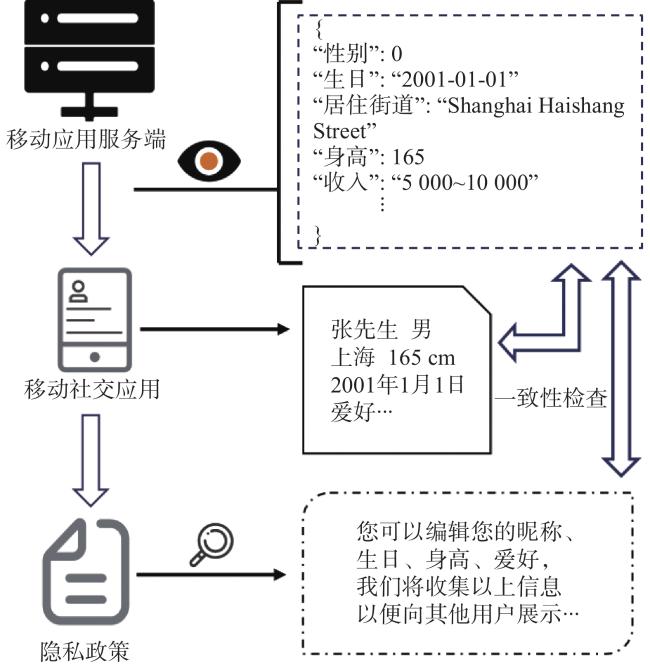
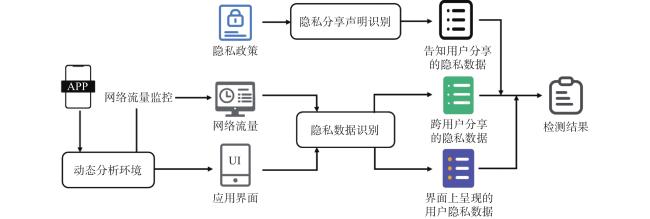
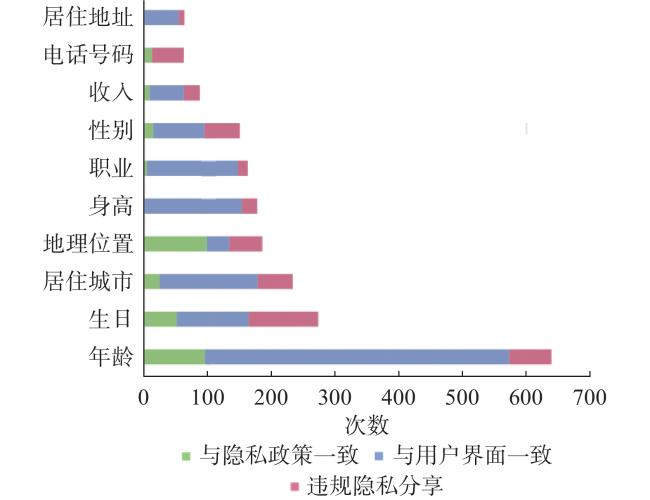
移动社交应用提供的社交互动功能使得用户可以轻松地获取其他用户的个人信息,进而促成跨用户的隐私分享。根据相关法律规定的最小必要原则,应用分享的个人信息应当限定于展示功能所需要的最小范围,因此不得分享未在隐私政策声明且未在用户界面上展示的个人信息。目前相关工作缺少对跨用户隐私分享合规性的研究,因此设计了自动化合规检测系统,以隐私政策和用户界面作为判定是否符合最小必要原则的依据,检测违规的跨用户隐私分享行为。该系统面向应用市场509个移动社交应用展开合规检测,对每个移动社交应用进行20 min的动态测试发现,47个移动社交应用存在合计101次非重复的违规隐私分享行为,涉及18类用户隐私数据。经过人工验证,确认91.09%的违规隐私分享行为实际存在。实验结果表明,该系统相较先前工作在精准率和召回率上均有良好表现。
朱启瑞 , 陈荣华 , 杨哲慜 , 李帅 , 张源 , 杨珉 . 移动社交应用跨用户隐私分享行为的最小必要合规检测方法[J]. 网络空间安全科学学报, 2024 , 2(3) : 3 -12 . DOI: 10.20172/j.issn.2097-3136.240301
The social interaction functions provided by mobile social applications (apps) allow users to easily obtain the personal information of other users, thereby promoting cross-user privacy sharing. According to the data minimization principle stipulated in relevant laws and regulations, the personal information shared by the application should be limited to the minimum scope necessary to the display function. Therefore, personal information not stated in the privacy policy and not displayed on the user interface shall not be shared. However, security communities barely pay attention to the compliance of cross-user privacy sharing. Therefore, an automated compliance detection system was designed to use privacy policies and user interfaces as the basis for determining whether the data minimization principle is met in cross-user privacy sharing behaviors. According to the compliance inspection results of 509 mobile social apps, which each app is dynamically tested for 20 minutes, a total of 101 unique violations of privacy sharing behaviors was found in 47 mobile apps, involving 18 types of user privacy data. Through manual verification, it was confirmed that 91.09% violations of privacy sharing behaviors actually exist. Experimental results show that the system performs well in both precision and recall compared to previous work.
表 1 系统性能评估Table 1 Performance of system |
| TP | FP | TN | FN | precision | recall | |
| 违规应用 | 40 | 7 | — | — | 85.11% | 90.91% |
| 合规应用 | — | — | 43 | 4 |
| 1 |
ANDOW B,MAHMUD S Y,WANG W,et al. Policylint:investigating internal privacy policy contradictions on Google play[C]// 28th USENIX Conference on Security Symposium. USA:USENIX Association,2019:585-602.
|
| 2 |
YU L, LUO X, CHEN J, et al. PPChecker: Towards accessing the trustworthiness of android Apps' privacy policies[J]. IEEE Transactions on Software Engineering, 2018, 47 (2): 1- 1.
|
| 3 |
ANDOW B,MAHMUD S Y,WHITAKER J,et al. Actions speak louder than words:Entity-sensitive privacy policy and data flow analysis with POLICHECK[C]// 29th USENIX Conference on Security Symposium. USA:USENIX Association,2020:985-1002.
|
| 4 |
程啸. 隐私政策的性质与法律规制[J/OL]. (2022-07-05)[2024-01-22]. http://www.legaldaily.com.cn/IT/content/2022-07/05/content_8743317.html.
CHENG X. The nature and legal regulation of the privacy policy[J/OL]. (2022-07-05)[2024-01-22]. http://www.legaldaily.com.cn/IT/content/2022-07/05/content_8743317.html.
|
| 5 |
MU Z,YUE D,QIAN F,et al. Towards automatic generation of security-centric descriptions for android apps[C]// ACM Sigsac Conference on Computer & Communications Security. New York:ACM,2015:518-529.
|
| 6 |
LE Y, TAO Z, LUO X, et al. Toward automatically generating privacy policy for android apps[J]. IEEE Transactions on Information Forensics & Security, 2017, 12 (4): 865- 880.
|
| 7 |
PANDITA R,XIAO X,WEI Y,et al. WHYPER:Towards automating risk assessment of mobile applications[C]// 22nd USENIX conference on Security. USA:USENIX Association,2013:527-542.
|
| 8 |
QU Z,RASTOGI V,ZHANG X,et al. Autocog:Measuring the description-to-permission fidelity in android applications[C]// 2014 ACM SIGSAC Conference on Computer and Communications Security. New York:ACM,2014:1354-1365.
|
| 9 |
SLAVIN R,WANG X,HOSSEINI M B,et al. Toward a framework for detecting privacy policy violations in android application code[C]// 38th International Conference on Software Engineering. New York:ACM,2016:25-36.
|
| 10 |
WANG X,QIN X,HOSSEINI M B,et al. GUILeak:Tracing privacy policy claims on user input data for Android applications[C]//International Conference on Software Engineering. New York:ACM,2018:37-47.
|
| 11 |
ZIMMECK S,WANG Z,ZOU L,et al. Automated analysis of privacy requirements for mobile apps[C]// Network and Distributed System Security Symposium,2017.
|
| 12 |
REN J,RAO A,LINDORFER M,et al. ReCon:Revealing and controlling PII leaks in mobile network traffic[C]// 14th Annual International Conference on Mobile Systems,Applications,and Services. New York:ACM,2015:361-374.
|
| 13 |
CONTINELLA A,FRATANTONIO Y,LINDORFER M,et al. Obfuscation-resilient privacy leak detection for mobile apps through differential analysis[C]// Network and Distributed System Security Symposium,2017.
|
| 14 |
LI S,YANG Z,HUA N,et al. Collect responsibly but deliver arbitrarily? A study on cross-user privacy leakage in mobile apps[C]// 2022 ACM SIGSAC Conference on Computer and Communications Security. New York:ACM,2022:1887-1900.
|
| 15 |
KOCH W,CHAABANE A,EGELE M,et al. Semi-automated discovery of server-based information oversharing vulnerabi-lities in Android applications[C]// 26th ACM SIGSOFT International Symposium on Software Testing and Analysis. New York:ACM,2017:147-157.
|
| 16 |
LI Y,YANG Z,YAO G,et al. DroidBot:A lightweight UI-guided test input generator for android[C]// 2017 IEEE/ACM 39th International Conference on Software Engineering Companion (ICSE-C). New York:ACM,2017:23-26.
|
| 17 |
ALDO C,MAXIMILIAN H,THOMAS K. Mitmproxy - an interactive HTTPS proxy[DB/OL]. (2024-01-04)[2024-01-22]. https://mitmproxy.org/.
|
| 18 |
HUANG J ,LI Z ,XIAO X ,et al. Supor:precise and scalable sensitive user input detection for android apps[C]// Usenix Conference on Security Symposium. USA:USENIX Association,2015:977-992.
|
| 19 |
HUANG J,ZHANG X,TAN L. Detecting sensitive data disclosure via bi-directional text correlation analysis[C]// 24th ACM SIGSOFT International Symposium on Foundations of Software Engineering. New York:ACM,2016:169-180.
|
| 20 |
NAN Y,YANG M,YANG Z,et al. UIPi-cker:User-input privacy identification in mobile applications[C]// Usenix Co-nference on Security Symposium. USA:USENIX Association,2015:993-1008.
|
| 21 |
NAN Y,YANG Z,WANG X,et al. Finding clues for your secrets:semantics-driven,learning-based privacy discovery in mobile Apps[C]// Network and Distributed System Security Symposium,2018.
|
| 22 |
MILLER G A. WordNet: A lexical database for English[J]. Communications of the ACM 38, 1995, 38 (11): 39- 41.
|
| 23 |
SPEER R,CHIN J,HAVASI C. ConceptNet 5.5:An open multilingual graph of general knowledge[C]// National Conference on Artificial Intelligence. AAAI Press,2017:4444-4451.
|
| 24 |
DEVLIN J,CHANG M W,LEE K,et al. BERT:Pretraining of deep bidirectional transformers for language understa-nding[C]// North American Chapter of the Association for Computational Linguistics,2018:4171-4186.
|
| 25 |
ZHANG T,WU F,KATIYAR A,et al. Revisiting few-sample BERT fine-tuning[C]// 9th International Conference on Learning Representations,2021.
|
| 26 |
DODGE J,ILHARCO G,SCHWARTZ R,et al. Fine-tuning pretrained language models:weight initializations,data orders,and early stopping[J]. ArXiv Preprint ArXiv,2020:2002.06305.
|
| 27 |
YOSINSKI J,CLUNE J,BENGIO Y,et al. How transferable are features in deep neural networks?[C]// 27th International Conference on Neural Information Processing Systems. USA:MIT Press,2014:3320-3328.
|
| 28 |
JIAO X,YIN Y,SHANG L,et al. TinyB-ERT:Distilling BERT for natural language understanding[C]// Findings of the Association for Computational Linguistic. Association for Computational Linguistics,2020:4163-4174.
|
| 29 |
REGINA M,MEYER M,GOUTAL S. Text data augmentation:Towards better detection of spear-phishing emails[J]. ArXiv Preprint ArXiv,2020:2007.02033.
|
| 30 |
XIE Q,DAI Z,HOVY E,et al. Unsupervised data augmentation for consistency training[C]// Neural Information Processing Systems. New York:Curran Associates Inc,2020:6256-6268.
|
| 31 |
OpenAI. Introducing ChatGPT[EB/OL]. (2022-11-30)[2024-01-22]. https://openai.com/index/chatgpt/.
|
/
| 〈 |
|
〉 |