基于深度学习的网络基线与加密流量分类技术
网络出版日期: 2024-07-08
基金资助
国家部委基金项目(FFX22641X017,FFX24641X004,HHX23641X003);院士基金项目(SCX23641X004)
版权
Network baseline and encrypted traffic classification technology based on deep learning
Online published: 2024-07-08
Copyright
随着网络通信技术不断更新以及服务不断扩展增强,再加上不断增加的互联网设备、应用程序以及服务数量等,网络管理愈加复杂和严峻,同时网络安全事件的发生也更加频繁。网络正常状态下的特征分布通常与异常状态下的特征分布存在显著不同,因此通过构建安全流量基线可以发现网络异常。目前的基线模型大多依赖于人工设计规则,漏报率和误报率过高。引入深度学习技术,提出了一种基于LSTM(Long Short-Term Memory)的动态基线构建方法,同时融合了3个维度的流量特征。此外,由于异常访问和攻击通常被敌手进行加密传输,为保证系统安全运行,需要对加密流量进行细粒度分类,筛选出正常访问应用服务流量。因此,提出一种基于深度学习的加密流量分类技术,通过挖掘流量特征深层表征可实现加密流量的细粒度分类。
贺二路 , 吴向博 , 刘丽哲 , 国晓博 , 杨晓鹏 , 李皓 . 基于深度学习的网络基线与加密流量分类技术[J]. 网络空间安全科学学报, 2024 , 2(2) : 76 -85 . DOI: 10.20172/j.issn.2097-3136.240207
As network communication technology was continuously updated and services were constantly expanded and strengthened, along with the increasing number of internet devices, applications and services, network management became more complex and challenging. At the same time, the occurrence of network security incidents also became more frequent. The feature distribution under normal network conditions usually differed significantly from that under abnormal conditions, thus constructing a security traffic baseline could detect network anomalies. The baseline models at that time mostly relied on manually designed rules, which had high rates of false negatives and false positives. This paper introduced Deep learning technology was introduced, a dynamic baseline construction method based on LSTM was proposed, which also integrated traffic features from three dimensions. Moreover, because abnormal access and attacks were usually encrypted for transmission by adversaries, to ensure the safe operation of the system, it was necessary to classify encrypted traffic with fine granularity and filter out normal access application service traffic. Therefore, a deep learning-based encrypted traffic classification technology was proposed that could achieve fine-grained classification of encrypted traffic by mining deep representations of traffic features.
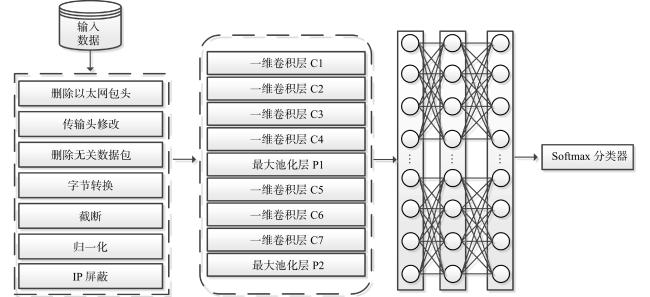
图 3 基于深度学习的加密流量分类模型结构Fig.3 Structure of encryption traffic classification model based on deep learning |
表 1 一维卷积神经网络卷积结构及其参数Table 1 Convolution structure and parameters of one-dimensional convolutional neural networks |
| 卷积层数 | 卷积核尺寸 | 输出维度 | 步长 |
| Conv1D C1 | 5 | 200 | 1 |
| Conv1D C2 | 5 | 200 | 1 |
| Conv1D C3 | 5 | 150 | 1 |
| Conv1D C4 | 5 | 150 | 1 |
| Conv1D C5 | 5 | 150 | 1 |
| Conv1D C6 | 5 | 100 | 1 |
| Conv1D C7 | 5 | 100 | 1 |
表 2 各模型分类评估结果对比Table 2 Comparison of classification evaluation results of each model |
| 模型 | Accuracy | Precision | Recall | F1 |
| SVM | 0.79 | 0.84 | 0.83 | 0.83 |
| KNN | 0.83 | 0.86 | 0.85 | 0.85 |
| MLP | 0.73 | 0.90 | 0.80 | 0.85 |
| RBF | 0.91 | 0.92 | 0.92 | 0.92 |
| ID-CNN | 0.92 | 0.92 | 0.97 | 0.94 |
表 3 ISCX VPN-nonVPN数据集的分类测试结果Table 3 Classification test results of the ISCX VPN-nonVPN dataset |
| 序号 | 标签 | Precision | Recall | F1 |
| 1 | Chat | 0.71 | 0.81 | 0.76 |
| 2 | 0.69 | 0.98 | 0.81 | |
| 3 | File Transfer | 0.99 | 0.95 | 0.97 |
| 4 | Streaming | 0.97 | 0.98 | 0.97 |
| 5 | VoIP | 0.99 | 0.87 | 0.93 |
| 6 | VPN: Chat | 0.73 | 0.99 | 0.84 |
| 7 | VPN: File Transfer | 0.93 | 0.98 | 0.95 |
| 8 | VPN: E-mail | 0.78 | 0.99 | 0.87 |
| 9 | VPN: Streaming | 0.99 | 0.99 | 0.99 |
| 10 | VPN: Torrent | 0.99 | 0.99 | 0.99 |
| 11 | VPN: VoIP | 0.96 | 0.98 | 0.97 |
| Accuracy | 0.92 | |||
表 4 ISCX Tor-nonTor数据集的分类测试结果Table 4 Classification test results of ISCX Tor-nonTor dataset |
| 序号 | 标签 | Precision | Recall | F1 |
| 1 | Chat | 0.78 | 0.95 | 0.86 |
| 2 | 0.98 | 0.98 | 0.98 | |
| 3 | File Transfer | 0.99 | 0.99 | 0.99 |
| 4 | Streaming | 0.98 | 0.93 | 0.95 |
| 5 | VoIP | 0.99 | 0.94 | 0.96 |
| 6 | P2P | 0.99 | 0.98 | 0.98 |
| 7 | Web Browsing | 0.80 | 0.91 | 0.85 |
| 8 | Tor: Chat | 0.81 | 0.99 | 0.89 |
| 9 | Tor: E-mail | 0.95 | 0.99 | 0.97 |
| 10 | Tor: File Transfer | 0.99 | 0.99 | 0.99 |
| 11 | Tor: Streaming | 0.99 | 0.97 | 0.98 |
| 12 | Tor: VoIP | 0.99 | 0.99 | 0.99 |
| 13 | Tor: P2P | 0.99 | 0.98 | 0.98 |
| 14 | Tor: Web Browsing | 0.98 | 0.99 | 0.98 |
| Accuracy | 0.98 | |||
| 1 |
张小翠. 监控阈值模型及报警事件关联规则研究[J]. 中国金融电脑, 2016, (5): 76- 81.
ZHANG X C. Research on monitoring threshold model and alarm event association rules[J]. Financial Computer of China, 2016, (5): 76- 81.
|
| 2 |
郭炜. 基于动态基线的业务运营支撑网异常流量检测研究[C]//第八届中国通信学会学术年会论文集,2011:4.
GUO W. Study on detecting abnormal net flow of business and operation support network based on dynamic baseline[C]//Proceedings of the 8th Annual Conference of China Society of Communications. National Defense Industry Press,2011:4.
|
| 3 |
马艳春, 肖创柏. 基于动态基线分析方法的网络蠕虫检测机制的研究[J]. 华北科技学院学报, 2008, 5 (1): 94- 97,111.
|
| 4 |
刘忏, 张鹏, 王朝晖, 等. 基于均方差算法的铁路信息系统智能监控动态基线技术[J]. 电子技术与软件工程, 2022, (11): 236- 240.
LIU C, ZHANG P, WANG Z H, et al. Intelligent monitoring dynamic baseline technology of railway information system based on mean square error algorithm[J]. Electronic Technology & Software Engineering, 2022, (11): 236- 240.
|
| 5 |
蔡国庆, 刘鹏, 李憧, 等. 政务网站流量安全基线分析研究[J]. 信息安全研究, 2020, 6 (6): 537- 542.
CAI G Q, LIU P, LI C. Research on web traffic security baseline analysis of government website[J]. Journal of Information Security Research, 2020, 6 (6): 537- 542.
|
| 6 |
胡杰, 唐静, 谢仕义. 基于实时动态基线的运行设备多元状态估计方法[J]. 热力发电, 2021, 50 (2): 125- 131.
HU J, TANG J, XIE S Y. Multivariate state estimation technique for equipment running condition using real-time dynamic baseline[J]. Thermal Power Generation, 2021, 50 (2): 125- 131.
|
| 7 |
马玉超. 基于机器学习的动态基线性能时序数据异常检测研究与应用[J]. 中国金融电脑, 2020, (6): 51- 59.
MA Y C. Research and application of anomaly detection in dynamic baseline performance time series data based on machine learning[J]. Financial Computer of China, 2020, (6): 51- 59.
|
| 8 |
李菁菁, 杨校林, 李俊, 等. 基于离群点检测的链路流量细粒度监测[J]. 数据与计算发展前沿, 2021, 3 (6): 142- 150.
LI J J, YANG Y L, LI J, et al. Subtle aberration monitoring of link traffic based on outlier detection[J]. Frontiers of Data and Computing, 2021, 3 (6): 142- 150.
|
| 9 |
FINSTERBUSCH M, RICHTER C, ROCHA E, et al. A survey of payload-based traffic classification approaches[J]. IEEE Communications Surveys & Tutorials, 2013, 16 (2): 1135- 1156.
|
| 10 |
VELAN P, ČERMÁK M, ČELEDA P, et al. A survey of methods for encrypted traffic classification and analysis[J]. International Journal of Network Management, 2015, 25 (5): 355- 374.
|
| 11 |
ARNDT D J,ZINCIR-HEYWOOD A N. A comparison of three machine learning techniques for encrypted network traffic analysis[C]//Proceedings of IEEE symposium on Computational Intelligence for Security and Defense Applications (CISDA),2011:107-114.
|
| 12 |
SHEN M, WEI M, ZHU L, et al. Classification of encrypted traffic with second-order markov chains and application attribute bigrams[J]. IEEE Transactions on Information Forensics and Security, 2017, 12 (8): 1830- 1843.
|
| 13 |
WRIGHT C V, MONROSE F, MASSON G M. On inferring application protocol behaviors in encrypted network traffic[J]. Journal of Machine Learning Research, 2006, 7 (12): 2745- 2769.
|
| 14 |
WANG Z. The applications of deep learning on traffic identification[J]. BlackHat USA, 2015, 24 (11): 1- 10.
|
| 15 |
CHEN Z T,HE K,LI J,et al. Seq2Img:a sequence-to-image based approach towards IP traffic classification using convolutional neural networks[C]//IEEE International Conference on Big Data. IEEE,2017:1271-1276.
|
| 16 |
REZAEI S ,LIU X. How to achieve high classification accuracy with just a few labels:a semi-supervised approach using sampled packets[J]. 2018. DOI:10.48550/arXiv.1812.09761.
|
| 17 |
WANG W,ZHU M,WANG J L,et al. End-to-end encrypted traffic classification with one-dimensional convolution neural networks[C]//2017 IEEE International Conference on Intelligence and Security Informatics (ISI). IEEE,2017:43-48.
|
| 18 |
LOPEZ-MARTIN M, CARRO B, SANCHEZ-ESGUEVILLAS A, et al. Network traffic classifier with convolutional and recurrent neural networks for internet of things[J]. IEEE Access, 2017, 5, 18042- 18050.
|
| 19 |
WANG W, SHENG Y, WANG J, et al. HAST-IDS: learning hierarchical spatial-temporal features using deep neural networks to improve intrusion detection[J]. IEEE Access, 2017, 6, 1792- 1806.
|
| 20 |
HÖCHST J,BAUMGÄRTNER L,HOLLICK M,et al. Unsupervised traffic flow classification using a neural autoencoder[C]//2017 IEEE 42Nd Conference on Local Computer Networks (LCN). IEEE,2017:523-526.
|
| 21 |
LOTFOLLAHI M, JAFARI S M, ZADE S H, et al. Deep packet: A novel approach for encrypted traffic classification using deep learning[J]. Soft Computing, 2020, 24 (3): 1999- 2012.
|
| 22 |
VU L,BUI C T,NGUYEN Q U. A deep learning based method for handling imbalanced problem in network traffic classification[C]//Proceedings of the 8th International Symposium on Information and Communication Technology. 2017:333-339.
|
| 23 |
HOCHREITER S,SCHMIDHUBER J. Long short-term memory[J]. Neural Computation,1997,9(8):1735-1780.
|
| 24 |
KUMANO Y,ATA S,NAKAMURA N,et al. Towards real-time processing for application identification of encrypted traffic[C]//2014 International Conference on Computing,Networking and Communications (ICNC). IEEE,2014:136-140.
|
| 25 |
BAR-YANAI R,LANGBERG M,PELEG D,et al. Realtime classification for encrypted traffic[C]//Proceedings of the 9th International Symposium on (SEA 2010)2010:373-385.
|
| 26 |
GARDNER M W, DORLING S R. Artificial neural networks (the multilayer perceptron): a review of applications in the atmospheric sciences[J]. Atmospheric Environment, 1998, 32 (14-15): 2627- 2636.
|
| 27 |
张晓航, 李政, 朱晓明, 等. 基于RBF神经网络的可信加密流量分类方法[J]. 计算机与现代化, 2022, (2): 45- 51.
ZHANG X H, LI Z, ZHU X M, et al. Trustworthy encryption traffic classification method based on RBF neural network[J]. Computer and Modernization, 2022, (2): 45- 51.
|
/
| 〈 |
|
〉 |