基于复制中位数聚合的拜占庭容错安全分布式矩阵乘法
网络出版日期: 2026-07-09
基金资助
国家自然科学基金(U21B2021, 62472015, 62202027)
版权
Byzantine-resilient secure distributed matrix multiplication based on replicated median aggregation
Online published: 2026-07-09
Supported by
Project supported by the National Natural Science Foundation of China (U21B2021, 62472015, 62202027)
Copyright
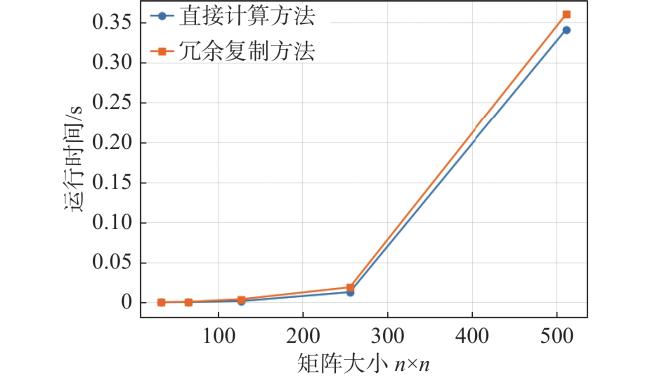
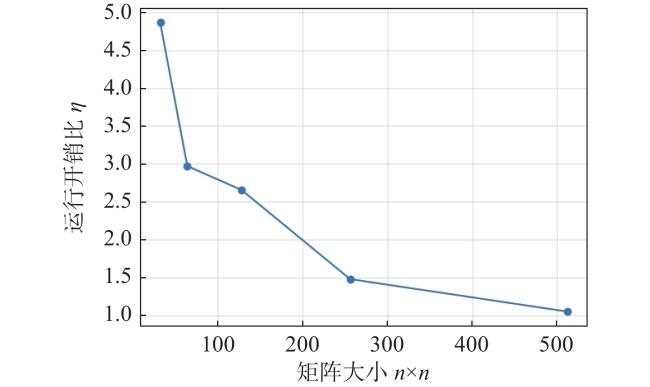
安全分布式矩阵乘法(secure distributed matrix multiplication, SDMM)是解决大规模分布式计算中数据隐私泄露与节点滞后问题的关键技术。然而,现有安全分布式矩阵计算(secure distributed matrix computation, SDMC)的多项式编码框架多基于半诚实安全模型,面对篡改计算结果的拜占庭恶意攻击时,缺乏轻量化的节点识别机制。针对该问题,本文提出一种面向主动结果篡改场景的拜占庭容错验证扩展方案。该方案在依托传统多项式掩码技术实现隐私保护的基础上,引入冗余复制计算策略,结合逐元素中位数鲁棒聚合机制,可有效抵御数据投毒攻击。同时,部署轻量化统计验证层,通过弗罗贝尼乌斯范数偏差评分实现恶意节点的检测与隔离。理论分析证明,在恶意节点数量满足诚实多数阈值约束的条件下,本方案可实现矩阵乘积结果的精准重建。实验结果表明,当矩阵维度由32提升至512时,该方案表现出良好的可扩展性,运行开销比由4.86降至1.06。该方案无需依托复杂的密码学证明机制,可为去中心化云环境下的矩阵乘法运算提供一种高可扩展、可验证的具备拜占庭容错能力的解决方案。
刘怀远 , 刘懿中 , 刘建伟 . 基于复制中位数聚合的拜占庭容错安全分布式矩阵乘法[J]. 网络空间安全科学学报, 2026 , 4(3) : 53 -63 . DOI: 10.20172/j.issn.2097-3136.260620
Secure distributed matrix multiplication (SDMM) is a core technique to solve data privacy leakage and node straggler problems in large-scale distributed computation. Most existing polynomial coding frameworks of secure distributed matrix computation (SDMC) are based on the semi-honest security model and lack lightweight mechanisms to identify Byzantine malicious nodes that tamper with calculation results. To solve this problem, this paper proposes a Byzantine fault-tolerant verification extension scheme for active result tampering scenarios. While retaining the privacy protection capability of the traditional polynomial masking scheme, the proposed scheme introduces a redundant replication strategy and combines it with element-wise robust median aggregation to effectively mitigate data poisoning attacks. Furthermore, it deploys a lightweight statistical verification layer, which detects and isolates malicious nodes through Frobenius norm deviation scores. Theoretical analysis demonstrates that the scheme can realize the accurate reconstruction of matrix products when the number of malicious nodes meets the honest majority threshold condition. Experimental results show that the proposed scheme has excellent scalability when the matrix dimension increases from 32 to 512, and its runtime overhead ratio drops significantly from 4.86 to 1.06. Independent of complex cryptographic proof mechanisms, the proposed scheme provides a highly scalable, verifiable and Byzantine fault-tolerant solution for matrix multiplication operations in decentralized cloud environments.
表 1 不同矩阵规模下的性能开销Table 1 Runtime and overhead across matrix sizes |
| 矩阵规模 | 基准计算开销/ | 冗余计算开销/ | 运行开销比 |
| 32 | 4.86 | ||
| 64 | 2.97 | ||
| 128 | 2.66 | ||
| 256 | 1.48 | ||
| 512 | 1.06 |
| 1 |
Dean J, Ghemawat S. MapReduce: simplified data processing on large clusters[J]. Commun ACM, 2008, 51 (1): 107- 113.
|
| 2 |
Fan X W, Zhang Y F, Zhang T H, et al. Secure and efficient distributed matrix multiplication based on polynomial coding[C]//Proceedings of the 2025 7th International Conference on Next Generation Data-driven Networks (NGDN). Piscataway: IEEE Press, 2025: 332-339.
|
| 3 |
Yu Q, Maddah-Ali M, Avestimehr S. Polynomial codes: an optimal design for high-dimensional coded matrix multiplication[J]. Advances in Neural Information Processing Systems, 2017, 30.
|
| 4 |
Mital N, Ling C, Gündüz D. Secure distributed matrix computation with discrete Fourier transform[J]. IEEE Transactions on Information Theory, 2022, 68 (7): 4666- 4680.
|
| 5 |
Makkonen O, Saçıkara E, Hollanti C. Algebraic geometry codes for secure distributed matrix multiplication[J]. IEEE Transactions on Information Theory, 2025, 71 (4): 2373- 2382.
|
| 6 |
Matthews G L, Soto P. Algebraic geometric rook codes for coded distributed computing[C]//Proceedings of the 2024 IEEE Information Theory Workshop (ITW). Piscataway: IEEE Press, 2024: 717-722.
|
| 7 |
孙钰, 刘霏霏, 李大伟, 等. 联邦学习拜占庭攻击与防御研究综述[J]. 网络空间安全科学学报, 2023, 1 (1): 17- 37.
Sun Y, Liu F F, Li D W, et al. Survey on Byzantine attacks and defenses in federated learning[J]. Journal of Cybersecurity, 2023, 1 (1): 17- 37.
|
| 8 |
Li S H, Ngai E C H, Voigt T. An experimental study of Byzantine-robust aggregation schemes in federated learning[J]. IEEE Transactions on Big Data, 2024, 10 (6): 975- 988.
|
| 9 |
Li C X, Xiao M, Skoglund M. Coded robust aggregation for distributed learning under Byzantine attacks[J]. IEEE Transactions on Information Forensics and Security, 2025, 20, 11636- 11651.
|
| 10 |
Makkonen O, Hollanti C. General framework for linear secure distributed matrix multiplication with Byzantine servers[J]. IEEE Transactions on Information Theory, 2024, 70 (6): 3864- 3877.
|
| 11 |
Hofmeister C, Bitar R, Xhemrishi M, et al. Secure private and adaptive matrix multiplication beyond the singleton bound[J]. IEEE Journal on Selected Areas in Information Theory, 2022, 3 (2): 275- 285.
|
| 12 |
Ghasvarianjahromi S, Yakimenka Y, Kliewer J. Decentralized sparse matrix multiplication under Byzantine attacks[J]. IEEE Transactions on Information Forensics and Security, 2025, 20, 7333- 7346.
|
| 13 |
周一可, 朱友文, 吴启晖. IDumbo: 全流程隐私保护异步拜占庭共识协议[J]. 网络空间安全科学学报, 2025, 3 (2): 49- 58.
Zhou Y K, Zhu Y W, Wu Q H. IDumbo: whole-process privacy-preserving asynchronous Byzantine consensus protocol[J]. Journal of Cybersecurity, 2025, 3 (2): 49- 58.
|
| 14 |
Ning X. Practical secure outsourcing computation in complex cloud environments[C]//Proceedings of the 2025 2nd International Conference on Image Processing, Intelligent Control and Computer Engineering. New York: ACM, 2025: 71-77.
|
| 15 |
Wu D Y, Liang B, Lu Z J, et al. Efficient secure multi-party computation for multi-dimensional arithmetics and its applications[J]. Cryptography, 2025, 9 (3): 50.
|
| 16 |
Wang J Y, Mtibaa A. CoVFeFE: collusion-resilient verifiable computing framework for resource-constrained devices at network edge[C]//Proceedings of the 2024 IEEE 13th International Conference on Cloud Networking (CloudNet). Piscataway: IEEE Press, 2024: 1-9.
|
| 17 |
Duan S, Zhang H, Zhao B. WaterBear: information-theoretic asynchronous BFT made practical[J/OL]. IACR Cryptology ePrint Archive, 2022: 21. https://ia.cr/2022/021.
|
| 18 |
Zhu J B, Tang H X, Li S Z, et al. Generalized Lagrange coded computing: a flexible computation-communication tradeoff for resilient, secure, and private computation[J]. IEEE Transactions on Communications, 2025, 73 (6): 4213- 4227.
|
| 19 |
Makkonen O. New schemes for secure distributed matrix multiplication: cooperative and analog SDMM[D]. Aalto University, 2022.
|
| 20 |
Soto P. Optimal secure coded distributed computation over all fields[PP/OL]. V1. arXiv (2025-04-25)[2025-12-12]. https://doi.org/10.48550/arXiv.2504.18038.
|
| 21 |
Severinson L A. Straggler-resilient distributed computing[D]. Gothenburg: Chalmers University of Technology, 2022.
|
| 22 |
Liu T, Huang Z, Li J A, et al. SoK: opportunities for accelerating multi - party computation via trusted hardware[C]//Proceedings of the 2024 International Symposium on Secure and Private Execution Environment Design (SEED). Piscataway: IEEE Press, 2024: 143-154.
|
/
| 〈 |
|
〉 |