基于大语言模型辅助的智能文本隐写传输方法
网络出版日期: 2026-05-25
基金资助
国家自然科学基金(U22B2062,62571240);东南大学移动通信全国重点实验室开放研究基金资助课题(2026D06);江苏省前沿引领技术基础研究重大项目(BK20222001)
版权
Large Language Model-Assisted Intelligent Text Steganography Transmission Method
Online published: 2026-05-25
Copyright
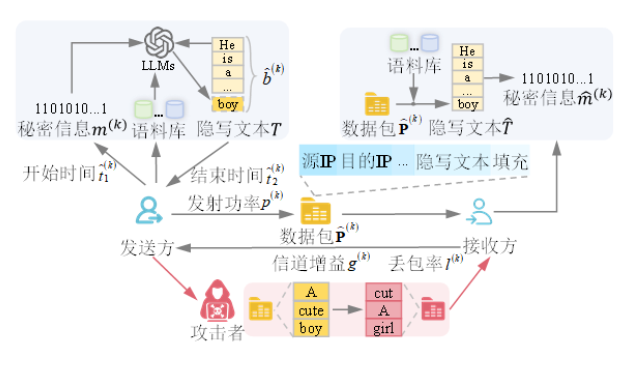
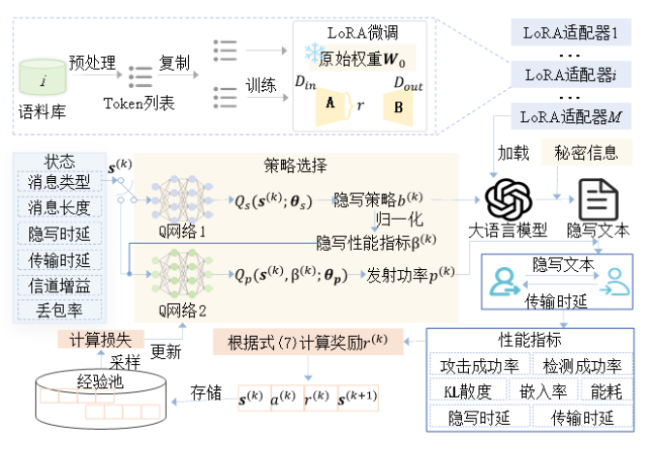
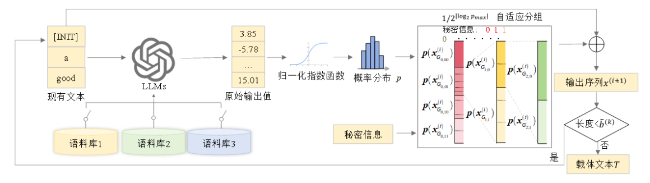
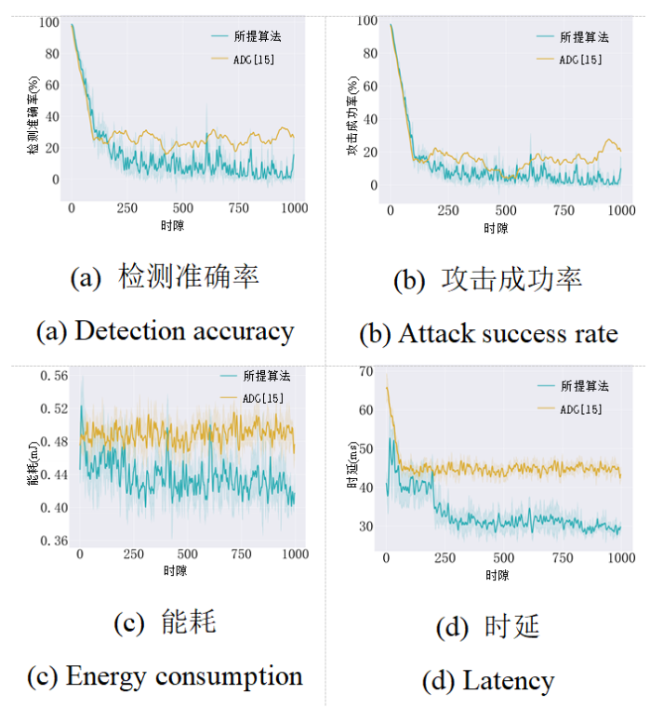
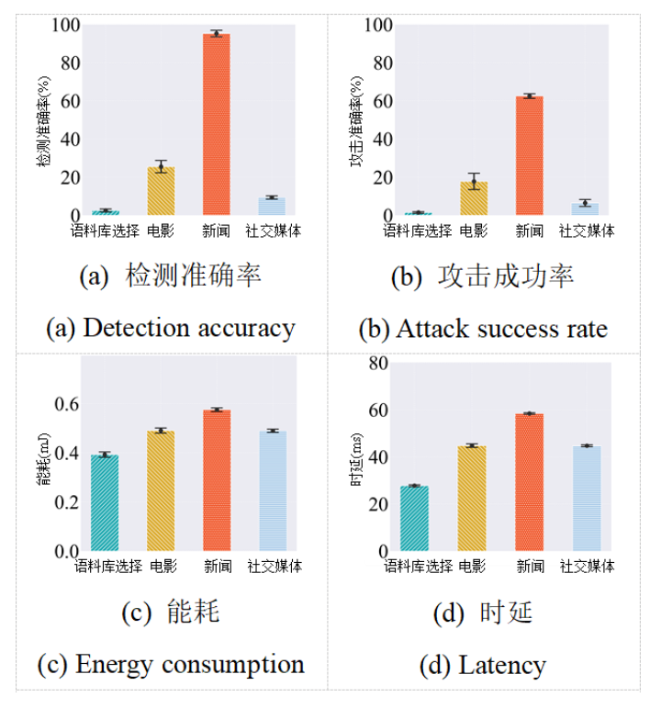
生成式文本隐写主要利用语言模型来生成隐写文本,然而,以往的方法通常在单一语料库上训练并生成随机长度的隐写文本,导致隐写文本的风格和长度无法适应变化的消息类型和信道条件。为此,提出了一种基于大语言模型辅助的智能文本隐写传输方法,可以有效降低隐写文本的传输开销。首先,利用多种语料库对大语言模型进行参数微调,得到适配不同语料风格的适配器。在隐写阶段,根据微调后的大语言模型给出的词元概率分布,通过自适应动态分组选择词元,递归地嵌入秘密信息。其次,设计了双智能体强化学习框架,基于实时信道状态和攻击成功率等安全指标,实现了自适应优化隐写策略,包括语料库的类型和输出的句子长度,并实现了发射功率的选择。该方法综合考虑了隐写安全需求和实际传输环境,构建奖励函数评估所选策略的优劣,用于指导隐写策略和发射功率的选取,实现隐蔽性与传输鲁棒性的平衡。结果表明,相较于直接使用自适应动态分组算法进行传输,所提方法在保持相近嵌入率与信息散度的前提下,时延降低了38.5%,攻击成功率降低至0.83%。
戴俊浩 , 吴怡 , 卢晓珍 , 任德翔 . 基于大语言模型辅助的智能文本隐写传输方法[J]. 网络空间安全科学学报, 2026 : 1 -10 . DOI: 10.20172/j.issn.2097-3136.260523
Generative text steganography primarily utilizes language models to generate steganographic text, however, previous methods typically trained on a single corpus, generated steganographic texts of random lengths, failing to adapt to varying message types and channel conditions. To address this, we proposed a large language model-assisted intelligent text steganographic transmission method to reduce transmission overhead. We parameter-efficiently fine-tuned a large language model on multiple corpora to obtain adapters for different corpus styles, and using the model's token probability distribution, recursively embedded secret information via adaptive dynamic grouping. We then designed a dual-agent reinforcement learning framework that adaptively optimizes the steganographic strategy—including corpus type and sentence length—and selects transmission power based on real-time channel state and security indicators such as attack success rate. This method considered both steganographic security and the transmission environment, constructed a reward function to evaluate each strategy, and guided strategy and power selection to balance concealment and robustness. The results showed that, compared to direct use of adaptive dynamic grouping, our method reduced delay by 38.5% and attack success rate to 0.83%, while maintaining similar embedding rates and information divergence. Consequently, the proposed method achieves a good balance between stealthiness and transmission robustness under varying channel conditions and message types.
Key words: Text Steganography; Large Language Model; Reinforcement Learning
| 算法1 基于大语言模型的生成式文本隐写方法 |
| 输入:上下文 1)根据语料库类型 2)调用大语言模型获取概率分布 3)计算最大概率 4)根据式(10)计算分组数量 5)初始化分组 6) For 7) 根据式(11)计算目标阈值 8) 9) 根据式(12)选择token 10) 从 11)将 12)初始化token序列 13) For 14) 将二进制块转换成分组索引 15) 根据式(13)计算约束概率 16) 根据式(14)选择词元 17) 将 18)反令牌化 19)输出隐写文本 |
| 算法2 基于大语言模型辅助的智能文本隐写传输方法 |
| 输入:每轮训练的时隙数 初始化:上层Q网络 1)For 2) 观测当前状态 3) 隐写策略智能体根据式(9)选择隐写子策略 4) 调用算法1生成隐写文本 5) 根据隐写策略构造扩展状态 6) 功率选择智能体根据式(15)选择发射功率 7) 以功率 8) 获取 9) 根据式(7)计算奖励 10) 观测下一状态 11) 将经验存入经验回放缓冲池 12) 采样并参数更新 |
表 3 发射功率消融实验Table 3 Ablation study of transmission power |
| 方法 | 时延(ms) | 攻击成功率(%) | 检测准确率(%) |
| 固定功率-24dbm | 48.80 | 8.74 | 20.16 |
| 自适应功率 | 27.71 | 0.83 | 4.13 |
| 1 |
吴国华, 龚礼春, 袁理锋, 等. 中文文本信息隐藏研究进展[J]. 通信学报, 2019, 40 (9): 145- 156.
WU G H, GONG L C, YUAN L F, et al. Review of information hiding on Chinese text[J]. Journal on Communications, 2019, 40 (9): 145- 156.
|
| 2 |
张卫明, 陈可江, 俞能海. 可证安全隐写: 理论、应用与展望[J]. 网络空间安全科学学报, 2023, 1 (1): 38- 46.
Zhang W M, CHEN K J, YU N H. Provable Secure Steganography: Theory, Application and Prospects[J]. Journal of Cybersecurity, 2023, 1 (1): 38- 46.
|
| 3 |
梅佳蒙, 任延珍, 王丽娜. 安全性可控的生成式文本隐写算法[J]. 网络与信息安全学报, 2022, 8 (3): 53- 65.
Mei J M, REN Y Z, WANG L N. Generation -based linguistic steganography with controllable security[J]. Chinese Journal of Network and Information Security, 2022, 8 (3): 53- 65.
|
| 4 |
DAI W H, YU Y, DAI Y H, et al. Text steganography system using Markov chain source model and DES algorithm[J]. Journal of Software, 2010, 5, 785- 792.
|
| 5 |
Zhou X J, Peng W L, Yang B Y, et al. Linguistic steganography based on adaptive probability distribution[J]. IEEE Transactions on Dependable and Secure Computing, 2022, 19 (5): 2982- 2997.
|
| 6 |
Yang Z L, Wang K, Li J, et al. TS-RNN: text steganalysis based on recurrent neural networks[J]. IEEE Signal Processing Letters, 2019, 26 (12): 1743- 1747.
|
| 7 |
FANG T, JAGGI M, ARGYRAKI K. Generating steganographic text with LSTMs[C]//Proc of the ACL 2017 Student Research Workshop. Vancouver, Canada: Association for Computational Linguistics, 2017: 100-106.
|
| 8 |
DING J Y, CHEN K J, WANG Y F, et al. Discop: provably secure steganography in practice based on “distribution copies”[C]//Proc of the 2023 IEEE Symposium on Security and Privacy (SP). San Francisco, CA, USA: IEEE, 2023: 2238-2255.
|
| 9 |
Wu, J X, Wu Z X, Xue Y M, et al. Generative Text Steganography with Large Language Model[C]// Proc of the 32nd ACM International Conference on Multimedia. New York: ACM, 2024.
|
| 10 |
CHAPMAN M, DAVIDA G. Hiding the hidden: a software system for concealing ciphertext as innocuous text[C]//Proc of the International Conference on Information and Communications Security. Berlin: Springer, 1997: 335-345.
|
| 11 |
BENGIO Y, DUCHARME R, VINCENT P, et al. A neural probabilistic language model[J]. Journal of Machine Learning Research, 2003, 3, 1137- 1155.
|
| 12 |
YANG Z L, GUO X Q, CHEN Z M, et al. RNN-stega: linguistic steganography based on recurrent neural networks[J]. IEEE Transactions on Information Forensics and Security, 2018, 14 (5): 1280- 1295.
|
| 13 |
Yan R Y, Yang Y T, Song T. A Secure and Disambiguating Approach for Generative Linguistic Steganography[J]. IEEE Signal Processing Letters, 2023, 30, 1047- 1051.
|
| 14 |
Xiang L Y, Ou C F, He X, et al. A Content-Preserving Secure Linguistic Steganography [C]//Proc of the AAAI Conference on Artificial Intelligence, 40(42), 35885-35893.
|
| 15 |
Zhang S Y, Yang Z L, Yang J S, et al. Provably Secure Generative Linguistic Steganography[C]// Findings of the Association for Computational Linguistics: ACL-IJCNLP, 2021: 3046-3055.
|
| 16 |
向凌云, 杨双辉, 王蓉, 等. 基于序列到隐写序列的约束型自然语言信息隐藏方法[J]. 计算机学报, 2023, 46 (08): 1650- 1669.
Xiang L Y, Yang S R, W R, et al. Constrained Linguistic Steganography Based on Sequence to Steganographic Sequence Model[J]. Chinese Journal of Computers, 2023, 46 (08): 1650- 1669.
|
| 17 |
金家立, 马卫娇, 李晖, 等. 基于Transformer神经机器翻译的文本隐写方法[J]. 计算机应用与软件, 2025, 42 (5): 381- 386.
Jin J L, Ma W J, Li H, et al. Text Steganography Method Based on Transformer Neural Machine Translation[J]. Computer Applications and Software, 2025, 42 (5): 381- 386.
|
| 18 |
LUO Y B, HUANG Y F. Text steganography with high embedding rate: using recurrent neural networks to generate Chinese classic poetry[C]//Proc of the 5th ACM Workshop On Information Hiding and Multimedia Security. New York: ACM Press, 2017: 99-104.
|
| 19 |
刘玉玲, 王翠林, 付章杰. 语义空间下基于情感表达的生成式文本隐写方法[J]. 通信学报, 2023, 44 (4): 176- 186.
Liu Y L, WANG C L, FU Z J. Generative text steganography method based on emotional expression in semantic space[J]. Journal on Communications, 2023, 44 (4): 176- 186.
|
| 20 |
Ziegler Z, Deng Y T, Rush A. Neural Linguistic Steganography[C]//Proc of the 2019 Conference on Empirical Methods in Natural Language Processing and the 9th International Joint Conference on Natural Language Processing. Hong Kong, China: Association for Computational Linguistics, 2019: 1210-1215.
|
| 21 |
李晖, 金家立, 金纾羽, 等. 基于自动选择编码及动态选词策略的文本隐写方法[J]. 通信学报, 2022, 43 (9): 240- 253.
LI H, JIN J L, JIN S Y, et al. Text steganography method based on automatic selection coding and dynamic word selection strategy[J]. Journal on Communications, 2022, 43 (9): 240- 253.
|
| 22 |
Li X X, Wang Z C, Zhang X P. Black-Box Steganography for Large Language Models[J]. IEEE Transactions on Circuits and Systems for Video Technology, 2025, 35 (11): 11698- 11707.
|
| 23 |
孙雄韬, 刘干, 李怡然, 等. 文本隐私感知与保护研究综述[J]. 网络空间安全科学学报, 2023, 1 (2): 2- 21.
SUN X T, LIU G, LI Y R, et al. Survey of Text Privacy Perception and Protection[J]. Journal of Cybersecurity, 2023, 1 (2): 2- 21.
|
| 24 |
Luong N C, Hoang D T, Gong S M, et al. Applications of Deep Reinforcement Learning in Communications and Networking: A Survey[J]. IEEE Communications Surveys & Tutorials, 2019, 21 (4): 3133- 3174.
|
| 25 |
LU X Z, XIAO L, XU T W, et al. Reinforcement learning based PHY authentication for VANETs[J]. IEEE Transactions on Vehicular Technology, 2020, 69 (3): 3068- 3079.
|
| 26 |
XIAO L, LU X Z, XU T W, et al. Reinforcement learning-based physical-layer authentication for controller area networks[J]. IEEE Transactions on Information Forensics and Security, 2021, 16, 2535- 2547.
|
| 27 |
XU T W, LU X Z, XIAO L, et al. Voltage based authentication for controller area networks with reinforcement learning[C]//Proc of the IEEE International Conference on Communications. IEEE, 2019: 1-5.
|
| 28 |
刘子涵, 贾玲如, 卢晓珍, 等. 基于强化学习的无人机轻量化身份认证方法[J]. 网络空间安全科学学报, 2025, 3 (4): 16- 28.
LIU Z H, JIA L R, LU X Z, et al. Lightweight authentication approach for unmanned aerial vehicles based on reinforcement learning[J]. Journal of Cybersecurity, 2025, 3 (4): 16- 28.
|
| 29 |
Wang Y N, Chen M Z, Saad W, et al. Performance Optimization for Semantic Communications: An Attention-based Learning Approach[C]//2021 IEEE Global Communications Conference (GLOBECOM), Madrid, Spain, 2021: 1-6.
|
| 30 |
钟天尧, 姚欢, 冯智斌, 等. 任务场景驱动的无线通信跨层智能适变方法[J]. 通信学报, 2026, 47 (02): 61- 72.
Zhong T Y, Yao H, Feng Z B, et al. Task scenario-driven cross-layer intelligent adaptation approaches for wireless communication[J]. Journal on Communications, 2026, 47 (02): 61- 72.
|
| 31 |
Gao X Y, Yin H, Sun Y P, et al. Multilevel Feature Transmission in Dynamic Channels: A Semantic Knowledge Base and Deep-Reinforcement -Learning-Enabled Approach[J]. IEEE Internet of Things Journal, 2025, 12 (8): 10150- 10162.
|
| 32 |
吉立建, 林伟伟, 段超, 等. AI驱动的自适应网络安全测评框架研究[J]. 网络空间安全科学学报, 2025, 3 (5): 61- 72.
Ji L J, Lin W W, Duan C, et al. Towards an AI-driven adaptive framework for cybersecurity assessment[J]. Journal of Cybersecurity, 2025, 3 (5): 61- 72.
|
| 33 |
刘双成, 李思民, 李海南, 等. 面向无人机群多智能体强化学习的对抗仿真平台与攻防验证[J]. 网络空间安全科学学报, 2023, 1 (2): 93- 111.
LIU S C, LI S M, LI H N, et al. Simulation Platform and Attack and Defense Verification for Adversarial Multi-Agent Reinforcement Learning in UAV Swarms[J]. Journal of Cybersecurity, 2023, 1 (2): 93- 111.
|
/
| 〈 |
|
〉 |