基于异构图注意力网络与跨类型蒸馏的生成式恶意流量检测模型
网络出版日期: 2026-05-06
基金资助
国家自然科学基金(62102049);四川省自然科学基金(2025ZNSFSC0507);先进密码技术与系统安全四川省重点实验室开放基金(SKLACSS-202402)
版权
Generative malicious traffic dectection model based on heterogeneous graph attention network and cross-type distillation
Online published: 2026-05-06
Copyright
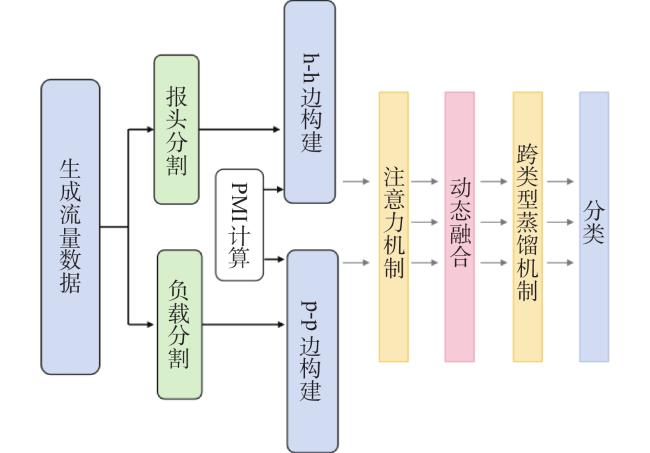
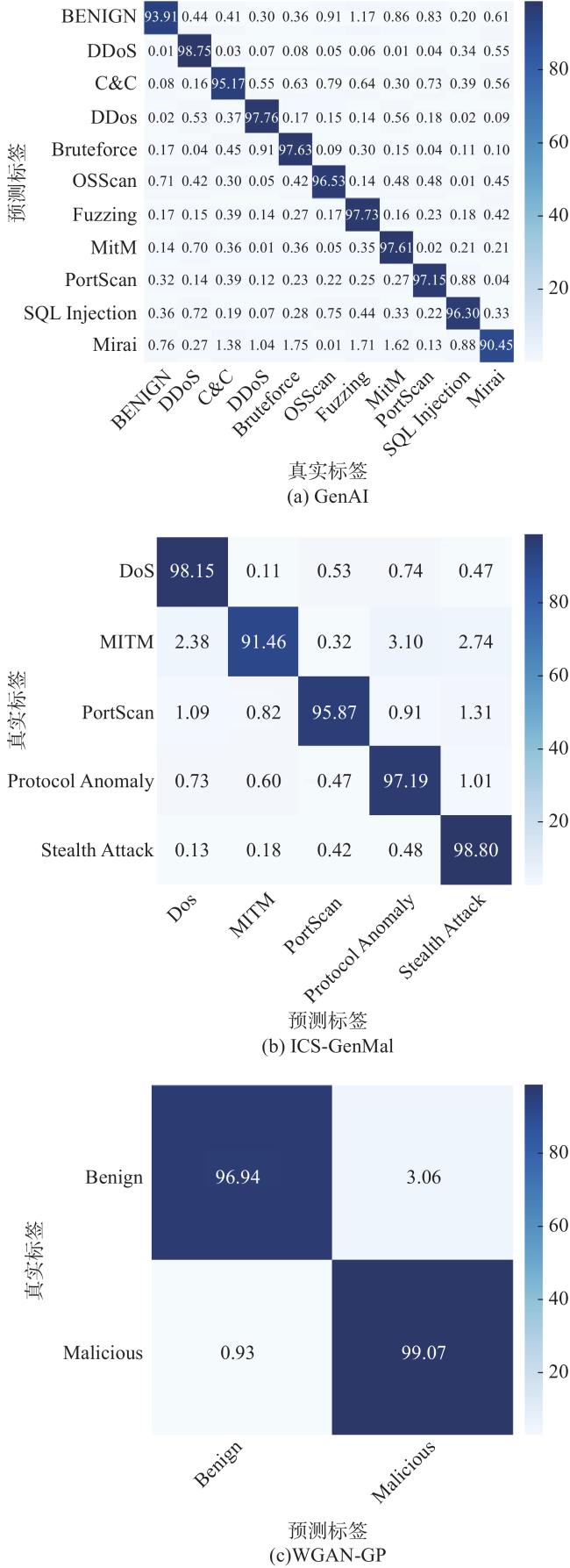
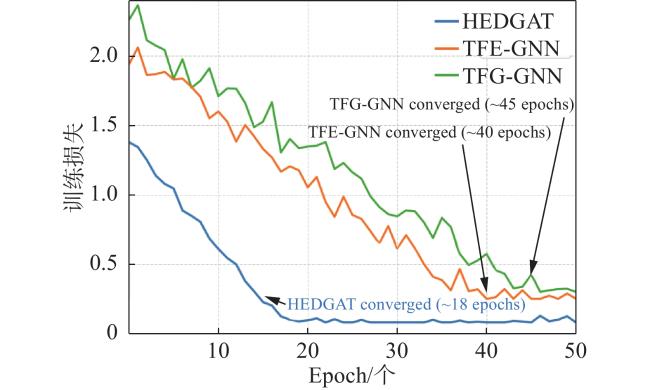
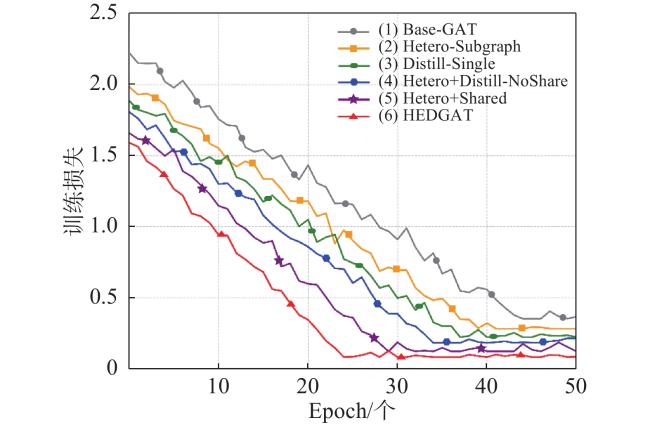
随着网络安全威胁的不断升级,生成式恶意流量的检测已成为网络安全领域的核心挑战。生成式流量通过人工智能技术模拟真实网络行为,增加了恶意流量隐藏的复杂性,使传统检测方法面临失效风险。图神经网络凭借其强大的结构建模能力,在捕获生成式流量字节单元间的复杂关联模式方面展现出显著潜力。然而,传统同构图建模方法难以全面刻画生成式流量中头部与负载之间的多维异构关系。异构图神经网络虽能应对此类复杂性,但独立边类型建模导致参数冗余和训练开销激增,且缺乏边类型间的协同知识传递机制。为此,提出了一种跨类型蒸馏机制,通过构建统一的结构表示路径,实现异构边类型间的双向知识传递,打破传统异构图神经网络的“信息孤岛”效应,显著提升弱语义边的特征表达能力。在此基础上,设计了一种轻量化生成式恶意流量检测模型——HEDGAT(Heterogeneous Edge-aware Distilled Graph Attention Model)。该模型采用边类型权重共享机制,将多种边类型的传播权重压缩至统一表示空间,并融入图注意力计算,大幅降低训练时间,同时保留感知结构差异的能力。基于异构图框架,HEDGAT能够精确刻画字节单元间及头部与负载间的复杂依赖关系,结合动态融合机制生成全面的流量表示。在多个生成式流量数据集上的包级和流级分类实验表明,HEDGAT在检测准确率、训练效率和模型参数规模方面均优于现有方法,展现出性能和轻量化优势。
余坤 , 卢嘉中 , 张峰 , 刘小垒 . 基于异构图注意力网络与跨类型蒸馏的生成式恶意流量检测模型[J]. 网络空间安全科学学报, 2025 , 3(6) : 68 -79 . DOI: 10.20172/j.issn.2097-3136.250605
With the increasing severity of cybersecurity threats, encrypted traffic dectection has become a core challenge in the field of network security. Graph neural networks, with their powerful structural modeling capabilities, have shown significant potential in capturing complex correlation patterns among encrypted traffic byte units. However, traditional homogeneous graph modeling methods struggle to comprehensively characterize the multidimensional heterogeneous relationships between headers and payloads in encrypted traffic. While heterogeneous graph neural networks can address such complexity, independent edge-type modeling leads to parameter redundancy and a sharp increase in training overhead, coupled with a lack of collaborative knowledge transfer mechanisms between edge types. To address this, this paper proposes a cross-type distillation mechanism that constructs a unified structural representation path to enable bidirectional knowledge transfer between heterogeneous edge types, breaking the information silo effect of traditional heterogeneous graph neural network and significantly enhancing the feature expression capability of weak semantic edges. Building on this, this paper designs a lightweight malicious traffic detection model, HEDGAT (Heterogeneous Edge-aware Distilled Graph Attention Model). This model employs an edge-type weight-sharing mechanism to compress the propagation weights of multiple edge types into a unified representation space, integrating graph attention computation to significantly reduce training time while preserving the ability to perceive structural differences. Based on a heterogeneous graph framework, HEDGAT can precisely capture complex dependencies between byte units and between headers and payloads, combining a dynamic fusion mechanism to generate comprehensive traffic representations. Packet-level and flow-level classification experiments on multiple encrypted traffic datasets demonstrate that HEDGAT outperforms existing methods in classification accuracy, training efficiency, and model parameter scale, exhibiting superior performance and lightweight advantages.
表 1 模型在3个数据集上的性能对比Table 1 Performance comparison of the models on 3 datasets |
| 数据集 | 模型 | 准确率 | F1 | 收敛epoch |
| GenAI | AppScanner | 70.5% | 70.6% | 42 |
| BFCN | 96.8% | 96.7% | 40 | |
| ATVITSC | 91.9% | 91.5% | 39 | |
| CMTSNN | 92.5% | 91.3% | 40 | |
| METAROCKETC | 96.7% | 94.8% | 33 | |
| TFE-GNN | 95.2% | 95.3% | 37 | |
| TFG-GNN | 96.5% | 96.8% | 34 | |
| HEDGAT | 98.1% | 98.1% | 28 | |
| ICS- GenMal | AppScanner | 66.8% | 65.5% | 48 |
| BFCN | 96.5% | 97.1% | 35 | |
| ATVITSC | 94.2% | 92.8% | 31 | |
| CMTSNN | 93.1% | 91.6% | 41 | |
| METAROCKETC | 96.6% | 96.5% | 36 | |
| TFE-GNN | 95.3% | 94.8% | 39 | |
| TFG-GNN | 96.0% | 95.6% | 34 | |
| HEDGAT | 97.9% | 98.0% | 26 | |
| WGAN-GP | AppScanner | 70.2% | 71.8% | 46 |
| BFCN | 97.3% | 96.8% | 32 | |
| ATVITSC | 96.9% | 96.7% | 32 | |
| CMTSNN | 94.0% | 93.8% | 39 | |
| METAROCKETC | 96.6% | 96.2% | 37 | |
| TFE-GNN | 95.1% | 94.9% | 38 | |
| TFG-GNN | 95.8% | 95.7% | 32 | |
| HEDGAT | 98.1% | 98.1% | 27 |
表 2 各模型在3个数据集上的训练效率对比Table 2 Training efficiency comparison of different models on 3 datasets |
| 数据集 | 模型 | 单epoch训练时间/s | 全量数据训练 总耗时 /min |
| GenAI | AppScanner | 33 | 23 |
| BFCN | 35 | 23 | |
| ATVITSC | 39 | 25 | |
| CMTSNN | 57 | 38 | |
| METAROCKETC | 45 | 25 | |
| TFE-GNN | 38 | 23 | |
| TFG-GNN | 34 | 19 | |
| HEDGAT | 35 | 16 | |
| ICS- GenMal | AppScanner | 97 | 77 |
| BFCN | 84 | 49 | |
| ATVITSC | 88 | 45 | |
| CMTSNN | 96 | 66 | |
| METAROCKETC | 92 | 55 | |
| TFE-GNN | 96 | 62 | |
| TFG-GNN | 90 | 51 | |
| HEDGAT | 87 | 38 | |
| WGAN-GP | AppScanner | 67 | 51 |
| BFCN | 65 | 35 | |
| ATVITSC | 73 | 39 | |
| CMTSNN | 88 | 57 | |
| METAROCKETC | 69 | 43 | |
| TFE-GNN | 79 | 50 | |
| TFG-GNN | 74 | 39 | |
| HEDGAT | 70 | 32 |
表 3 各模型在不同场景下的性能结果Table 3 Performance results of different models on different scenarios |
| 模型名称 | 噪声干扰 准确率 | 噪声干 扰损失 | 数据不平 衡F1分数 |
| Base-GAT | 89.5% | 0.42 | 0.87 |
| Hetero-Subgraph | 90.7% | 0.36 | 0.89 |
| Distill-Single | 91.2% | 0.34 | 0.90 |
| Hetero+Distill-NoShare | 91.5% | 0.30 | 0.91 |
| Hetero+Shared | 92.6% | 0.25 | 0.92 |
| HEDGAT | 94.5% | 0.12 | 0.95 |
| 1 |
Scarselli F, Gori M, Tsoi A C, et al. The graph neural network model[J]. IEEE Transactions on Neural Networks, 2009, 20 (1): 61- 80.
|
| 2 |
Zhang C X, Song D J, Huang C, et al. Heterogeneous graph neural network[C]//Proceedings of the 25th ACM SIGKDD International Conference on Knowledge Discovery & Data Mining. New York: ACM, 2019: 793-803.
|
| 3 |
Liu Y, Wang X, Qu B, et al. ATVITSC: a novel encrypted traffic classification method based on deep learning[J]. IEEE Transactions on Information Forensics and Security, 2024, 19, 9374- 9389.
|
| 4 |
胡斌, 周志洪, 姚立红, 李建华等, 结合报文负载与流指纹特征的恶意流量检测[J]. 计算机工程, 2020, 46(11): 157-163.
Hu B, Zhou Z H, Yao L H, Li J H, et al. Malicious traffic detection combining packet payload and flow fingerprint features[J]. Computer Engineering, 2020, 46(11): 157-163.
|
| 5 |
Lu J Z, Zhang W S, Hamzei M, et al. The applications of machine learning mechanisms in the compositions of Internet of Things services: a systematic study, current progress, and future research agenda[J]. Engineering Applications of Artificial Intelligence, 2025, 147, 110345.
|
| 6 |
Zhu S Z, Xu X L, Gao H H, et al. CMTSNN: a deep learning model for multiclassification of abnormal and encrypted traffic of Internet of things[J]. IEEE Internet of Things Journal, 2023, 10 (13): 11773- 11791.
|
| 7 |
Li X H, Xu M F, Vijayakumar P, et al. Detection of low-frequency and multi-stage attacks in industrial Internet of things[J]. IEEE Transactions on Vehicular Technology, 2020, 69 (8): 8820- 8831.
|
| 8 |
Rey V, Sánchez P M, Huertas C A, et al. Federated learning for malware detection in IoT devices[J]. Computer Networks, 2022, 204, 108693.
|
| 9 |
Niktabe S, Lashkari A H, Roudsari A H. Unveiling DoH tunnel: toward generating a balanced DoH encrypted traffic dataset and profiling malicious behavior using inherently interpretable machine learning[J]. Peer-to-Peer Networking and Applications, 2024, 17 (1): 507- 531.
|
| 10 |
Lu J Z, Wang C L, Huang Y Y, et al. An adversarial example defense algorithm for intelligent driving[J]. IEEE Network, 2024, 38 (6): 98- 105.
|
| 11 |
程华, 谢金鑫, 陈立皇. 基于CNN的加密C&C通信流量识别方法[J]. 计算机工程, 2019, 45 (8): 31- 34,41.
Cheng H, Xie J X, Chen L H. CNN-based encrypted C & C communication traffic identification method[J]. Computer Engineering, 2019, 45 (8): 31- 34,41.
|
| 12 |
Kan H, Ren R. Research on data feature processing and detection of encrypted malicious traffic in graph neural networks[J]. International Journal of Network Security, 2024, 26 (6): 985- 991.
|
| 13 |
蒋彤彤, 尹魏昕, 蔡冰, 等. 基于层次时空特征与多头注意力的恶意加密流量识别[J]. 计算机工程, 2021, 47 (7): 101- 108.
Jiang T T, Yin W X, Cai B, et al. Encrypted malicious traffic identification based on hierarchical spatiotemporal feature and multi-head attention[J]. Computer Engineering, 2021, 47 (7): 101- 108.
|
| 14 |
Zhang H Z, Yue H D, Xiao X, et al. Revolutionizing encrypted traffic classification with MH-net: a multi-view heterogeneous graph model[J]. Proceedings of the AAAI Conference on Artificial Intelligence, 2025, 39 (1): 1048- 1056.
|
| 15 |
Zhao J J, Cui Z W, Fu J S, et al. A unified framework for robust encrypted malicious traffic detection in adverse environments via graph structure learning[J]. IEEE Transactions on Network Science and Engineering, 2026, 13, 245- 261.
|
| 16 |
Zha C, Wang Z Y, Fan Y F, et al. DM-IDS: a network intrusion detection method based on dual-modal fusion[J]. IEEE Transactions on Network and Service Management, 2025, 22 (4): 3646- 3661.
|
| 17 |
Wang M L, Zhang B W, Zang X D, et al. Malicious traffic classification via edge intelligence in IIoT[J]. Mathematics, 2023, 11 (18): 3951.
|
| 18 |
Ullah S, Boulila W, Koubâa A, et al. MAGRU-IDS: a multi-head attention-based gated recurrent unit for intrusion detection in IIoT networks[J]. IEEE Access, 2023, 11, 114590- 114601.
|
| 19 |
Bovenzi G, Ciuonzo D, Krolikowski J, et al. Lightweight GenAI for network traffic synthesis: fidelity, augmentation, and classification[PP]. arXiv preprint arXiv: 2603. 25507, 2026.
|
| 20 |
Aceto G, Giampaolo F, Guida C, et al. Synthetic and privacy-preserving traffic trace generation using generative AI models for training network intrusion detection systems[J]. Journal of Network and Computer Applications, 2024, 229, 103926.
|
| 21 |
Taylor V F, Spolaor R, Conti M, et al. Robust smartphone app identification via encrypted network traffic analysis[J]. IEEE Transactions on Information Forensics and Security, 2018, 13 (1): 63- 78.
|
/
| 〈 |
|
〉 |