面向信息系统抗复杂攻击评测的网络安全知识图谱嵌入方法
网络出版日期: 2026-04-01
基金资助
国家重点研发计划(2024YFB3109603);深圳市科技计划重大专项(KJZD20231023094701003)
版权
Cybersecurity knowledge graph embedding method for security assessment of information systems under complex attacks
Online published: 2026-04-01
Copyright
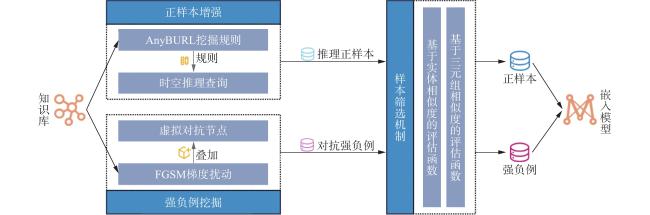
针对高级持续性威胁(Advanced Persistent Threat,APT)等复杂攻击场景下信息系统安全评测面临的挑战,提出了一种融合逻辑规则推理与对抗学习的网络安全知识图谱嵌入方法。该方法基于AnyBURL工具从复杂攻击知识图谱中挖掘逻辑规则,并推理生成语义一致的正样本,以缓解正样本稀缺问题;同时引入对抗样本生成机制,在决策边界附近动态构造强负例,为模型优化提供更具判别性的训练信号。为保障样本的可靠性,该方法设计了一种基于相似度的样本筛选策略,对候选样本进行综合评估。实验结果表明,该嵌入方法在复杂攻击行为预测方面显著优于现有方法,平均倒数排名(Mean Reciprocal Rank, MRR)达到 0.571,Hits@10达到 0.663,分别较基线模型提升了 39.6% 和 21.9%。因此,该方法能够有效提升复杂攻击路径的表示与推理能力,为复杂攻击场景下的信息系统安全评测提供可靠支撑。
关键词: 信息系统安全评测; 复杂网络攻击; 网络安全知识图谱嵌入; 逻辑规则挖掘; 对抗样本
谢禹舜 , 马洁 , 张昊迪 , 李鉴明 , 王泽世 , 江昊 , 王帅 . 面向信息系统抗复杂攻击评测的网络安全知识图谱嵌入方法[J]. 网络空间安全科学学报, 2025 , 3(5) : 48 -60 . DOI: 10.20172/j.issn.2097-3136.250505
To address the challenge of evaluating the security of information systems under complex attacks, such as Advanced Persistent Threat (APT), a cybersecurity knowledge graph embedding method integrating logical rule reasoning with adversarial learning is proposed. Specifically, logical rules are mined from the complex attack knowledge graph by leveraging the AnyBURL tool, and semantically consistent positive samples are inferred accordingly, thereby mitigating the problem of positive sample sparsity. In parallel, an adversarial example generation mechanism is introduced to dynamically construct hard negative samples near the decision boundary, so that more discriminative gradient signals can be received by the model during training. To further ensure the sample’s reliability, a similarity-based sample filtering strategy is designed to comprehensively evaluate candidate samples. Experimental results demonstrate that the proposed method significantly outperforms existing baseline models in complex attack behavior prediction, with a Mean Reciprocal Rank (MRR) of 0.571 and Hits@10 of 0.663 achieved, corresponding to improvements of 39.6% and 21.9%, respectively. These results indicate that the representation and reasoning ability of complex attack paths can be effectively enhanced by the proposed method. Moreover, reliable support is provided for the security evaluation of information systems under complex attack scenarios.
| 算法1 KGE-Cyber的训练流程 |
| 输入 知识图谱 输出 训练样本 1. 初始化; 2. 依据式 (3) 从知识图谱 3. 对任意 4. // 步骤 1:正样本增强 5. 基于逻辑规则 6. 选取置信度大于 7. // 步骤 2:强负例挖掘 8. 依据式 (5) 计算对抗扰动 9. 依据式 (6) 生成对抗强负例 10. // 步骤 3:样本筛选机制 11. 依据式 (7) 和式 (8),分别计算 12. 保留相似度得分大于 13. 循环结束。 |
表 1 5个知识库的统计信息Table 1 Statistical details of five knowledge bases |
| 知识库 | 实体/个 | 关系/种 | 三元组/条 |
| Cyber-Base-KG | 4 | ||
| Cyber-KG | 5 | ||
| Cyber-Infer-KG | 5 | ||
| Film-KG | 5 | ||
| Book-KG | 381 | 98 | 344 |
表 2 KGE-Cyber和对比方法的实验结果Table 2 Experimental results of KGE-Cyber and comparison methods |
| 模型 | Cyber-Base-KG | Cyber-KG | Cyber-Infer-KG | Film-KG | Book-KG | |||||||||
| MRR | Hits@10 | MRR | Hits@10 | MRR | Hits@10 | MRR | Hits@10 | MRR | Hits@10 | |||||
| TransE[18] | 0.173 | 0.355 | 0.185 | 0.374 | 0.181 | 0.367 | 0.164 | 0.321 | 0.125 | 0.389 | ||||
| TransH[19] | 0.192 | 0.381 | 0.211 | 0.397 | 0.205 | 0.391 | 0.187 | 0.370 | 0.142 | 0.403 | ||||
| DistMult[23] | 0.133 | 0.189 | 0.145 | 0.201 | 0.142 | 0.192 | 0.047 | 0.082 | 0.085 | 0.136 | ||||
| ComplEx[24] | 0.147 | 0.228 | 0.156 | 0.235 | 0.153 | 0.231 | 0.065 | 0.132 | 0.068 | 0.231 | ||||
| CSEA[31] | 0.271 | 0.403 | 0.289 | 0.458 | 0.283 | 0.425 | 0.331 | 0.482 | 0.220 | 0.419 | ||||
| RelaGraph[32] | 0.399 | 0.521 | 0.409 | 0.544 | 0.403 | 0.538 | 0.415 | 0.500 | 0.251 | 0.464 | ||||
| KGE-Cyber | 0.553 | 0.629 | 0.571 | 0.663 | 0.560 | 0.647 | 0.480 | 0.531 | 0.272 | 0.489 | ||||
| Δ | 38.5% | 20.7% | 39.6% | 21.9% | 38.9% | 20.2% | 15.7% | 6.2% | 8.4% | 5.3% | ||||
表 3 不同组件对于KGE-Cyber的影响Table 3 Effects of different components on KGE-Cyber |
| 方法 | MRR | Hits@10 |
| KGE-Pos | 0.452 | 0.611 |
| KGE-Neg | 0.436 | 0.603 |
| KGE-Pos-Neg | 0.548 | 0.655 |
| KGE-Pos-Filter | 0.466 | 0.615 |
| KGE-Neg-Filter | 0.463 | 0.612 |
| KGE-Cyber(完整版) | 0.571 | 0.663 |
| 1 |
Baskerville R. Information systems security design methods: implications for information systems development[J]. ACM Computing Surveys, 1993, 25 (4): 375- 414.
|
| 2 |
Lee S, Kim J, Woo S, et al. A comprehensive security assessment framework for software-defined networks[J]. Computers & Security, 2020, 91, 101720.
|
| 3 |
Chahal N S, Bali P, Khosla P K. A Proactive approach to assess web application security through the integration of security tools in a security orchestration platform[J]. Computers & Security, 2022, 122, 102886.
|
| 4 |
Palma A, Acitelli G, Marrella A, et al. A compliance assessment system for incident management process[J]. Computers & Security, 2024, 146, 104070.
|
| 5 |
Tatam M, Shanmugam B, Azam S, et al. A review of threat modelling approaches for APT-style attacks[J]. Heliyon, 2021, 7 (1): e05969.
|
| 6 |
Li Y P, Li X. Research on multi-target network security assessment with attack graph expert system model[J]. Scientific Programming, 2021, 9921731.
|
| 7 |
Hogan A, Blomqvist E, Cochez M, et al. Knowledge graphs[J]. ACM Computing Surveys, 2022, 54 (4): 1- 37.
|
| 8 |
Ge X O, Wang Y C, Wang B, et al. Knowledge graph embedding: an overview[J]. APSIPA Transactions on Signal and Information Processing, 2024, 13 (1): 1- 51.
|
| 9 |
Kamigaito H, Hayashi K. Comprehensive analysis of negative sampling in knowledge graph representation learning[C]// International Conference on Machine Learning. Proceedings of Machine Learning Research, 2022, 162: 10661-10675.
|
| 10 |
Meilicke C, Chekol M W, Betz P, et al. Anytime bottom-up rule learning for large-scale knowledge graph completion[J]. The VLDB Journal, 2024, 33 (1): 131- 161.
|
| 11 |
Dhillon G, Torkzadeh G. Value‐focused assessment of information system security in organizations[J]. Information Systems Journal, 2006, 16 (3): 293- 314.
|
| 12 |
Bennouk K, Aitaali n, et al. A comprehensive review and assessment of cybersecurity vulnerability detection methodologies[J]. Journal of Cybersecurity and Privacy, 2024, 4 (4): 853- 908.
|
| 13 |
Sharma A, Gupta B B, Singh A K, et al. Advanced Persistent Threats (APT): evolution, anatomy, attribution and countermeasures[J]. Journal of Ambient Intelligence and Humanized Computing, 2023, 14 (7): 9355- 9381.
|
| 14 |
Yi N, Wang Q, Yan L M, et al. A multi-stage game model for the false data injection attack from attacker’s perspective[J]. Sustainable Energy, Grids and Networks, 2021, 28, 100541.
|
| 15 |
Alhajjar E, Maxwell P, Bastian N. Adversarial machine learning in network intrusion detection systems[J]. Expert Systems with Applications, 2021, 186, 115782.
|
| 16 |
Sikos L F. Cybersecurity knowledge graphs[J]. Knowledge and Information Systems, 2023, 65 (9): 3511- 3531.
|
| 17 |
Attack flow project v. 3.0. 0[EB/OL]. [2025-11-10]. https://center-for-threat-informed-defense.github.io/attack-flow/.
|
| 18 |
Bordes A, Usunier N, Garcia-duran A, et al. Translating embeddings for modeling multi-relational data[J]. Advances in Neural Information Processing Systems, 2013, 26, 2787- 2795.
|
| 19 |
Wang Z, Zhang J W, Feng J L, et al. Knowledge graph embedding by translating on hyperplanes[J]. Proceedings of the AAAI Conference on Artificial Intelligence, 2014, 28 (1): 1112- 1119.
|
| 20 |
Lin Y K, Liu Z Y, Sun M S, et al. Learning entity and relation embeddings for knowledge graph completion[J]. Proceedings of the AAAI Conference on Artificial Intelligence, 2015, 29 (1): 2181- 2187.
|
| 21 |
Sun Z, Deng Z H, Nie J Y, et al. Rotate: Knowledge graph embedding by relational rotation in complex space[C]//International Conference on Learning Representations, OpenReview. net, 2019.
|
| 22 |
Nickel M, Tresp V, Kriegel H P. A three-way model for collective learning on multi-relational data[C]//International Conference on Machine Learning, Omnipress, 2011, 11: 809-816.
|
| 23 |
Yang B, Yih W, He X, et al. Embedding entities and relations for learning and inference in knowledge bases[C]//International Conference on Learning Representations, 2015.
|
| 24 |
Trouillon T, Welbl J, Riedel S, et al. Complex embeddings for simple link prediction[C]//International Conference on Machine Learning, Proceedings of Machine Learning Research, 2016, 48: 2071-2080.
|
| 25 |
Kazemi S M, Poole D. Simple embedding for link prediction in knowledge graphs[C]// Advances in Neural Information Processing Systems, 2018, 31: 4289-4300.
|
| 26 |
Dettmers T, Minervini P, Stenetorp P, et al. Convolutional 2D knowledge graph embeddings[J]. Proceedings of the AAAI Conference on Artificial Intelligence, 2018, 32 (1): 1811- 1818.
|
| 27 |
Nguyen D Q, Nguyen T D, Nguyen D Q, et al. A novel embedding model for knowledge base completion based on convolutional neural network[C]//Proceedings of the 2018 Conference of the North American Chapter of the Association for Computational Linguistics: Human Language Technologies, Volume 2 (Short Papers). Kerrville: Association for Computational Linguistics 2018: 327-333.
|
| 28 |
Nguyen D Q, Vu T, Nguyen T D, et al. A capsule network-based embedding model for knowledge graph completion and search personalization[C]//Proceedings of the 2019 Conference of the North American Chapter of the Association for Computational Linguistics: Human Language Technologies, Volume 1 (Long and Short Papers). Kerrville: Association for Computational Linguistics 2019: 2180-2189.
|
| 29 |
Xu B W, Ye D H, Xing Z C, et al. Predicting semantically linkable knowledge in developer online forums via convolutional neural network[C]//Proceedings of the 2016 31st IEEE/ACM International Conference on Automated Software Engineering (ASE). Piscataway: IEEE Press, 2016: 51-62.
|
| 30 |
Han Z B, Li X H, Liu H T, et al. DeepWeak: Reasoning common software weaknesses via knowledge graph embedding[C]//Proceedings of the 2018 IEEE 25th International Conference on Software Analysis, Evolution and Reengineering (SANER). Piscataway: IEEE Press, 2018: 456-466.
|
| 31 |
Shi B, Wang H, Li Y Y, et al. RelaGraph: Improving embedding on small-scale sparse knowledge graphs by neighborhood relations[J]. Information Processing & Management, 2023, 60 (5): 103447.
|
| 32 |
Wang P, Liu J J, Yao Q, et al. A cybersecurity knowledge graph completion method forScalable scenarios[C]//Knowledge Science, Engineering and Management. Cham: Springer, 2023: 83-98.
|
| 33 |
Xiang X Y, Ma C C, Zeng L Y, et al. Uncovering multi-step attacks with threat knowledge graph reasoning[J]. Security and Safety, 2025, 4, 2024019.
|
| 34 |
Szegedy C, Zaremba W, Sutskever I, et al. Intriguing properties of neural networks [C/OL]// International Conference on Learning Representations. Scottsdale, AZ, USA: International Conference on Learning Representations, 2014. https://openreview.net/forum?id=rJvEZlZAb.
|
| 35 |
Top250 film works knowledge graph at home and abroad[EB/OL].[2025-10-11].http://data.openkg.cn/dataset/top250film.
|
| 36 |
A dream in red mansions character relationship knowledge graph[EB/OL]. [2025-10-11]. http://data.openkg.cn/dataset/the-dream-of-the-red-chamber-main.
|
| 37 |
Paszke A, Gross S, Chintala S, et al. PyTorch: an imperative style, high-performance deep learning library[C]//Annual Conference on Neural Information Processing Systems. Vancouver, BC, Canada: Neural Information Processing Systems Foundation, 2019: 8024-8035.
|
/
| 〈 |
|
〉 |