基于深度学习的无人机机载CAN入侵检测研究
网络出版日期: 2025-08-20
基金资助
国家重点研发项目(2023YFE0111100);国家自然科学基金(62272370);中国科协青年人才托举工程(2022QNRC001);高等学校学科创新引智计划(B16037);陕西省秦创原科学家+工程师计划(2024QCY-KXJ-149);嵩山实验室资助项目(241110210200);网络空间安全教育部重点实验室开放基金课题资助(KLCS20240405);中央高校基础研究经费(QTZX23071)
版权
Research on airborne CAN intrusion detection of UAV based on deep learning
Online published: 2025-08-20
Copyright
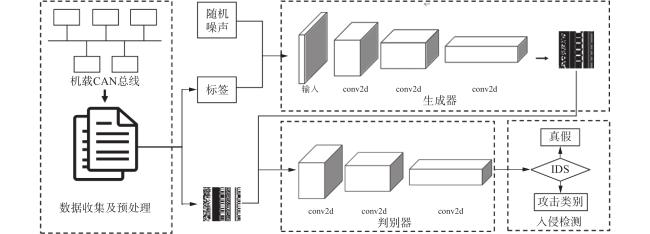
随着无人机在社会生产中的广泛应用,其安全问题逐渐凸显,特别是在通信与网络安全领域。机载CAN(Controller Area Network)总线网络设计时缺乏安全机制,容易被恶意设备利用,导致通信数据可能被篡改或监控,带来严重的安全威胁。这一问题的根源在于CAN总线最初设计时侧重于通信效率和低资源消耗,而忽视了安全需求,难以应对当前复杂的安全形势和多样化的攻击手段。此外,无人机平台受限的资源环境使得传统的身份验证和加密技术难以直接应用于CAN总线网络。为解决这一问题,提出了一种基于增强型生成对抗网络(Generative Adversarial Network,GAN)的无人机机载CAN总线网络入侵检测方法。该方法利用生成器和判别器之间的博弈机制生成伪样本,以增强判别器的训练效果,从而提高检测性能。基于此方法,构建了实验框架,并在资源受限的环境下验证了其有效性与可行性。实验结果表明,增强型GAN模型在精确率、召回率和F1分数上分别较其他3个先进深度学习模型平均提升约5.56%、3.93%和4.34%,展现了其在无人机CAN总线入侵检测中的高效性与可靠性,为无人机系统安全提供了重要技术支持与参考价值。
李腾 , 魏至立 , 党泽旭 , 马建峰 . 基于深度学习的无人机机载CAN入侵检测研究[J]. 网络空间安全科学学报, 2025 , 3(3) : 57 -67 . DOI: 10.20172/j.issn.2097-3136.250304
With the extensive application of UAVs in social production, their security issues have become increasingly prominent, particularly in the realm of communication and network security. Due to the deficiency of security mechanisms in design, the airborne CAN bus network is prone to be exploited by malicious devices, and the communication data may be tampered with or monitored, thereby posing severe security threats. The fundamental cause of this problem lies in that the initial design of the CAN bus prioritizes communication efficiency and low resource consumption, but neglects the security requirements, and is incapable of coping with the current complex security situation and diversified attack means. Additionally, the constrained resource environment of the UAV platform makes it challenging to directly apply traditional authentication and encryption technologies to the CAN bus network. To address this issue, an intrusion detection approach for the CAN bus network of UAVs based on an enhanced generative adversarial network (GAN) is proposed. This approach utilizes the game mechanism between the generator and the discriminator to generate pseudo-samples to enhance the training effect of the discriminator and improve the detection performance. Based on this approach, an experimental framework is established, and its validity and feasibility are verified in the resource-constrained environment. The experimental results show that the enhanced GAN model improves accuracy, recall, and F1 score by an average of about 5.56%, 3.93%, and 4.34% compared to the other three advanced deep learning models, respectively. This demonstrates its efficiency and reliability in drone CAN bus intrusion detection, providing important technical support and reference value for drone system security.
表 1 标签分类Table 1 Label classification |
| 消息类型 | 标签 代码 | 真实类别 概率 | 判别器判断的 类别概率 |
| DoS_GNSS | 0 | 0 | 0.5 |
| DoS_propulsion | 1 | 0 | 0.2 |
| FuzzyAttack_GNSS | 2 | 0 | 0.1 |
| FuzzyAttack_propulsion | 3 | 0 | 0.3 |
| Normal_GNSS | 4 | 1 | 0.7 |
| Normal_propulsion | 5 | 0 | 0.4 |
| ReplayAttack_GNSS | 6 | 0 | 0.1 |
| ReplayAttack_propulsion | 7 | 0 | 0.1 |
表 2 无人机设备配置Table 2 UAV equipment configuration |
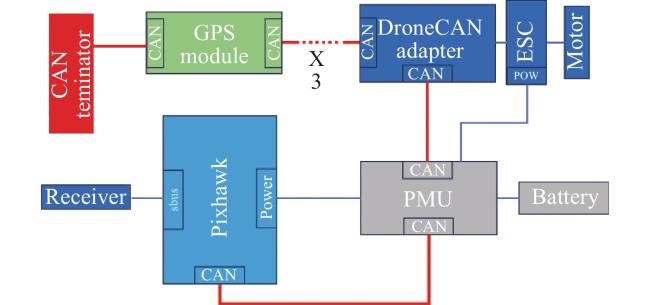
| 组件类型 | 型号 |
| 飞行控制器 | Pixhawk2.4.8 PIX 32位APM开源STM32 |
| 无人机电源管理单元 | CUAV CAN PMU/UAVCAN |
| 导航系统 | Holybro DroneCAN M8N/M9N GPS |
| 遥控接收器 | 天地飞WFR07S |
| 电子调速器 | Little Bee 45A BLHeli-S Dshot600 ESC |
| UAVCAN转接板 | Matek mateksys DRONECAN TO PWM ADAPTER |
表 3 UAV设备配置Table 3 UAV equipment configuration |
| 消息类型 | 精确率 | 召回率 | F1分数 |
| DoS_GNSS | 98.89% | 98.00% | 98.44% |
| DoS_propulsion | 98.90% | 99.10% | 99.00% |
| FuzzyAttack_GNSS | 82.19% | 87.12% | 84.58% |
| FuzzyAttack_propulsion | 98.99% | 98.40% | 98.70% |
| Normal_GNSS | 82.87% | 76.75% | 79.69% |
| Normal_propulsion | 73.78% | 86.10% | 79.46% |
| ReplayAttack_GNSS | 98.79% | 98.20% | 95.50% |
| ReplayAttack_propulsion | 82.71% | 70.30% | 76.00% |
表 4 评估指标对比Table 4 Comparison of evaluation indicators |
| 参数 | 精确率 | F1分数 | 召回率 |
| 增强型GAN | 98.38% | 89.30% | 89.25% |
| 原始GAN | 77.50% | 81.08% | 83.78% |
| Densenet | 85.69% | 85.68% | 85.90% |
| Resnet | 84.62% | 84.69% | 84.93% |
| ShufflenetV2 | 85.00% | 84.50% | 85.14% |
| 1 |
FAHLSTROM P G, GLEASON T J, SADRAEY M H. Introduction to UAV systems[M]. John Wiley & Sons, 2022.
|
| 2 |
RODRIGUES M, PIGATTO D F, FONTES J V, et al. UAV integration into IoIT: Opportunities and challenges[J]. ICAS, 2017, 2017, 95.
|
| 3 |
WU C, ZHANG T. Intelligent unmanned systems: Important achievements and applications of the new generation of artificial intelligence[J]. Frontiers of Information Technology & Electronic Engineering, 2020, 21 (5): 649- 654.
|
| 4 |
BAYINDIR K ç, GöZüKüçüK M A, TEKE A. A comprehensive overview of hybrid electric vehicle: Powertrain configurations, powertrain control techniques and electronic control units[J]. Energy Conversion and Management, 2011, 52 (2): 1305- 1313.
|
| 5 |
BRÄUNINGER J, EMIG R, KÜTTNER T, et al. Controller area network for truck and bus applications[J]. SAE Transactions, 1990: 704-714.
|
| 6 |
RAVI N, EL-SHARKAWY M. Integration of UAVs with real time operating systems using UAVCAN[C]//2019 IEEE 10th Annual Ubiquitous Computing, Electronics & Mobile Communication Conference (UEMCON). IEEE, 2019: 0600-0605.
|
| 7 |
MAINETTI L, PATRONO L, VILEI A. Evolution of wireless sensor networks towards the internet of things: A survey[C]//SoftCOM 2011, 19th International Conference on Software, Telecommunications and Computer Networks. IEEE, 2011: 1-6.
|
| 8 |
ROTARIU C, BOZOMITU R G, CEHAN V, et al. A wireless sensor network for remote monitoring of bioimpedance[C]//2015 38th International Spring Seminar on Electronics Technology (ISSE). IEEE, 2015: 487-490.
|
| 9 |
郭晶晶, 刘允刚, 满永超, 等. 自主多旋翼无人机系统: 感知、规划与控制[J]. 控制理论与应用, 2024, 41(10): 1707-1725.
GUO J J, LIU Y G, MAN Y C, et al. Autonomous multi-rotor unmanned aerial system: Perception, planning and control [J]. Control Theory and Applications, 2024, 41(10): 1707-1725.
|
| 10 |
KHAN N A, JHANJHI N Z, BROHI S N, et al. Emerging use of UAV’s: Secure communication protocol issues and challenges[M]. Drones in Smart-cities. Elsevier, 2020: 37-55.
|
| 11 |
BUSCEMI A. Automation of controller area network reverse engineering: Approaches, opportunities and security threats[D]. University of Luxembourg, Luxembourg, 2022.
|
| 12 |
ZHANG Q. An overview and analysis of hybrid encryption: the combination of symmetric encryption and asymmetric encryption[C]//2021 2nd International Conference on Computing and Data Science (CDS). IEEE, 2021: 616-622.
|
| 13 |
BUDUMA N, BUDUMA N, PAPA J. Fundamentals of deep learning[M]. O'Reilly Media Inc, 2022.
|
| 14 |
DONG S, WANG P, ABBAS K. A survey on deep learning and its applications[J]. Computer Science Review, 2021, 40, 100379.
|
| 15 |
YANG Y, XIE G, WANG J, et al. Intrusion detection for in-vehicle network by using single GAN in connected vehicles[J]. Journal of Circuits, Systems and Computers, 2021, 30 (1): 2150007.
|
| 16 |
SHAHRIAR M H, HAQUE N I, RAHMAN M A, et al. G-ids: Generative adversarial networks assisted intrusion detection system[C]//2020 IEEE 44th Annual Computers, Software, and Applications Conference (COMPSAC). IEEE, 2020: 376-385.
|
| 17 |
CHO K T, SHIN K G. Fingerprinting electronic control units for vehicle intrusion detection[C]//25th USENIX Security Symposium. USENIX, 2016: 911-927.
|
| 18 |
CHO K T, SHIN K G. Viden: Attacker identification on in-vehicle networks[C]//Proceedings of the 2017 ACM SIGSAC Conference on Computer and Communications Security. ACM, 2017: 1109-1123.
|
| 19 |
HAN M L, LEE J, KANG A R, et al. A statistical-based anomaly detection method for connected cars in internet of things environment[C]//Internet of Vehicles-Safe and Intelligent Mobility: Second International Conference. Springer International Publishing, 2015: 89-97.
|
| 20 |
LEE H, JEONG S H, KIM H K. OTIDS: A novel intrusion detection system for in-vehicle network by using remote frame[C]//2017 15th Annual Conference on Privacy, Security and Trust (PST). IEEE, 2017: 57-5709.
|
| 21 |
MARCHETTI M, STABILI D, GUIDO A, et al. Evaluation of anomaly detection for in-vehicle networks through information-theoretic algorithms[C]//2016 IEEE 2nd International Forum on Research and Technologies for Society and Industry Leveraging a Better Tomorrow (RTSI). IEEE, 2016: 1-6.
|
| 22 |
YAZDI M, SAMAEE M, MASSICOTTE D. A review on automated sleep study[J]. Annals of Biomedical Engineering, 2024, 53(9): 1-29.
|
| 23 |
SONG Y Y, YING L U. Decision tree methods: applications for classification and prediction[J]. Shanghai Archives of Psychiatry, 2015, 27 (2): 130.
|
| 24 |
RIGATTI S J. Random forest[J]. Journal of Insurance Medicine, 2017, 47 (1): 31- 39.
|
| 25 |
LI S, LI W, COOK C, et al. Independently recurrent neural network (IndRNN): Building a longer and deeper RNN[C]//Proceedings of the IEEE Conference on Computer Vision and Pattern Recognition. IEEE, 2018: 5457-5466.
|
| 26 |
YU Y, SI X, HU C, et al. A review of recurrent neural networks: LSTM cells and network architectures[J]. Neural Computation, 2019, 31 (7): 1235- 1270.
|
| 27 |
PEDREGOSA F, VAROQUAUX G, GRAMFORT A, et al. Scikit-learn: Machine learning in Python[J]. the Journal of machine Learning Research, 2011, 12, 2825- 2830.
|
| 28 |
GUAN X, CAO X. Network intrusion detection method based on attention mechanism and DenseNet[C]//2022 IEEE 4th International Conference on Civil Aviation Safety and Information Technology (ICCASIT). IEEE, 2022: 1335-1340.
|
| 29 |
ZHU Z, ZHAI W, LIU H, et al. Juggler-ResNet: A flexible and high-speed ResNet optimization method for intrusion detection system in software-defined industrial networks[J]. IEEE Transactions on Industrial Informatics, 2021, 18 (6): 4224- 4233.
|
| 30 |
TAN S, HE D, CHAN S, et al. FlowSpotter: Intelligent IoT threat detection via imaging network flows[J]. IEEE Network, 2023.
|
| 31 |
SEO E, SONG H M, KIM H K. GIDS: GAN based intrusion detection system for in-vehicle network[C]//2018 16th Annual Conference on Privacy, Security and Trust (PST). IEEE, 2018: 1-6.
|
/
| 〈 |
|
〉 |